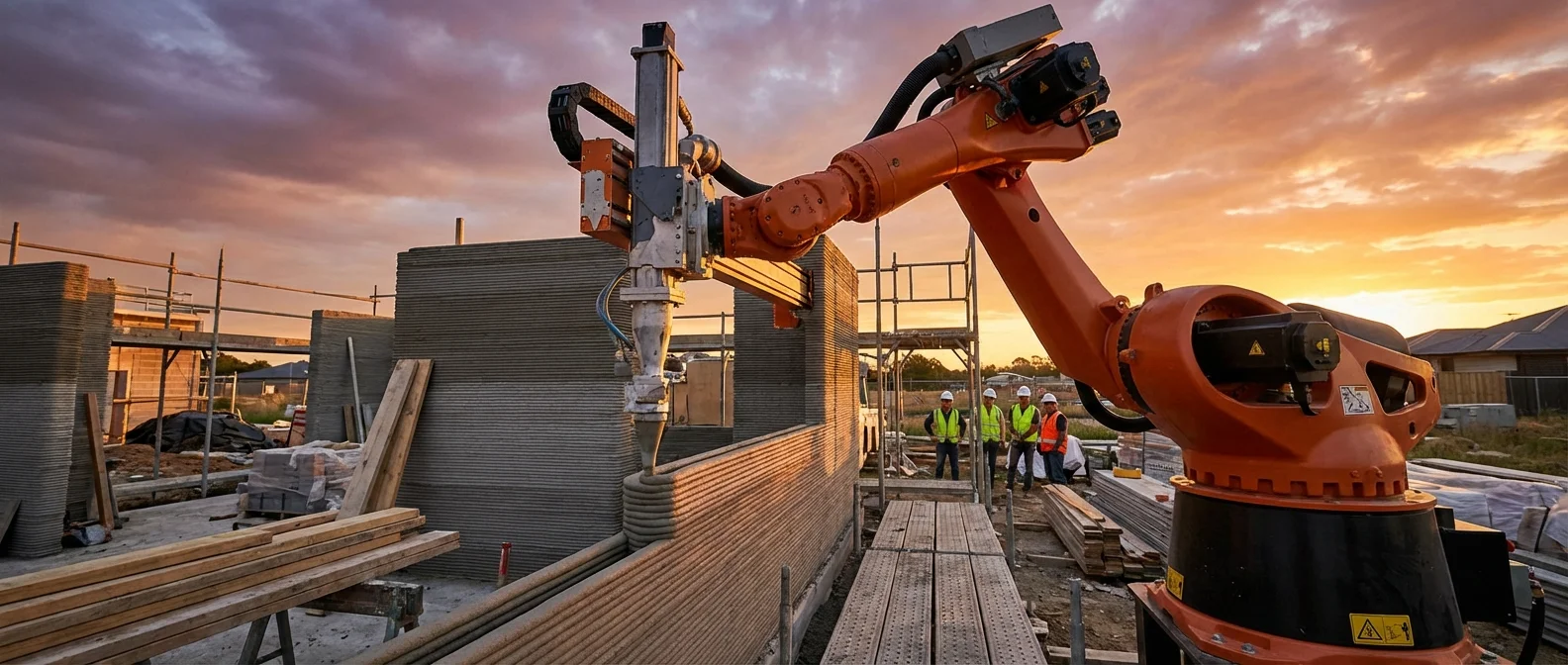
The construction industry is on the brink of a radical transformation. Bricklaying robots, concrete 3D printers that “build” entire houses, and autonomous welding systems are reshaping how we construct buildings. From Australia to Texas and from China to Europe, robotic construction is no longer experimental — it's a commercial reality.
📖 Read more: Hugging Face: Build a DIY Robot Arm for €100
🧱 Hadrian X: The Robot Bricklayer
Australian company FBR (formerly Fastbrick Robotics) created Hadrian X, the world's first fully automated end-to-end robotic bricklayer. The concept was born in 1994 when aeronautic and mechanical engineer Mark Pivac envisioned a mobile, dynamically stabilized construction robot. The first patents were filed between 2005 and 2008.
Built from steel, aluminum, and carbon fiber composites, Hadrian X can lay 1,000 bricks per hour. Instead of traditional mortar, it uses polyurethane adhesive — no waiting for drying, enabling round-the-clock operation without interruption.
🏆 Hadrian X Milestones
- September 2016: First multi-room structure built with zero human intervention
- November 2018: Three-bedroom, two-bathroom house completed in under three days
- August 2020: Four houses in Mexico, each finished in less than a single shift
- February 2025: PulteGroup (US) built a house in a single day in Florida
FBR has forged strategic partnerships with major players: Caterpillar invested $2 million, Wienerberger is developing custom blocks optimized for the system, and Liebherr is collaborating on commercialization. The most ambitious deal? A potential contract to build 50,000 homes in Saudi Arabia.
📖 Read more: Atlas in Hyundai Factories: Launching in 2028
🖨️ 3D Printing: Houses from a Printer
Construction-scale 3D printing began experimentally in the mid-1990s, when Behrokh Khoshnevis developed Contour Crafting technology at USC. Today, dozens of companies worldwide are building homes with robotic concrete printers.
ICON, based in Austin, Texas, leads the field. Using its Vulcan printer, ICON built Wolf Ranch in 2022 in partnership with Lennar — over 100 3D-printed homes, the largest community of its kind in the United States. In December 2022, NASA awarded ICON a $57.2 million contract to build structures on the Moon as part of the Artemis program.
In China, WinSun made headlines as early as 2014 by claiming to have built 10 houses in 24 hours at just $5,000 each, using fast-drying cement and recycled materials.
🌍 Europe and Global Developments
Europe is keeping pace. Danish company COBOD International built Europe's first 3D-printed building, the “BOD” in Copenhagen, fully completed in 2018. In the Netherlands, MX3D fabricated a stainless steel bridge spanning 12 meters and weighing 4,500 kilograms in Amsterdam — the world's first 3D-printed metal bridge, inaugurated in July 2021.
📖 Read more: Autonomous Drones 2026: The Evolution of Robotic Flight
In France, the Viliaprint project delivered five social housing units in Reims in June 2022, built with a hybrid method combining 3D-printed concrete walls with prefabricated elements. In Spain, pioneering 2024–2025 programs are constructing buildings using 3D printing, robotics, and artificial intelligence together, with automated finishing and full regulatory certification.
In Italy, WASP partnered with Mario Cucinella Architects to complete Tecla in 2021 — the first 3D-printed house made from clay. Built from local soil, water, and rice husks, it stands as a model of affordable, sustainable housing.
🤖 Beyond Bricks: Welding Robots and Drones
Robotic construction goes far beyond bricklaying and concrete pouring. In September 2022, researchers published in Nature the use of autonomous drone swarms for additive construction — drones that print cement structures mid-flight, eliminating the need for scaffolding entirely.
In the military sector, the US Army Corps of Engineers (ERDC) has been developing 3D printers for rapid deployment since 2015. The ACES program (Automated Construction for Expeditionary Structures) produced the first reinforced 3D-printed concrete barracks, while the Marines demonstrated they could print an entire building in 24 hours in the field.
📖 Read more: Boston Dynamics Atlas: Robot Does Parkour Better Than Humans
"3D printing in construction can reduce overall time, material usage, labor requirements, and total costs, while enhancing sustainability." — Wikipedia, Construction 3D Printing
🏠 Housing for All: The Social Dimension
According to the United Nations, by 2030 roughly 3 billion people — 40% of the world's population — will need access to affordable housing. 3D-printed homes could be part of the solution: low-cost dwellings with a small environmental footprint, adaptable to local climates, and buildable in remote areas.
ICON, for example, built homes for formerly homeless individuals at Community First! Village in Austin. The technology doesn't merely replace workers — it creates housing opportunities that would be economically impossible with conventional methods.
📖 Read more: Buying Robots in Greece: 2026 Market Guide
⚠️ Challenges and Limitations
Despite impressive demonstrations, robotic construction faces significant hurdles:
- Regulations: Many countries still lack regulatory frameworks for 3D-printed buildings. Spain is a pioneer with full certification in place
- Finishing work: 3D printing doesn't automatically solve interior finishes, electrical wiring, or plumbing
- Materials: Optimizing concrete mixes, structural integrity, and long-term durability requires ongoing research
- Environmental factors: Without proper curing, printed wall strength can drop by up to 30%
- Equipment costs: Construction-scale robotic printers are expensive, though they pay for themselves quickly on large projects
🔮 The Future: From Earth to the Moon
The convergence of robotics, 3D printing, and artificial intelligence is ushering in a new era. Second-generation robots don't just print walls — they combine printing with object manipulation, cutting, drilling, and inspection, using sensors and AI.
NASA and ICON are planning the first lunar structures by 2028, using local lunar regolith as building material — only 10% of the mass would need to be transported from Earth. The European Space Agency (ESA) is collaborating with Foster + Partners on futuristic domed moon shelters.
In the nearer term, we can expect robots that autonomously build entire neighborhoods — at a fraction of the traditional cost, in days instead of months, and with a CO₂ footprint potentially half that of current methods. The question isn't whether robots will transform construction — it's how fast.