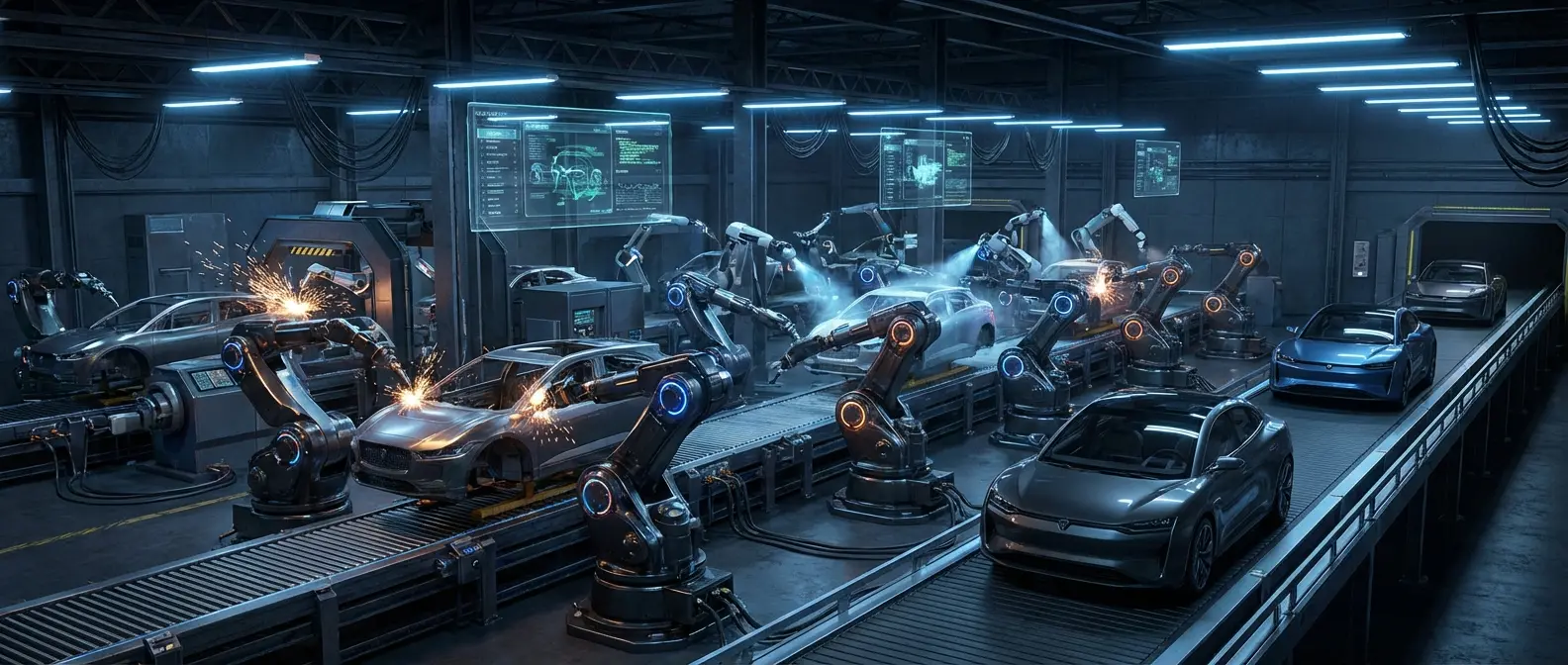
Imagine a massive car factory operating 24 hours a day, 7 days a week, without a single human worker. No lights, no air conditioning, no breaks, no unions. Only humanoid robots assembling cars with surgical precision, never getting tired, never making mistakes. This science fiction scenario, known as "Dark Factory" or “Lights-Out Manufacturing,” is no longer fantasy — it's the upcoming reality expected to become achievable within the next five years.
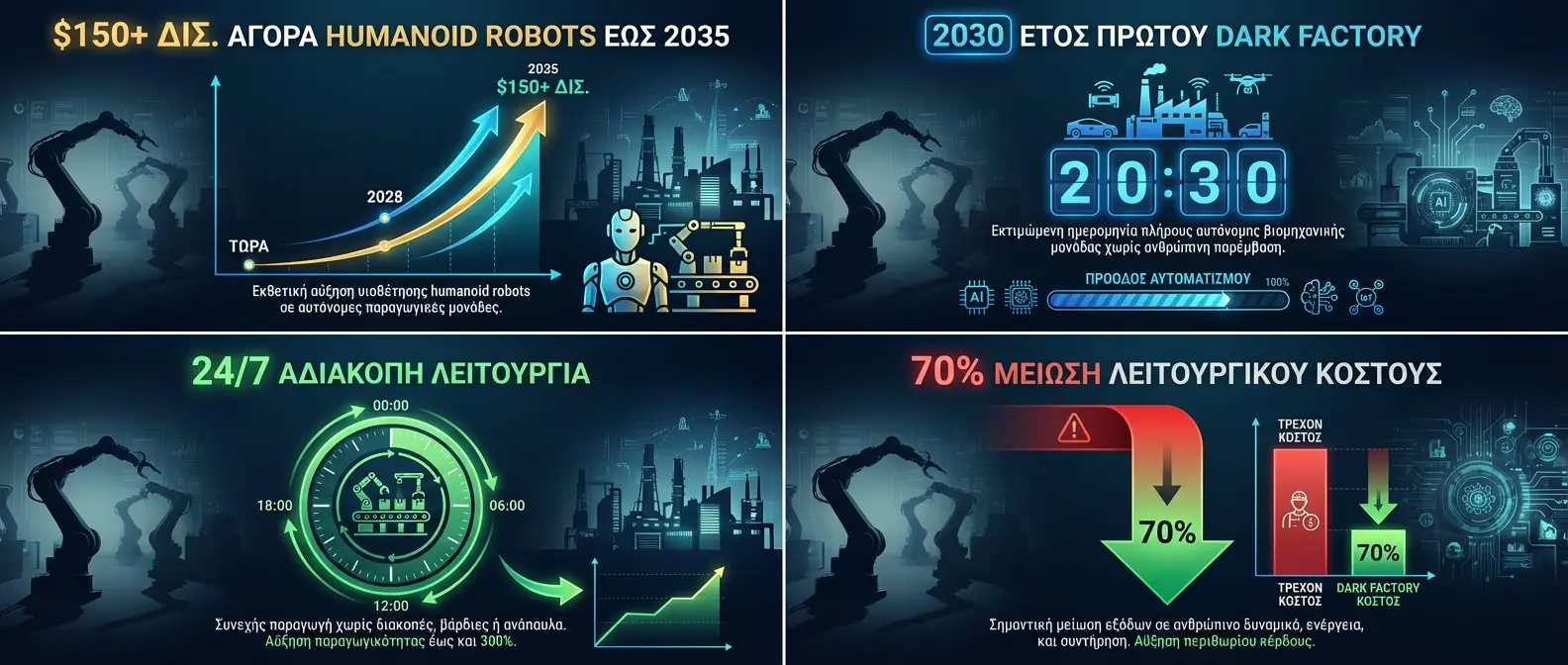
📌 What is a “Dark Factory”? A factory that operates fully autonomously, without any human presence. It doesn't need lighting (hence “dark”), heating, or air conditioning, dramatically reducing operating costs.
According to the latest reports from top tech sites like WIRED, the idea of a fully automated car factory with humanoid robots is now at the forefront of investments in both the US and China. Automakers, from Hyundai and BMW to Chinese giants like BYD, are investing billions of dollars in this technology, aiming to have the first operational “dark factory” by 2030.
🏭 What Exactly Is the “Dark Factory”?
The term “Dark Factory” or “Lights-Out Manufacturing” describes a production facility that operates without human workers. The name comes from the fact that, since there are no humans, lighting is unnecessary. Robots don't need to see the way we do — they use infrared cameras, LiDAR, pressure sensors, and artificial intelligence to perceive their environment.
The idea isn't new. For decades, factories have used industrial robotic arms for repetitive tasks like welding and painting. But those robots are “blind” — they only perform predetermined movements, unable to adapt to unexpected situations. The coming revolution is different: humanoid robots with two arms, two legs, and artificial intelligence that enables them to learn, adapt, and perform complex tasks that until recently were considered impossible for machines.
🤖 The Players: Who Will Win the Battle?
The competition for dominance in humanoid robotics is more intense than ever. Companies from the US, China, Europe, and Japan are investing enormous sums to create the robot that will forever change industrial production. Let's look at the key players.
🇺🇸 American Giants
🚗 Tesla Optimus
Elon Musk has promised that Optimus will “change the world more than cars.” The second generation (Optimus Gen 2) is already being tested in Tesla factories, performing simple sorting tasks.
Silicon Valley🦾 Figure AI
With $675 million in investment from Microsoft, OpenAI, and Jeff Bezos, Figure is developing robots that use AI to learn tasks by watching videos — without programming.
Startup Unicorn🐕 Boston Dynamics + Google
Google DeepMind is partnering with Boston Dynamics to integrate Gemini AI into the Atlas robot. It's already being tested in Hyundai factories for sorting car parts.
AI + Robotics Fusion🔬 Agility Robotics
Digit, Agility's robot, is already in use in Amazon warehouses. Designed for walking on uneven terrain and carrying boxes.
Warehouse Ready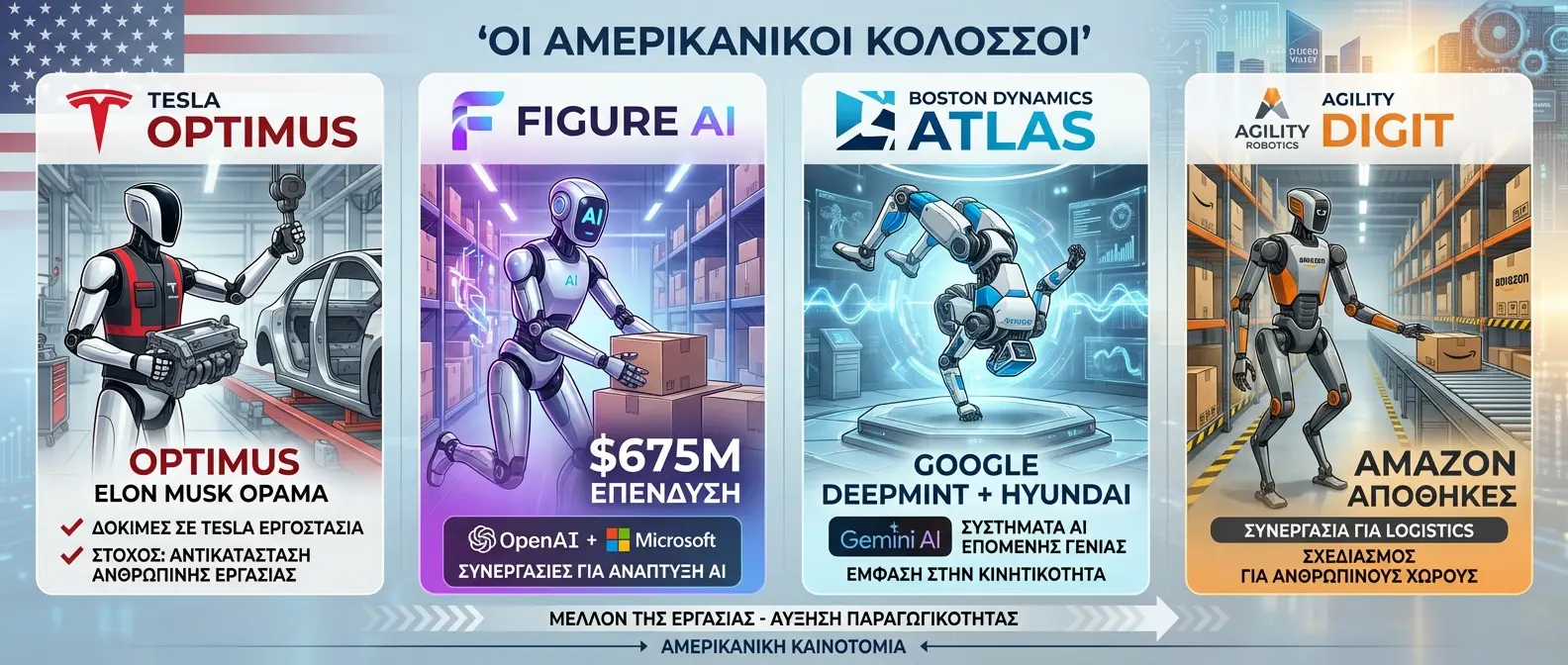
🇨🇳 The Chinese Factor
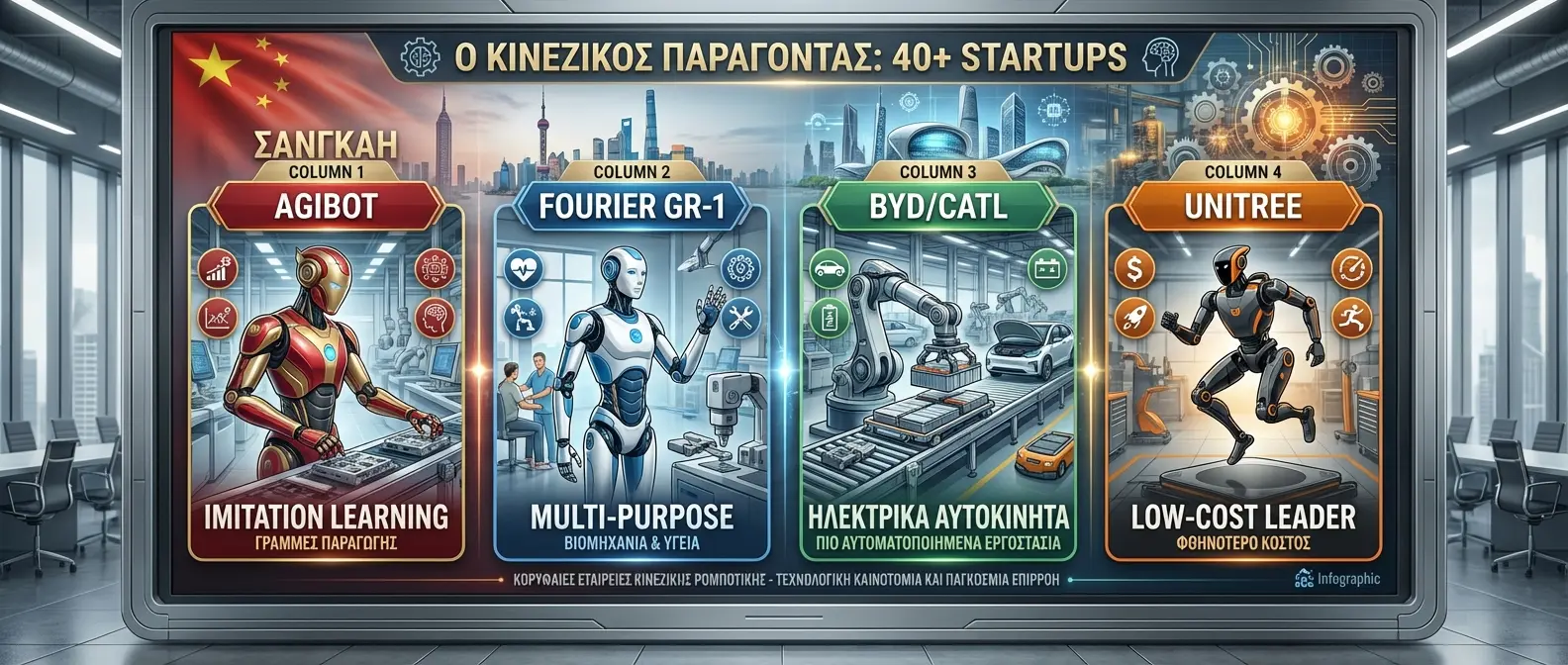
According to a recent WIRED report ("Your First Humanoid Robot Coworker Will Probably Be Chinese"), China has taken a significant lead in humanoid robots for industrial use. The Chinese government has designated humanoid robot development as a national priority, aiming for mass production by 2027.
💡 Did you know? China has over 40 startups developing humanoid robots, more than any other country in the world. Government support and access to cheap components give them a significant competitive advantage.
🤖 AgiBot (Zhiyuan)
The Chinese startup uses humans in special suits to train its robots through “imitation learning.” Its robots are already being tested on production lines.
Shanghai🏭 Fourier Intelligence
Fourier's GR-1 humanoid robot has already demonstrated walking capabilities and object interaction. It targets industrial and healthcare applications.
Multi-Purpose🚘 BYD & CATL
The Chinese electric vehicle and battery giants are investing in automation. BYD already has the most automated factories in the world.
EV Manufacturing🔄 Unitree Robotics
Known for its quadruped robots (a rival to Spot), Unitree is now entering the humanoid robot space with lower costs than competitors.
Low-Cost Leader🧠 The Secret Ingredient: Physical AI
The key to operating a “dark factory” isn't just the robots — it's the artificial intelligence that controls them. What experts call “Physical AI” is the ability of an AI system to perceive and interact with the physical world in real time.
Google DeepMind, OpenAI, and Anthropic are working feverishly on this problem. Google's recent partnership with Boston Dynamics is a milestone: the Atlas robot now uses Gemini AI to “understand” natural language commands and translate them into movements. Instead of programming every motion, you can simply say: “Go to shelf A and bring the blue component.”
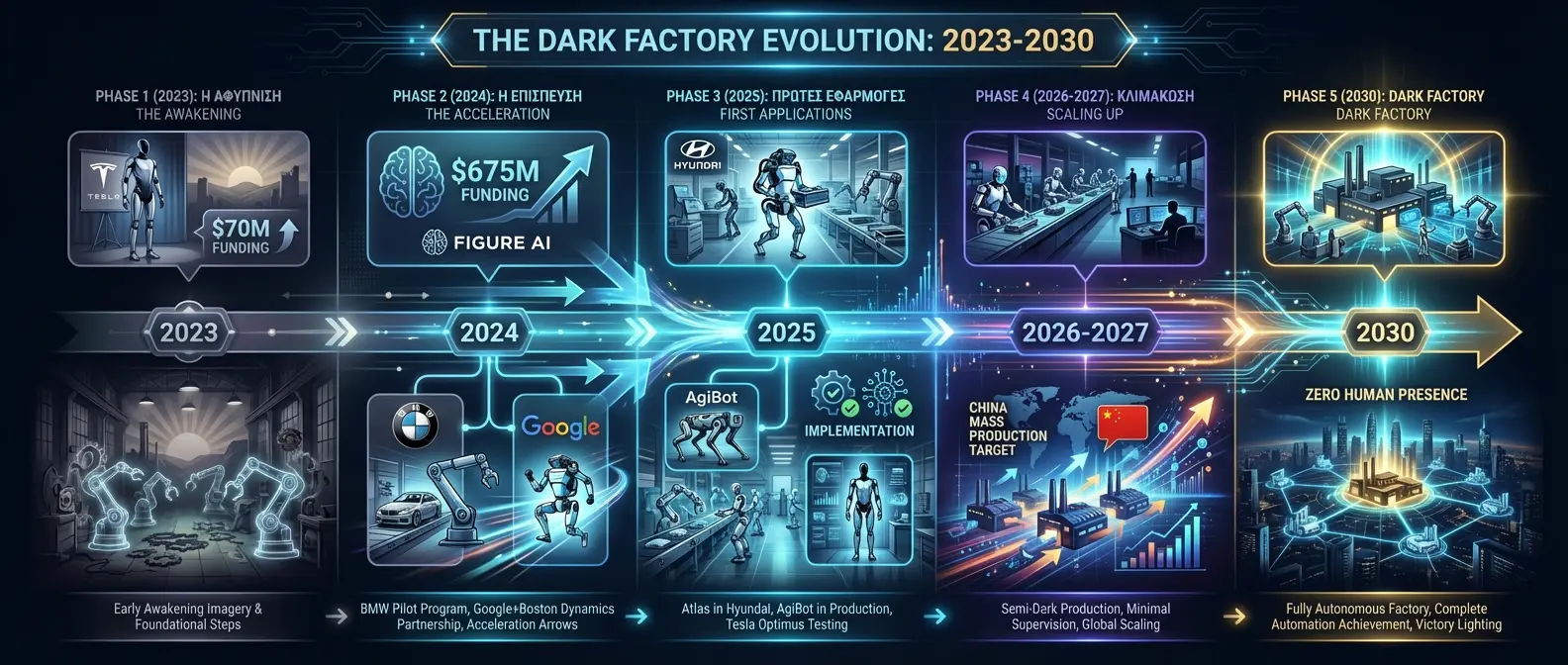
2023: The Awakening
Tesla introduces Optimus Gen 1. Figure AI raises $70M. The idea of humanoid robots in industry begins to be taken seriously.
2024: The Acceleration
Figure AI raises $675M. BMW announces a pilot program with Figure robots in its factories. Google acquires a strategic stake in Boston Dynamics.
2025: First Applications
Boston Dynamics Atlas robots are tested in Hyundai factories. Chinese AgiBot robots join production lines. Tesla Optimus in trial use.
2026-2027: Scaling Up
The first “semi-dark” production line is expected — with minimal human oversight. China aims for mass production of humanoid robots.
2030: The Dark Factory
The first fully autonomous car factory is expected, either in China or the US.
⚙️ How Will the Factory of the Future Work?
In a fully automated “dark factory,” production will resemble a living organism more than an assembly line. Humanoid robots will work collaboratively, communicating wirelessly with each other and with a central AI system that manages the entire facility.
Each robot will have a specialized role: some will transport components, others will weld, others will install electronics, and others will perform quality checks. Unlike humans who need lighting, heating, air conditioning, music to work, and coffee breaks, robots need none of that. All they need is electricity and maintenance.
This means a “dark factory” could operate at a fraction of the cost of a traditional factory. Estimates point to operating cost reductions of up to 70%, not counting the productivity increase from 24-hour operation without interruptions.
🌍 The Impact on Work and Society
Naturally, the prospect of factories without humans raises enormous questions about the future of work. The automotive industry directly employs tens of millions of people worldwide, and indirectly affects even more. What will happen to these workers when robots take over their jobs?
⚠️ The Other Side: According to a report by the International Labour Organization, industrial automation could affect up to 400 million jobs worldwide by 2030. The transition will require massive workforce retraining.
Proponents of automation argue that, historically, technology has always created more jobs than it eliminated. But this time things may be different: humanoid robots with AI don't just replace muscle power — they also replace cognitive abilities. This means that even supervisors, quality technicians, and production managers could find themselves out of work.
On the other hand, new jobs will be created: robotics engineers, AI trainers, maintenance technicians, automation designers. The question is whether the number and quality of these new positions will offset those that will be lost.
🔋 The Critical Challenge: Energy and Infrastructure
A fully automated factory doesn't require lighting, but it does require enormous amounts of electrical energy. The data centers powering AI systems are already among the world's largest energy consumers. Adding hundreds of robots per factory will increase demands even further.
This is one reason China has an advantage: the country has invested heavily in renewable energy sources and nuclear power plants, securing cheap and stable electricity for its industry. In the US, energy infrastructure is more fragmented, and building new data centers and factories often faces pushback from local communities concerned about environmental impact.
🚗 Which Automaker Will Be First?
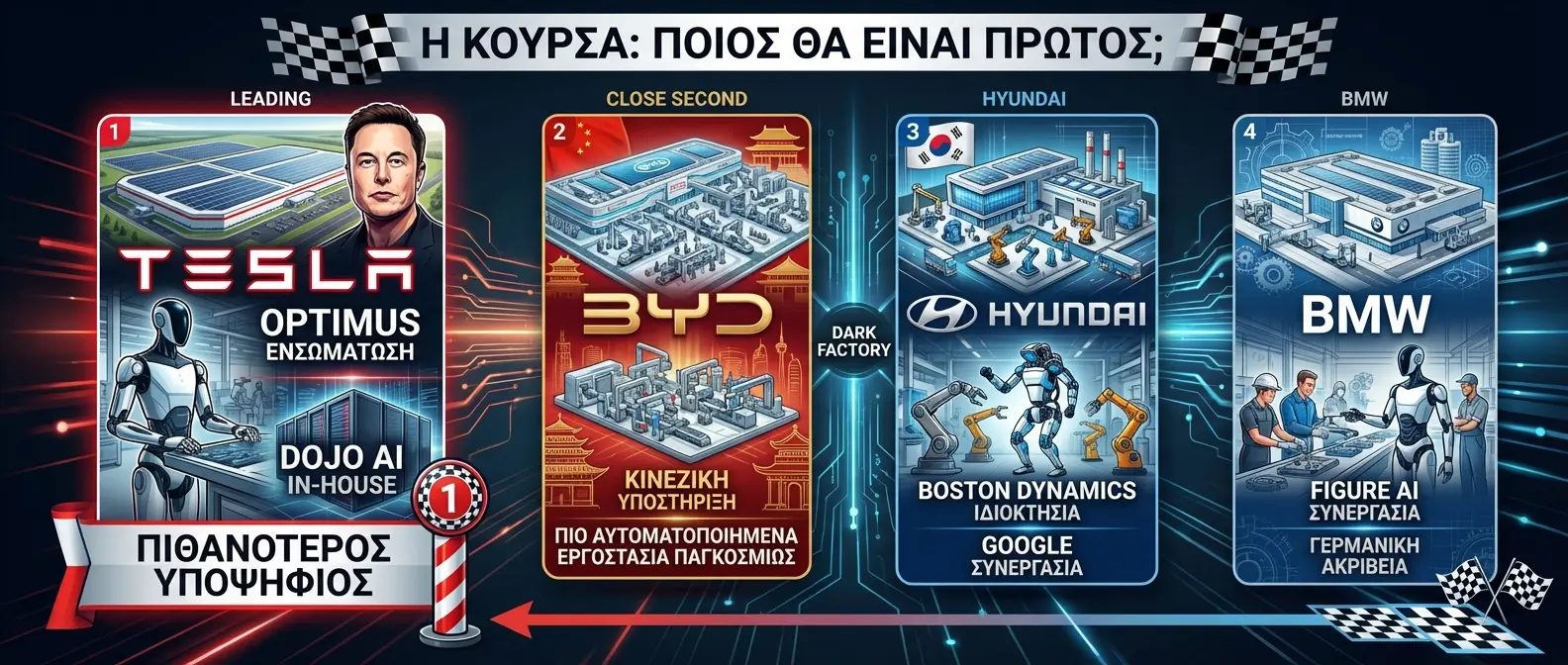
The competition for the first “dark factory” is fierce. The most likely candidates are:
- Tesla: Elon Musk has stated that his goal is for Gigafactory Texas to become the “most automated facility in the world.” With its own robot development (Optimus) and AI (Dojo), Tesla has all the pieces in-house.
- BYD: The Chinese giant already has the most advanced automated factories in the world. With Chinese government support and access to Chinese robotics startups, it's a strong candidate.
- Hyundai: The company owns Boston Dynamics and works closely with Google. Its factories in South Korea are already test beds for Atlas robots.
- BMW: The German company has a partnership with Figure AI and is already testing humanoid robots on its production lines in South Carolina.
🔮 The Future: What Does It Mean for Us?
The transition to “dark factories” won't happen overnight — it will be a gradual process unfolding over the coming decades. But the decisions being made now will determine which countries and companies lead the next industrial revolution.
For consumers, the benefits may include cheaper cars, better quality (due to fewer human errors), and faster production. For workers, the picture is more complex — the need for retraining and adapting to new roles will be urgent.
For governments, the challenge is to create policies ensuring the benefits of automation are shared fairly, while supporting the workers who will be affected. China has already announced national education programs in robotics and AI. Europe and the US remain to be seen how they will respond.
One thing is certain: the era of “dark factories” is coming. The question isn't if, but when — and who will be first.