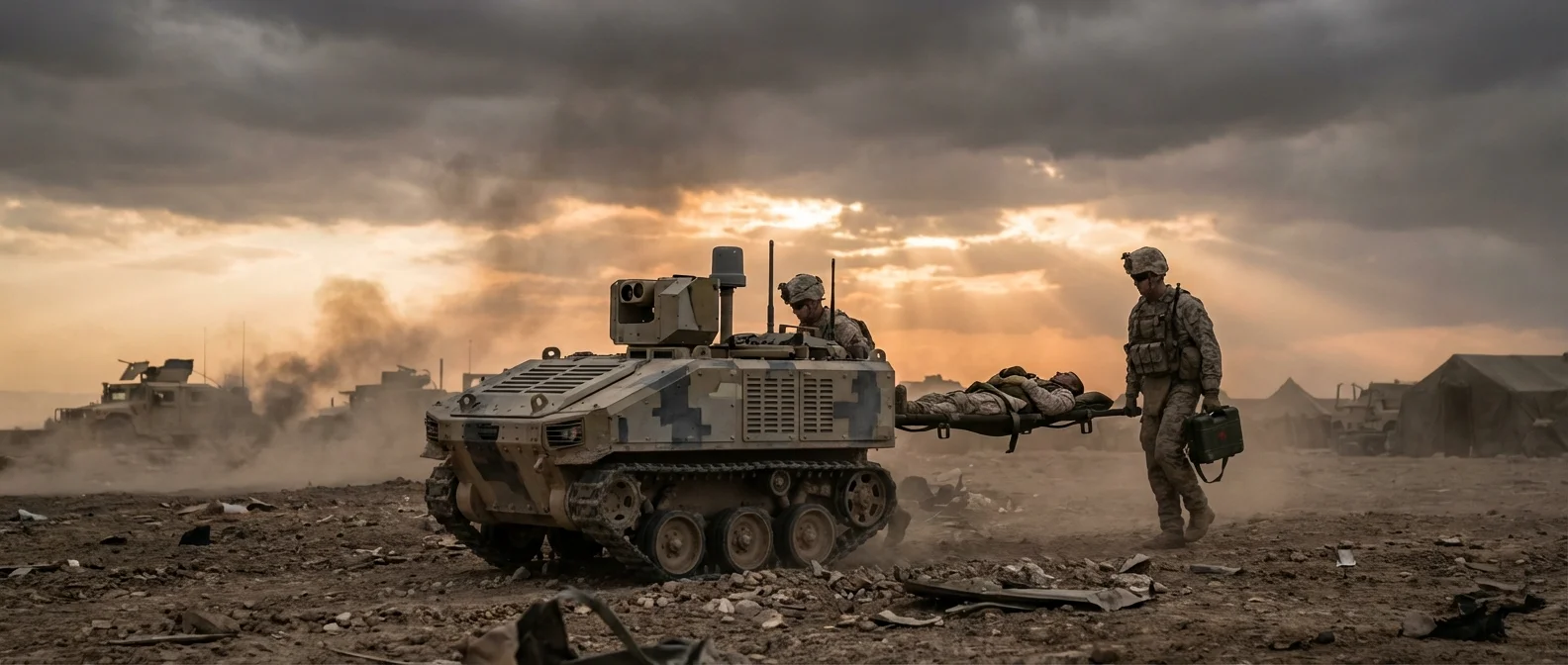
In modern combat, the “golden hour” — those critical 60 minutes after a wound is inflicted — determines whether a soldier lives or dies. According to U.S. military data, 90% of battlefield deaths occur before the casualty reaches a medical facility. Of those, roughly 24% could have been saved with faster triage and first aid. That's exactly the problem the DARPA Triage Challenge aims to solve — a groundbreaking initiative bringing robots to the front line of saving human lives.
📖 Read more: Chinese Robots: Why China Dominates Humanoid Robotics 2026
What Is the DARPA Triage Challenge
The DARPA Triage Challenge (DTC) was announced in 2022 and officially launched in 2023 as a three-year technology competition. Its goal is to develop novel physiological indicators and technologies that dramatically improve medical triage during mass casualty incidents — both military and civilian. The DTC is organized by DARPA's Biological Technologies Office (BTO), which was established in 2014 to bridge biology, engineering, and computer science.
💡 What is Triage? It's the process of assessing injuries based on severity, so that priority treatment goes to those with the greatest chance of survival. The practice was pioneered by Napoleon's surgeon-in-chief Dominique Jean Larrey during the Napoleonic Wars (1803–1815).
The challenge uses a series of competitive events to drive the development of technologies capable of:
- Autonomous injury assessment — robotic systems scanning vital signs without human intervention
- Hidden hemorrhage detection — AI algorithms detecting internal bleeding through non-invasive sensors
- Real-time severity classification — categorizing casualties in real time (critical, serious, minor, non-salvageable)
- Telemedicine in combat zones — remote guidance for delivering first aid through robotic platforms
The Critical Need: What the Numbers Tell Us
A comprehensive U.S. military study covering battlefield deaths in Afghanistan and Iraq between 2001–2011 revealed staggering figures. Of the 4,596 fatalities, 87% died before reaching a surgical unit. Among potentially preventable deaths, hemorrhage accounted for 90.9% — with 67.3% involving truncal hemorrhage, 19.2% junctional hemorrhage, and just 13.5% extremity hemorrhage.
| Injury Category | % of Deaths | Treatment Capability |
|---|---|---|
| Truncal hemorrhage | 67.3% | Surgery required (difficult in the field) |
| Junctional hemorrhage | 19.2% | New junctional tourniquets |
| Extremity hemorrhage | 13.5% | Tourniquets (78% effectiveness) |
| Airway obstruction | 8.0% | Cricothyroidotomy / NPA |
| Tension pneumothorax | ~5% | Needle decompression |
These numbers prove that faster, more accurate triage — ideally through automated systems — could save thousands of lives. And that's precisely where robots come in.
Battlefield Medical Robots
🤖 BEAR — Battlefield Extraction-Assist Robot
Vecna Technologies / BEAR
A humanoid robot designed to lift and carry casualties weighing up to 500 pounds across hazardous terrain. With hydraulic arms and a tracked locomotion system, the BEAR can navigate rubble and uneven ground while cradling a wounded soldier in its arms.
🔍 PackBot — iRobot Reconnaissance
iRobot / PackBot
Originally designed for bomb disposal and reconnaissance, the PackBot has evolved into a multi-mission platform. Equipped with CBRNE sensors (chemical, biological, radiological), thermal imaging cameras, and a robotic arm, it can assess casualties in zones too dangerous for human medics to enter.
🚁 Autonomous MEDEVAC Drones
Medical Delivery Drones
Large-capacity drones capable of delivering blood, plasma, medication, and medical equipment directly to the point of injury. Pilot programs in Rwanda (Zipline) have already proven that drone blood delivery saves lives — the military version requires resilience in hostile environments.
📖 Read more: Claude AI Controls Robots: From Mars to Quadrupeds
🇪🇪 THeMIS — Tracked Hybrid Modular Infantry System
Milrem Robotics (Estonia) / THeMIS
An Estonian UGV (unmanned ground vehicle) platform already in service with NATO member forces. In a CASEVAC (casualty evacuation) role, THeMIS can autonomously evacuate casualties via GPS waypoints, while integrating cameras and vital sign sensors.
AI Diagnostics in the Field: How It Works
The real revolution isn't just in robotic bodies — it's in their “brains.” The artificial intelligence systems enabling automated medical triage represent the true breakthrough:
These AI systems follow the MARCH protocol (Massive hemorrhage, Airway, Respiration, Circulation, Head injury/Hypothermia) — the same framework used by military medics under Tactical Combat Casualty Care (TCCC). Automating this protocol means a robot can perform the initial critical checks in seconds rather than minutes.
Timeline: From DARPA to the Battlefield
ARPA (later DARPA) founded — the beginning of cutting-edge defense research.
First TCCC guidelines published — the foundation of modern battlefield medicine.
DARPA Grand Challenge — autonomous vehicles in the Mojave Desert. The age of military robots begins.
Biological Technologies Office (BTO) established — biology meets robotics at DARPA.
DARPA Triage Challenge (DTC) announced — a three-year competition for robotic medical triage.
Final DTC challenge events — evaluating technologies in realistic mass casualty scenarios.
📖 Read more: Construction Robots Building Homes: Automation in 2026
Battlefield Technology Comparison
| System | Type | Capability | Status |
|---|---|---|---|
| BEAR Robot | Extraction | Casualty transport up to 500 lbs | Prototype |
| PackBot (iRobot) | Recon / EOD | CBRNE + thermal imaging | Active (16,000+ units) |
| THeMIS (Milrem) | Multi-role UGV | CASEVAC, cargo, weapons | NATO development |
| TALON (Foster-Miller) | Small UGV | EOD / reconnaissance | Active (4,000+ units) |
| Miloš L (Serbia) | Evacuation UGV | Wounded extraction | In development |
Civilian Applications: From Battlefield to Hospital
Triage technology isn't limited to the battlefield. The DARPA Triage Challenge explicitly targets civilian mass casualty incidents as well — earthquakes, bombings, natural disasters. The same algorithms that classify soldiers can be deployed in a field hospital after an earthquake.
🏥 Scenario: 7.0 Richter Earthquake in an Urban Area
Hundreds of casualties, limited rescue teams. Drones map debris fields, LiDAR-equipped robots locate trapped victims, AI triage determines who needs evacuation first. The same MARCH protocol, without bullets — but with the same time constraint: the “golden hour.”
Ethical Questions and Challenges
Using robots to save lives raises fewer ethical concerns than lethal autonomous weapons systems. However, significant questions remain:
- Who decides? — If a robot classifies someone as “non-salvageable,” who bears the responsibility?
- AI reliability — ML models are trained on data. If that data is incomplete or biased, triage decisions will be flawed
- Trust networks — Soldiers trust their medics. Will they trust a robot?
- Cybersecurity — If an adversary hacks the triage system, they could manipulate evacuation priorities
- Geneva Conventions — How does the protection of medical personnel and equipment apply to robotic systems?
The Future: 2026 and Beyond
With an annual budget of $4.122 billion (FY2024), DARPA remains the world's most ambitious funder of defense innovation. The Triage Challenge is part of a broader vision that includes:
As AI grows more capable and robots more resilient, the vision of a “digital medic” on the battlefield no longer belongs to science fiction. The DARPA Triage Challenge may be the most important life-saving robotics initiative of the 21st century — proving that military technology can produce tools of hope, not just destruction.
🏛️ DARPA by the numbers: Founded in 1958, 220 employees, headquartered in Virginia. Among its inventions: ARPANET (the precursor to the Internet), GPS, autonomous vehicles, military-scale artificial intelligence — and now, robots that save lives.