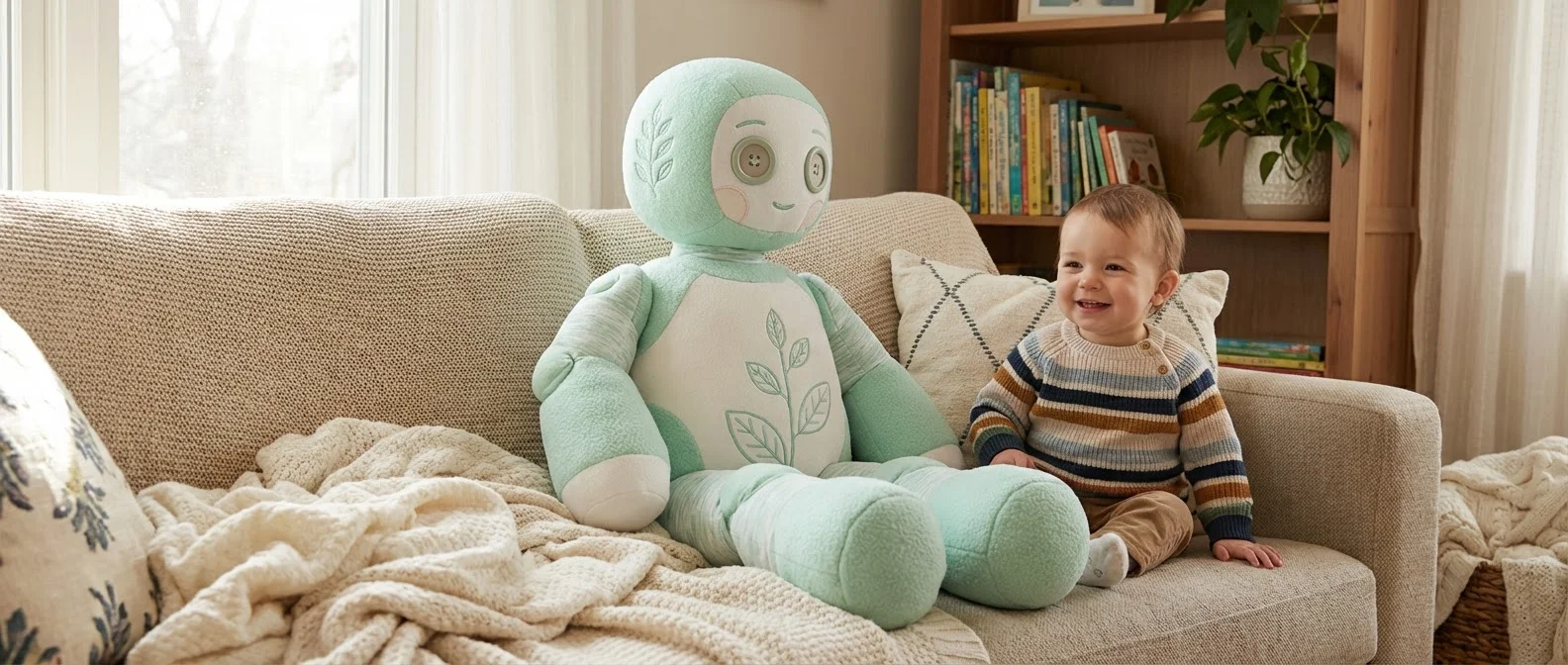
Most humanoid robots in the news weigh upward of 70 kilograms, run industrial servo motors capable of snapping bones, and the only reason they are not in homes is precisely that: nobody wants an 80-kilogram machine walking next to their children. Fauna Robotics, a New York City startup, decided to approach the problem from the opposite direction. Instead of making an industrial robot safer, they designed a robot you can hug — and then gave it real capabilities.
📖 Read more: Humanoid Robots at CES 2026: The Highlights
🏢 Who Is Fauna Robotics?
Fauna Robotics is an American robotics company headquartered in New York City. Their mission: “capable, safe, fun — robots for everyone.” Unlike many startups that design in the US and manufacture in China, Fauna emphasizes that its products are designed in NYC and assembled in America.
The philosophy behind Sprout is not to build “yet another humanoid.” The team believes the future of robotics needs to be both useful and delightful — in homes, classrooms, and everyday human spaces. In January 2026, they published a technical paper on arXiv titled “Fauna Sprout: A lightweight, approachable, developer-ready humanoid robot,” publicly documenting their design decisions.
🤖 What Is Sprout?
Sprout is a humanoid robot standing 107 centimeters tall — roughly the height of a five-year-old. It weighs just 22.7 kilograms, lighter than most robot dogs on the market. With 29 degrees of freedom, it walks, grasps objects, turns its head, and raises its eyebrows. Literally.
Its exterior is soft to the touch — not metallic, not plastic, but engineered so that anyone touching the robot does not feel like they are touching a machine. The battery is swappable, delivering 3 to 3.5 hours of runtime per charge.
🛡️ Why Soft? The Safety-First Philosophy
Safety is not a feature that gets “added on.” It is the foundation of the entire design. Fauna Robotics follows a safety-first philosophy built on multiple layers:
- Lightweight materials: At 22.7 kg, even if Sprout falls on someone, the risk of injury is dramatically lower compared to an 80 kg humanoid.
- Soft exterior: The surface is designed without sharp edges or pinch points — minimizing any risk from physical contact.
- Compliant motor control: The motors yield to external forces. Push the robot's arm, and it gives way rather than resisting.
- Limited joint torques: Unlike industrial robots, Sprout physically cannot exert force capable of causing injury.
- E-Stop: An emergency stop button built into the body.
- Safety sensing: Four time-of-flight sensors and a torso IMU provide continuous spatial awareness.
⚙️ Technical Specifications
| Category | Specification |
|---|---|
| Total DoF | 29 |
| Neck | 2 DoF |
| Arms | 6 DoF per arm |
| Grippers | 1 DoF per hand, rubberized interior |
| Legs | 5 DoF per leg, low-impact feet |
| Vision | ZED 2i stereoscopic camera |
| Sensors | 4× Time-of-Flight, torso IMU |
| Compute | NVIDIA Jetson AGX Orin 64GB, 1 TB SSD |
| Face | Articulated eyebrows, full-color 360° LED array |
| Audio | Directional microphone array, dual high-fidelity speakers |
| Battery | Swappable, 3–3.5 hour runtime |
| Connectivity | Ethernet port, E-Stop |
The 64 GB of memory on the Jetson AGX Orin means Sprout can run image recognition, voice processing, and navigation models locally, without any cloud dependency. The 1 TB SSD allows for on-device data storage, AI model hosting, and logging — ideal for researchers who need real-world field data.
🎮 Teleoperation & Autonomy
Sprout offers two operating modes: teleoperation via VR headset, and modular autonomy.
In teleoperation mode, the operator wears a VR headset and controls the robot's entire body in real time. The arms reach from floor to countertop height, the grippers are robust with rubberized interiors, and a companion app makes piloting “easy to learn.”
In autonomous mode, the robot uses navigation, mapping, and human-awareness modules. It can navigate indoor environments, avoid obstacles, and detect human presence — essential for safe unsupervised operation.
😊 Social Interaction
This is where Sprout truly stands apart. Most humanoid robots look like robots. Sprout looks like a character.
Articulated eyebrows create expressions: surprise, curiosity, joy. A 360-degree full-color LED array around the face generates dynamic expressions. Directional microphones pinpoint who is speaking, and dual high-fidelity speakers enable natural conversation — with custom voices and gestures.
This is not just a “nice feature.” Human-robot interaction (HRI) remains an underexplored domain, largely because most humanoid robots were designed for industrial applications and lacked expressiveness entirely. Sprout gives researchers the ability to study HRI in real-world conditions, on a platform they can safely deploy around people.
🏬 Applications
🛍️ Retail & Hospitality
Greet guests, showcase products, and guide shoppers in stores and lobbies. With custom voices and gestures, Sprout creates attention-grabbing, shareable experiences at scale.
🏠 Consumer & Home
Personal assistant, family companion, or home concierge. Its soft construction makes it safe for environments with children and older adults.
🔬 Research & Education
A versatile platform for academic robotics research in locomotion, manipulation, and human-robot interaction. Ideal for collecting real-world data, student projects, and competitions.
🎭 Entertainment & Experiences
Bring interactive characters to life in theme parks, exhibitions, and live events. Custom voices and movements create immersive experiences impossible with screens alone.
🔬 Soft Robotics: The Bigger Picture
Soft robotics is not a new idea. Daniela Rus of MIT and Michael Tolley published a landmark paper in Nature in 2015 titled “Design, fabrication and control of soft robots,” laying the groundwork for a field that has grown rapidly since. The core premise: instead of rigid metals and ceramics, use compliant materials that absorb forces by “yielding” rather than resisting.
In nature, nearly every animal is predominantly soft. Octopuses, worms, caterpillars — all serve as inspiration for robots that can twist, squeeze, and navigate tight spaces. But soft robotics is exceptionally hard to control: the very flexibility that makes these robots safe makes them mathematically difficult to model.
The connection to collaborative robots (cobots) is direct: traditionally, industrial robots were isolated behind safety cages precisely because a collision with a rigid robot could cause serious injury. Soft robots eliminate or dramatically reduce that risk.
💰 What Does It Cost?
Fauna Robotics does not publicly list a price. Sprout is available as a “Creator Edition” through a request form on their website, with battery, grippers, and software included. This suggests the price is not in the low thousands — developer platforms in this category (with a Jetson Orin 64GB, stereoscopic vision, and bipedal locomotion) typically range from $15,000 to $50,000+.
For context, a SoftBank NAO costs around $9,000, a Unitree G1 starts at $16,000, and Boston Dynamics Spot begins at $74,500. Sprout, at 22.7 kg with a soft exterior, targets a gap none of these fill: a robot small enough, light enough, and friendly enough to operate alongside people without a cage.
🔮 What This Means for the Future
The real significance of Sprout is not the robot itself. It is the philosophy behind it: that the robots entering homes, schools, hospitals, and stores will not be the ones that can deadlift 100 kilograms. They will be the ones that do not scare you.
Soft robotics is shifting from research lab to commercial product. Fauna Robotics is not the only company on this path — but it is one of the few publishing technical papers, providing a full SDK, and targeting developers rather than heavy industry. That means innovation will not only come “from above,” but also from thousands of developers building applications Fauna never imagined.
Can a 107-centimeter robot with a soft skin change the way we relate to machines? Perhaps. But if any robot ever manages to get hugged instead of feared, the beginning probably looks a lot like Sprout.