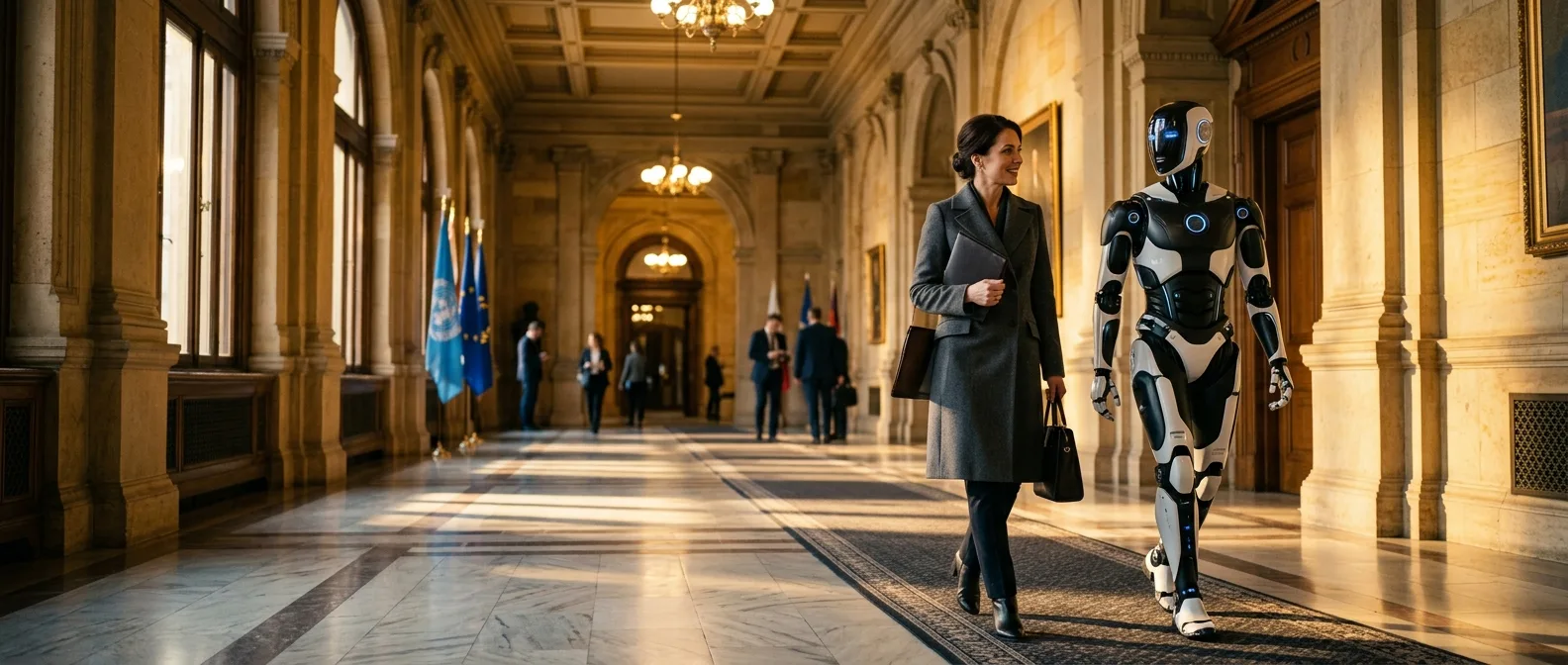
A humanoid robot walked the White House corridors on March 26, 2026, greeting guests in 11 languages while First Lady Melania Trump led an education summit. The Figure 03 didn't just make history as the first humanoid to officially enter America's seat of power. It turned a routine policy event into a glimpse of robotics' future — one where artificial intelligence meets political theater in the most powerful building on Earth.
The "Fostering the Future Together" summit couldn't have picked a better mascot. Figure AI's latest creation impressed attendees with natural conversation abilities and fluid movement that felt more human than machine. At $25,000 per unit, the Figure 03 remains out of reach for most consumers, but its White House debut sends an unmistakable signal about America's robotics ambitions.
🤖 Figure 03 Engineering That Actually Delivers
This isn't another tech demo masquerading as a product. The Figure 03 represents Figure AI's third-generation humanoid robot, designed from the ground up for mass production and real-world utility. Standing 5'3" to 5'7", it moves with a naturalness that erases the uncanny valley between human and machine.
Breakthrough features that matter: Vision system with double the frame rate and 60% wider field of view, palm-mounted cameras for precise object manipulation, and touch sensors sensitive enough to detect three grams of pressure — the weight of a paperclip resting on your fingertip.
The Figure 03's hands embed low-latency cameras that maintain visual awareness even when primary cameras are blocked. Picture a robot reaching into a cabinet and finding what it needs without direct line of sight to its own movements. That's the level of spatial intelligence we're talking about.
⚡ OpenAI Partnership Powers Real Intelligence
The collaboration with OpenAI isn't just marketing fluff. Figure 03 runs Helix, a proprietary vision-language-action AI system that enables natural conversation, command understanding, and real-time decision making. Unlike traditional industrial robots programmed for specific tasks, the Figure 03 learns from examples and adapts to new situations.
The system uploads terabytes of operational data for continuous learning and improvement. Every Figure 03 deployed in different environments contributes to the collective intelligence of the entire fleet. Think Tesla's Full Self-Driving data collection, but for humanoid robots navigating human spaces.
🏠 Built for Your Living Room (Eventually)
Figure AI makes no secret of its ultimate goal. The Figure 03 is engineered for home deployment, not just factory floors. Material choices reveal this philosophy: soft textiles instead of hard metal surfaces, multi-layer foam protection against injury, and 9% lighter weight than its predecessor.
Safety First Design
The battery system already carries UN38.3 certification and incorporates multiple protection layers. Clothing is machine-washable and removable without tools. The robot can wear different clothing configurations, including cut-resistant fabrics for industrial applications.
But how close are we to mass adoption? The $25,000 price tag sounds steep, but for a humanoid robot with these capabilities, it's relatively accessible. Compare that to Boston Dynamics' Atlas, which costs hundreds of thousands and isn't even for sale.
🏭 Mass Production Reality: The BotQ Project
Here's where things get serious. Figure AI created BotQ, a purpose-built facility for humanoid robot mass production. The first production line will manufacture up to 12,000 robots annually, with plans to reach 100,000 units within four years.
Vertical Integration
The company has internalized production of actuators, batteries, sensors, and electronic components to control quality and costs.
New Supply Chain
Building a global supplier network capable of producing thousands, eventually millions of specialized components.
The shift from CNC machining to processes like die-casting and injection molding represents a fundamental strategy change. This approach requires massive upfront investment in tooling but dramatically reduces per-unit production costs at scale.
🎯 Real Applications: From Classrooms to Factory Floors
Melania Trump's vision of humanoid teachers providing personalized education isn't science fiction. The Figure 03 can read student "emotional states" and adjust teaching pace accordingly. Its natural language processing handles multiple languages simultaneously, making it ideal for diverse classrooms.
Industrial Applications
In manufacturing, the Figure 03 operates at twice the speed of its predecessor with improved torque density. Hand and sensor upgrades enable better handling of small metal components and flexible materials like plastic bags — tasks that have stumped industrial robots for decades.
"We can accelerate civilization's progress when entrepreneurship provides innovation, government creates scale, and capital markets fund the proliferation of these emerging technologies."
— Melania Trump, White House
Wireless charging enables near-continuous operation — the robot simply steps onto a charging mat for predetermined intervals. In logistics and warehouses, this means minimal downtime and maximum productivity.
🌍 Humanoid Robot Geopolitics
The Figure 03's White House appearance wasn't coincidental. Trump has positioned artificial intelligence and robotics as strategic competition areas with China. Beijing has already unveiled its own advanced humanoids as the Chinese government pushes for dominance in emerging tech sectors.
The same-day appointment of Mark Zuckerberg (Meta), Larry Ellison (Oracle), and Jensen Huang (Nvidia) to an AI policy council wasn't coincidence either. The American government appears determined to maintain robotics technology leadership against international competitors.
⚠️ Challenges and Unanswered Questions
Despite the enthusiasm, serious questions remain unanswered. Melania Trump herself acknowledged technology risks during the summit, concerns echoed by French First Lady Brigitte Macron who attended virtually.
How ready is society for humanoid robots in homes and workplaces? What will the employment impact be? And how do we handle ethical questions raised by robots that mimic human behavior so convincingly?
The Acceptance Challenge
The Figure 03 can perform impressive tasks, but public acceptance remains an open question. Will people feel comfortable living and working alongside humanoid robots? The uncanny valley — the unease caused by almost-human robots — continues to challenge designers and psychologists alike.
🎯 Frequently Asked Questions
When will Figure 03 be available to consumers?
Figure AI targets 12,000 annual units from the BotQ production line. Currently, focus remains on corporate clients and research institutions, but the company has expressed its vision for home deployment as production scales.
How long does the Figure 03 battery last?
Figure AI hasn't announced specific operating hours, but the 2kW wireless charging capability enables rapid recharging. The system allows "near-continuous operation" as long as the robot can return periodically to charging docks.
What types of tasks can it perform?
The Figure 03 is designed as a general-purpose robot. It can manipulate objects, navigate homes and workplaces, communicate naturally with humans, and learn new tasks from examples rather than requiring programming for each specific function.
The Figure 03's White House debut wasn't just an impressive technology demonstration. It was a statement of intent about robotics' future — and perhaps the opening chapter of a story that will reshape how we live and work. The question isn't whether humanoid robots will become part of daily life, but how quickly it will happen and whether we'll be ready for that transformation.
Sources: