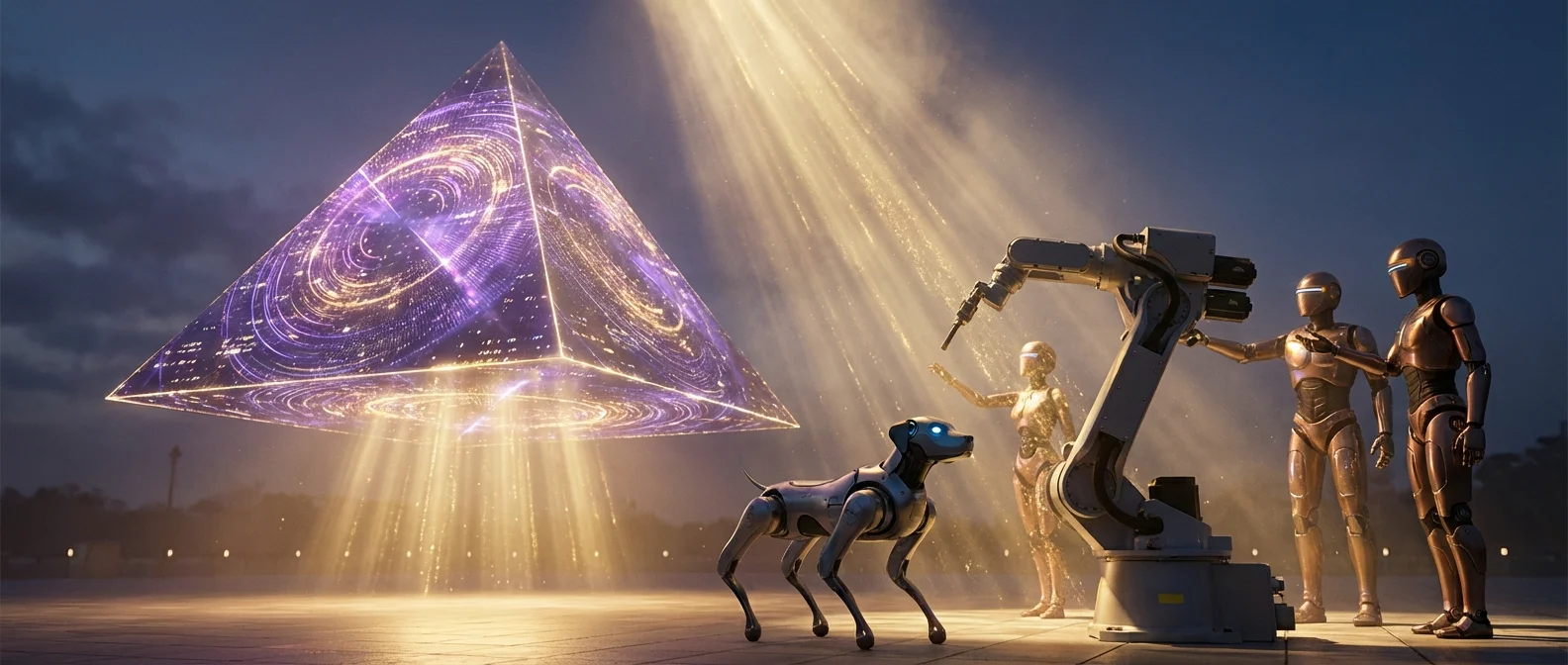
A single AI brain controlling a factory arm, a humanoid robot, and an autonomous drone — without starting from scratch each time. Foundation models in robotics are making this science fiction scenario reality, and the implications are staggering.
Stanford's AI researchers coined "Foundation Model" in 2021 to describe AI systems trained on massive datasets that adapt to countless downstream tasks. While ChatGPT and Claude conquered text, robotics foundation models are just hitting their stride. The results? Robots that learn like humans do — by watching, understanding, then doing.
🧠 What Makes a Robotics Foundation Model Different
Traditional robot AI is like teaching someone to drive by only showing them one specific car on one specific road. Foundation models are like teaching someone the principles of driving — then they can handle any vehicle, anywhere.
Vision
Real-time understanding of images and video from robot cameras
Language
Interpreting natural language commands: "pick up the red cup"
Action
Generating motor commands and joint-level robot control signals
Transfer
Applying the same model to completely different robot bodies
The breakthrough is VLA (Vision-Language-Action) architecture. Instead of separate systems for seeing, understanding commands, and moving, VLA models fuse everything into one neural network. Show it a scene, give it a command, and it outputs precise motor controls — all in one forward pass.
🚀 The Foundation Model Powerhouses
RT-2 (Robotics Transformer 2)
The first large-scale VLA model. Built on PaLM-E (55B parameters), it translates an image plus a text command directly into robot actions. Crucially, it can perform tasks it never saw during training (zero-shot generalization).
RoboCat
An AI model that controls robotic arms and self-improves: it generates new training data, uses it to train further, and adapts to unfamiliar arm models without full retraining.
Octo
An open-source generalist robot policy trained on 800,000+ trajectories from 22+ robot types (the Open X-Embodiment dataset). Supports text and goal-image commands. Fully open-source and runnable on consumer GPUs.
OpenVLA
Open Vision-Language-Action model based on Llama 2 (7B parameters), fine-tuned on 970K robotic episodes. Open, reproducible, and ideal for researchers who want to experiment and iterate quickly.
π0 (Pi-Zero)
Built by the startup Physical Intelligence ($400M+ funding). Uses a flow-matching architecture to generate smooth, natural motions. Demonstrated folding laundry, packing boxes, and cooking tasks.
Gemini Robotics
The evolution of RT-2. Two versions: Gemini Robotics (full VLA) and Gemini Robotics-ER (Embodied Reasoning). Enhanced physical interaction, followed by Gemini Robotics 1.5 in September 2025.
⚡ Why This Changes Everything
Before foundation models, building robot AI was like crafting a Swiss watch — precise, expensive, and completely custom for each use case. Foundation models turn it into smartphone manufacturing — standardized, scalable, and rapidly improving.
| Traditional Robot AI | Foundation Model Robot AI |
|---|---|
| One model per robot | One model for many robots |
| One model per task | One model, many tasks |
| Months of training | Hours of fine-tuning |
| Small, specialized datasets | Internet-scale data + robotics data |
| Hand-engineered pipelines | End-to-end learning |
| Poor generalization | Zero-shot to new objects and spaces |
🔧 Inside the VLA Pipeline
Internet-Scale Pre-training
The model devours billions of images, videos, and text from the web. It learns physics, object relationships, and common sense about how the world works — before it ever sees a robot.
Robot Demonstration Data
Hundreds of thousands of real robot trajectories get added to the mix. Key datasets include Open X-Embodiment (Google + 22 institutions) and DROID (Berkeley). This is where the model learns to translate understanding into action.
Multimodal Fusion
Camera feeds and language commands merge into a shared representation through Transformer architecture. The model simultaneously "sees" the world and "reads" what you want it to do.
Action Tokenization
Robot movements become "tokens" — just like words in ChatGPT. Joint positions, gripper states, and motor commands all get converted into a language the Transformer can understand and generate.
Fine-Tuning on Target Hardware
With surprisingly few demonstrations (100–1,000), the model adapts to a specific robot body and task. Techniques like LoRA make this process fast and cheap.
Real-Time Execution
The model runs on robot hardware (or edge GPUs) and translates in real time: camera input → understanding → precise motor commands, all in under 100 milliseconds.
🌍 World Models: Predicting the Future
VLA models react to what they see. World models go further — they predict what happens next. Yann LeCun calls world models the key to human-level AI, potentially arriving by 2030–2035.
NVIDIA Cosmos
A World Foundation Model platform designed specifically for robotics and autonomous vehicles. Simulates the physical world in real time for training without real-world data collection.
Genie 3
Generates high-resolution interactive 3D environments from text or images. Exports 3D spaces with multi-minute visual consistency. Made publicly available in January 2026.
World Labs Marble
The first commercial world model. Three phases: 3D space + time understanding, augmented reality support, and robotics applications. Spatial intelligence for creative use cases.
Meta World Model
Open world model targeting robotics and self-driving. Part of LeCun's vision for cognitive architecture beyond large language models.
🔄 Cross-Embodiment Transfer: The Holy Grail
Train once, deploy everywhere. Cross-embodiment transfer means a model trained on data from dozens of robot types can immediately control a completely new robot it's never seen before.
Open X-Embodiment: The Dataset That Changed Everything
In October 2023, Google DeepMind and 22+ research institutions dropped the Open X-Embodiment dataset — over 1 million robot trajectories that became robotics' ImageNet moment:
- 22+ robotic arm types (Franka Panda, Kuka iiwa, UR5, xArm, and more)
- Multiple gripper configurations (two-finger, suction, dexterous hands)
- Hundreds of manipulation tasks across dozens of environments
- The foundation for every major robotics foundation model since
This dataset didn't just enable better robots — it created an entirely new category of AI.
📊 The Numbers Behind the Revolution
🏭 Real-World Applications Happening Now
Manufacturing Gets Smart
Factory robots now learn new assembly tasks in hours instead of weeks. When a new product hits the production line, robots need just a handful of demonstrations to get up to speed. No more months of reprogramming for every product change.
Warehouses That Adapt
Amazon, Boston Dynamics, and logistics giants are deploying foundation-model-powered robots that handle thousands of different items without retraining. Each new SKU doesn't require a custom AI model — the foundation model generalizes across shapes, sizes, and materials.
Home Robots That Actually Help
Humanoid robots for homes — Tesla Optimus, Figure 02, and others — rely on VLA models to master household tasks. Physical Intelligence's π0 can fold laundry, pack boxes, and handle kitchen tasks with human-like dexterity.
Surgery Gets Precise
Foundation models trained on thousands of surgical videos enable autonomous suturing and tissue manipulation. Surgical robots can transfer expertise between different platforms, dramatically reducing certification time for new procedures.
Autonomous Driving Accelerates
Waymo, Tesla, and Chinese AV companies use world models to simulate billions of driving scenarios without logging real miles. NVIDIA Cosmos specifically targets this space, creating photorealistic driving simulations for training.
🎯 Gato: The First Generalist AI
DeepMind's Gato (May 2022) was the proof of concept that broke everyone's brain. One model, 604 different tasks — from image captioning to robotic arm control. On 450 of those tasks, Gato matched or exceeded human performance. The kicker? It switched between tasks without any retraining.
🔓 Open Source vs Closed: The Battle for Robot AI
The Great Divide in Robotics Foundation Models
The open vs closed debate is reshaping robotics AI:
- Open Champions: Octo, OpenVLA, Llama-based models — free, reproducible, community-driven innovation
- Closed Powerhouses: RT-2, Gemini Robotics, π0 — superior performance but limited access and commercial licensing
- Hybrid Approach: Google publishes datasets (Open X-Embodiment) and papers but keeps top models proprietary
The open-source community (Hugging Face, Berkeley, Stanford) is democratizing cutting-edge robotics AI. Octo runs on consumer GPUs, making advanced robot intelligence accessible to small labs and startups worldwide.
⚠️ The Hard Problems Still Unsolved
Training Data Bottleneck
Millions of robot demonstrations needed — expensive and difficult to collect at scale
Compute Requirements
Training requires thousands of GPUs. Each model costs millions of dollars to build
Safety Concerns
Hallucinations in text are annoying. Hallucinations in robot movements are dangerous
Real-Time Constraints
Multi-billion parameter models must run in under 100ms on robot hardware
Sim-to-Real Gap
Simulation training doesn't transfer 100% to the real world's imperfections
Fine Dexterity Limits
Delicate manipulation — threading a needle, handling an egg — remains extremely hard
🏆 Who's Winning the Foundation Model Race
| Organization | Models | Key Strengths |
|---|---|---|
| Google DeepMind | RT-2, RoboCat, Gemini Robotics | Scale, data, and existing LLM backbone |
| Physical Intelligence | π0, π0-FAST | Flow matching, practical task mastery |
| NVIDIA | Cosmos, Isaac Foundation | Hardware + software ecosystem |
| UC Berkeley / Stanford | Octo, OpenVLA | Open source, academic research |
| Meta AI | World Model, V-JEPA | Self-supervised learning, open models |
| Toyota Research | Diffusion Policy | Manipulation, human interaction |
🔮 What's Coming: 2026 and Beyond
Reasoning Robots
Robots that think step-by-step before acting, like reasoning LLMs
Internet-Scale Training
Training on billions of YouTube videos showing humans performing tasks
Simulation Mastery
World models + simulation = unlimited training data without real-world cost
Multi-Robot Coordination
Foundation models coordinating entire robot fleets in real time
The era of custom-built robot AI is ending. Foundation models are bringing to robotics what LLMs brought to text and diffusion models brought to images: democratization, scale, and intelligence that understands the world instead of blindly following rules. We're not just building better robots — we're building robots that think.