📖 Read more: Figure AI 03: A Humanoid Robot with an AI Brain
🧠 Pixels to Power: How Helix 02 Sees and Moves
Most humanoid robots split their brain in half. One system handles walking. Another manages arm movements. Figure AI threw that playbook out the window. Helix 02 connects camera pixels directly to every motor in the robot's body through a single neural network.🔍 What Does "Pixels-to-Torque" Actually Mean?
Traditional robots process images, decide what to do, calculate leg movements, then arm movements, then send commands to motors. Helix 02 sees a scene and instantly knows exactly how much force to apply to every joint simultaneously. No translation layers. No separate controllers.
Three-Layer Thinking Architecture
Helix 02 operates on three distinct levels, each running at different speeds: - **System 2** (The Strategist): High-level language and scene processing, breaking down commands like "unload the dishwasher" into smaller goals - **System 1** (The Coordinator): Connects all sensors (head cameras, palm cameras, touch sensors) to all joints at 200 Hz - **System 0** (The Athlete): Foundation layer running at 1 kHz for physical balance and coordination📖 Read more: Figure 03 Makes History as First Humanoid Robot in White House
⚡ Where Traditional Methods Hit the Wall
For decades, "loco-manipulation" — moving and manipulating objects simultaneously — has stumped robotics engineers. Traditional approaches split locomotion from manipulation with separate controllers connected through state machines.The problem isn't just technical. When you lift something heavy, it affects your balance. When you take a step, it changes your reach. Legs and arms constantly constrain each other. Most robots we've seen can do impressive things for a few seconds, but collapse when conditions change unexpectedly."True autonomy requires something fundamentally different: a unified learning system that reasons with the whole body simultaneously."
Figure AI
Replacing 109,504 Lines of Code
In one of the most striking details from Figure's announcement, System 0 replaces 109,504 lines of hand-engineered C++ code with a single neural network. This isn't just technical optimization — it's a philosophical shift in how we design robots. Instead of engineers trying to predict and program every possible scenario, the robot learns from observation. More like how children learn — not by reading instruction manuals, but by watching and mimicking.📖 Read more: IEEE 2026: Robotics #1 Industry Transformed by AI
🏠 The Ultimate Test: Four Minutes in the Kitchen
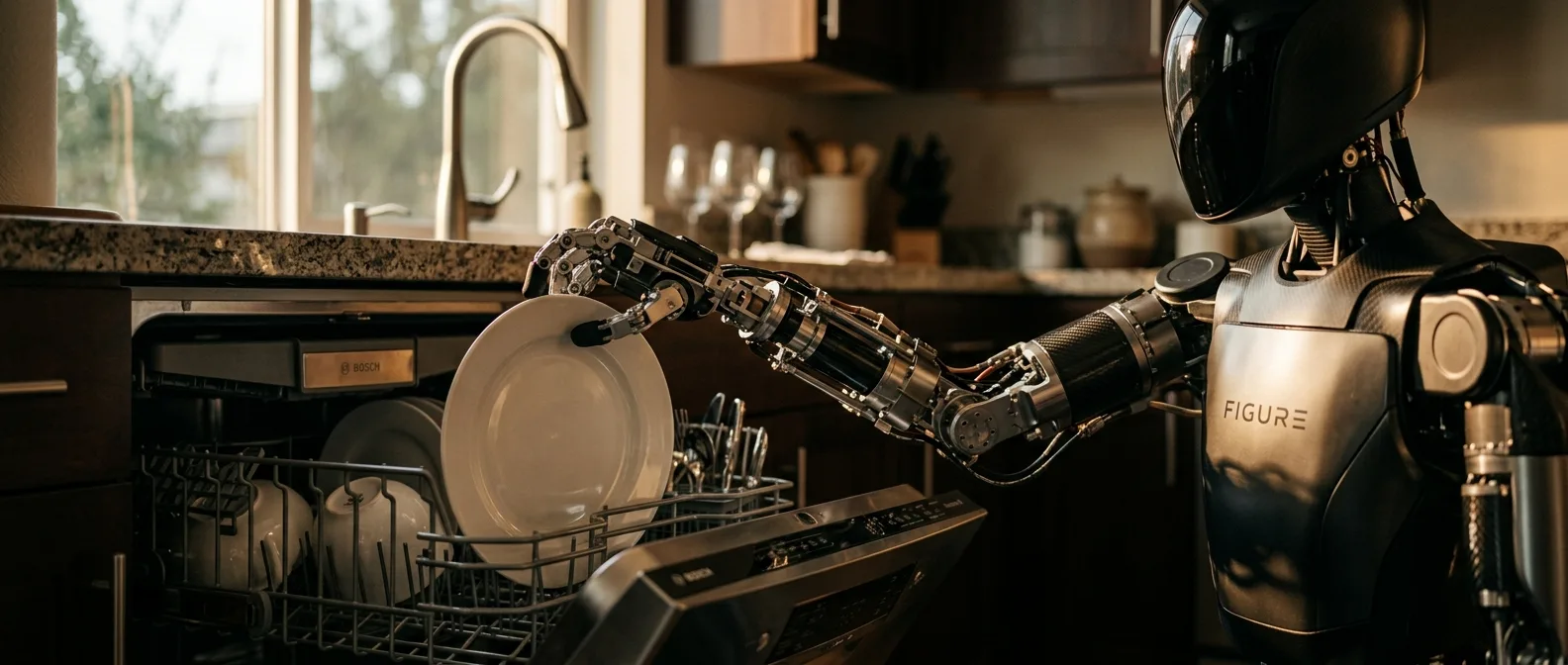
Helix 02's flagship demo is a four-minute sequence where the robot unloads and reloads a dishwasher in a full-sized kitchen. Sounds simple. Requires coordinating dozens of different movements: balanced walking, handling fragile objects, simultaneous two-handed manipulation, cabinet navigation. What makes the demonstration even more impressive is zero resets or human intervention. If something went wrong — a plate slipped, a cabinet door didn't open fully — the system had to correct itself. And it does.New Capabilities from Touch and Vision
Helix 02 runs on new hardware, the Figure 03 platform, which includes tactile sensors in the fingertips and cameras in the palms. The touch sensors can detect forces as small as three grams — sensitive enough to feel a paperclip.Pill Extraction
Removes individual pills from organizers despite visual occlusion
Precise Dosing
Dispenses exactly 5 ml from syringes using tactile feedback
Metal Part Sorting
Selects small components from tangled containers
📖 Read more: Atlas Production: 30,000 Humanoid Robots Annually from Boston...