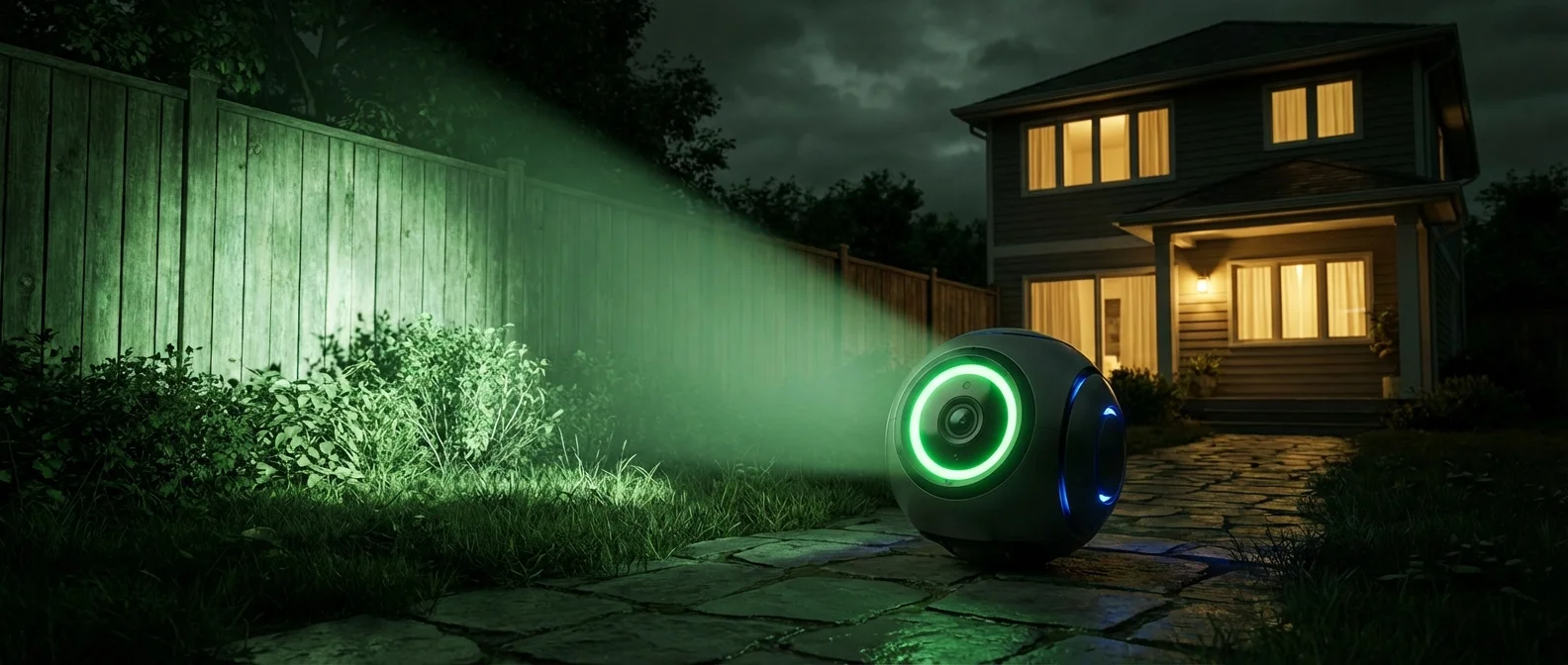
Home security has come a long way from locks and chains to CCTV cameras, and now to robots powered by artificial intelligence. In 2026, the idea of a robotic guard autonomously patrolling your home or business is no longer science fiction — it's a commercial reality. From the imposing Knightscope K5 units guarding shopping malls to the Amazon Astro rolling through your living room, security robots are fundamentally reshaping how we protect our spaces.
📖 Read more: Robot Dogs at the 2026 World Cup: High-Tech Stadium Guards
The Evolution of Home Security
The history of electronic home security dates back to 1969, when Marie Van Brittan Brown patented the first home security system based on closed-circuit television (CCTV). Since then, the technology has evolved rapidly: analog cameras, digital DVRs, Wi-Fi-connected IP cameras, followed by smart video doorbells, motion sensors, and smartphone notifications.
Today, the home security market stands at a new inflection point. Artificial intelligence, facial recognition, thermal imaging, and autonomous navigation are converging into an entirely new product category: security robots. Instead of static cameras that only cover a single direction, these robots can patrol, detect anomalies, recognize faces, and alert homeowners in real time.
Knightscope: Next-Generation Robotic Guards
Knightscope, founded in 2013 in Mountain View, California, in the wake of the Sandy Hook tragedy, is the pioneer in commercial security robots. With a mission to "build autonomous security machines that will make the United States the safest country in the world," Knightscope develops robots that autonomously patrol commercial spaces, university campuses, and airports.
K1 — Stationary Scanner
A fixed security system for indoor environments. Detects weapons, explosives, and chemical agents. Ideal for building entrances and airport security checkpoints.
K3 — Indoor Patrol
An autonomous indoor robot that patrols shopping malls, hospitals, and offices. Equipped with 360° cameras and motion sensors for comprehensive surveillance.
K5 — Outdoor Guardian
The flagship model: 5 feet tall, weighing 300-400 lbs. Features thermal camera, LiDAR, radar, and wireless signal detection. Patrols parking lots and campuses.
K7 — All-Terrain
Built for rough outdoor environments. Four-wheel drive, weather-resistant design. Ideal for industrial facilities and rugged perimeters.
Renting a Knightscope robot costs just $7 per hour — a fraction of the cost of hiring human security guards for round-the-clock shifts. The robots operate 24/7, never get tired, never call in sick, and never need breaks. Equipped with video cameras, thermal imaging, LiDAR, radar, air quality sensors, and wireless signal detection, they can read license plates, detect weapons, and recognize faces.
At an apartment complex in Las Vegas, deploying Knightscope robots dramatically reduced 911 calls. Clients including Microsoft, Uber, the Sacramento Kings, NBC Universal, and LaGuardia Airport already use Knightscope robots. The company has been publicly traded on NASDAQ (ticker: KSCP) since January 2022.
However, Knightscope robots haven't been without incidents. In 2016, a K5 lightly struck a toddler at Stanford Shopping Center. In 2017, a robot in Washington D.C. tumbled into a fountain, while a drunk man attacked a security robot in a parking lot. These incidents are a reminder that the technology is still maturing.
📖 Read more: Fauna Sprout: The Soft Humanoid Robot You Can Actually Hug
Amazon Astro: Your AI Home Guardian
While Knightscope serves commercial spaces, Amazon Astro brings robotic security into your home. Released in 2021 on an invitation-only basis at $1,599, it was described as “Alexa on wheels” — a wheeled robot that can autonomously patrol your house.
- Processors: Dual Qualcomm + Amazon AZ1 Neural Edge
- Display: 10.1″ touchscreen
- Cameras: 5MP bezel + 1080p periscope (visible + infrared)
- Weight: 20.6 lbs (9.3 kg)
- Security: Visual ID for family members, alerts for unknown persons
- Integration: Ring, Alexa, Amazon Sidewalk
In September 2022, Amazon announced Astro's integration with the Ring security system, effectively turning it into a remote-controlled robotic security guard. A call center can now remotely operate the robot to confront intruders after receiving an alert from the Ring system. The periscope camera allows Astro to raise its lens high enough to see over tables and countertops — something a fixed camera simply can't do.
Reception, however, was mixed. Wired magazine called Astro “a robot without a cause,” and many considered it more of a luxury gadget than a genuinely useful security tool. Still, the combination of autonomous navigation, AI recognition, and the Ring/Alexa ecosystem makes Astro arguably the most complete home security robot on the market today.
Ring Always Home Cam: The Autonomous Security Drone
In September 2020, Ring (an Amazon subsidiary) unveiled a radical concept: an autonomous aerial indoor camera — essentially a tiny drone that flies through your home. The Always Home Cam is automatically triggered by alarm sensors and flies along a predetermined path, recording video as it goes.
The concept is simple but powerful: instead of installing cameras in every room, a single drone can check the entire house. It doesn't record when docked at its charging base — it only activates when needed, partly addressing privacy concerns. Priced at $249, it's significantly more affordable than Astro and offers an entirely different approach to home security.
Security Robot & System Comparison
🛡️ Knightscope K5
- Type: Commercial robot
- Movement: Autonomous patrol
- Weight: 300-400 lbs
- Cost: ~$7/hr rental
- Sensors: Camera, thermal, LiDAR, radar
- Best for: Commercial spaces
🏠 Amazon Astro
- Type: Home robot
- Movement: Wheeled, autonomous navigation
- Weight: 20.6 lbs
- Cost: $1,599 (purchase)
- Sensors: 2 cameras, IR, periscope
- Best for: Homes, apartments
🚁 Ring Always Home Cam
- Type: Indoor drone
- Movement: Flight on preset path
- Weight: Lightweight
- Cost: $249 (purchase)
- Sensors: 1 video camera
- Best for: Homes
📹 Traditional CCTV
- Type: Static cameras
- Movement: Pan-tilt-zoom (fixed)
- Weight: <1 lb per camera
- Cost: $50-500/camera
- Sensors: Camera, night vision
- Best for: Everywhere
AI & Smart Security: The New Era
Beyond physical robots, artificial intelligence is also transforming traditional security systems. Modern IP cameras aren't limited to simple video recording anymore — they analyze footage in real time, recognize faces, detect anomalies, and push notifications to your smartphone.
Facial Recognition
Identifies family members and sends different notifications for known versus unknown faces. Ring's “Familiar Faces” feature (2025) does exactly this.
Smart Alerts
AI-powered motion detection distinguishes between people, animals, and vehicles, drastically reducing false alarms to a minimum.
Night Vision
Infrared LEDs and thermal imaging provide crystal-clear footage even in total darkness. Knightscope robots feature both technologies.
📖 Read more: Firefighter Robots: Saving Lives in the Flames
IoT Ecosystem
Integration with Alexa, Google Home, smart locks, and lighting. Lights turn on automatically when motion is detected. Amazon Sidewalk enables mesh networking.
Ring is a textbook example of this evolution. It started as a camera-doorbell startup in 2013 (under the name Doorbot) and today, as an Amazon subsidiary, it's the world's most recognized home security brand. Its ecosystem includes video doorbells, indoor and outdoor cameras, a security alarm system (Ring Alarm), an autonomous drone (Always Home Cam), and a robotic guard (Astro). The Ring Protect subscription ($4-20/month) allows video storage for up to 180 days.
Privacy vs. Security: The Great Dilemma
The rise of security robots and AI cameras raises serious privacy questions. Ring has repeatedly found itself at the center of controversy:
- In May 2023, the FTC (Federal Trade Commission) imposed a $5.8 million fine on Ring after employees illegally accessed customer video recordings
- Partnerships with police departments allowed access to footage without user consent — at least 11 times in 2022 alone
- In October 2025, Ring announced a partnership with Flock Safety (AI license plate recognition cameras), sparking fierce backlash. The EFF called it a “round-the-clock warrantless digital dragnet”
- In February 2026, following its Super Bowl LX advertisement, Ring was accused of normalizing mass surveillance — and subsequently withdrew from the Flock partnership
"Security robots and AI cameras promise protection, but they simultaneously create an unprecedented surveillance network. The question isn't whether we can build these systems — it's whether we should." — Electronic Frontier Foundation
Knightscope faces similar criticism. The Electronic Privacy Information Center (EPIC) has raised concerns about data collection, facial recognition, and the robots' ability to detect wireless signals — meaning they can theoretically locate mobile phones in the vicinity. There's also growing concern that security robots are displacing human guard jobs — all at a rate of $7 per hour.
Cost & Value Assessment: What's Worth Your Money?
For the average homeowner, the most practical solution remains a Ring-style system (video doorbell + indoor cameras + alarm system). The Always Home Cam ($249) offers intriguing value as an indoor security drone. Astro ($1,599) is the premium option with full robotic navigation. For commercial spaces, Knightscope remains the most battle-tested solution — though its systems aren't designed for residential use.
An important ongoing cost is the monthly subscription: Ring Protect runs $4-20/month, without which you can't store or review recorded footage. This means the real price is always hardware plus subscription — a model the industry is increasingly adopting.
The Future: What's Coming Next?
The trend is unmistakable: security robots will get smaller, cheaper, smarter, and more autonomous. In the coming years, we can expect:
- Smaller home robots: Astro-style robots at more accessible sizes and price points for everyday consumers
- Generative AI integration: Robots that “understand” scenes, explain what they see, and make real-time decisions
- Robot-drone collaboration: Systems combining ground-based robots with indoor drones for complete coverage
- Biometric security: Gait recognition and emotion detection through advanced video analysis
- Regulation & legislation: Stricter rules for AI surveillance and security robots expected in both the EU and the US
Home security robots are now a market reality and growing more capable by the day. Knightscope is paving the way in commercial security, Amazon Astro brings robotic protection into the home, and the Ring Always Home Cam proves that drones can serve as indoor security guards. However, the balance between safety and privacy remains the biggest challenge — and society must decide where to draw the line.