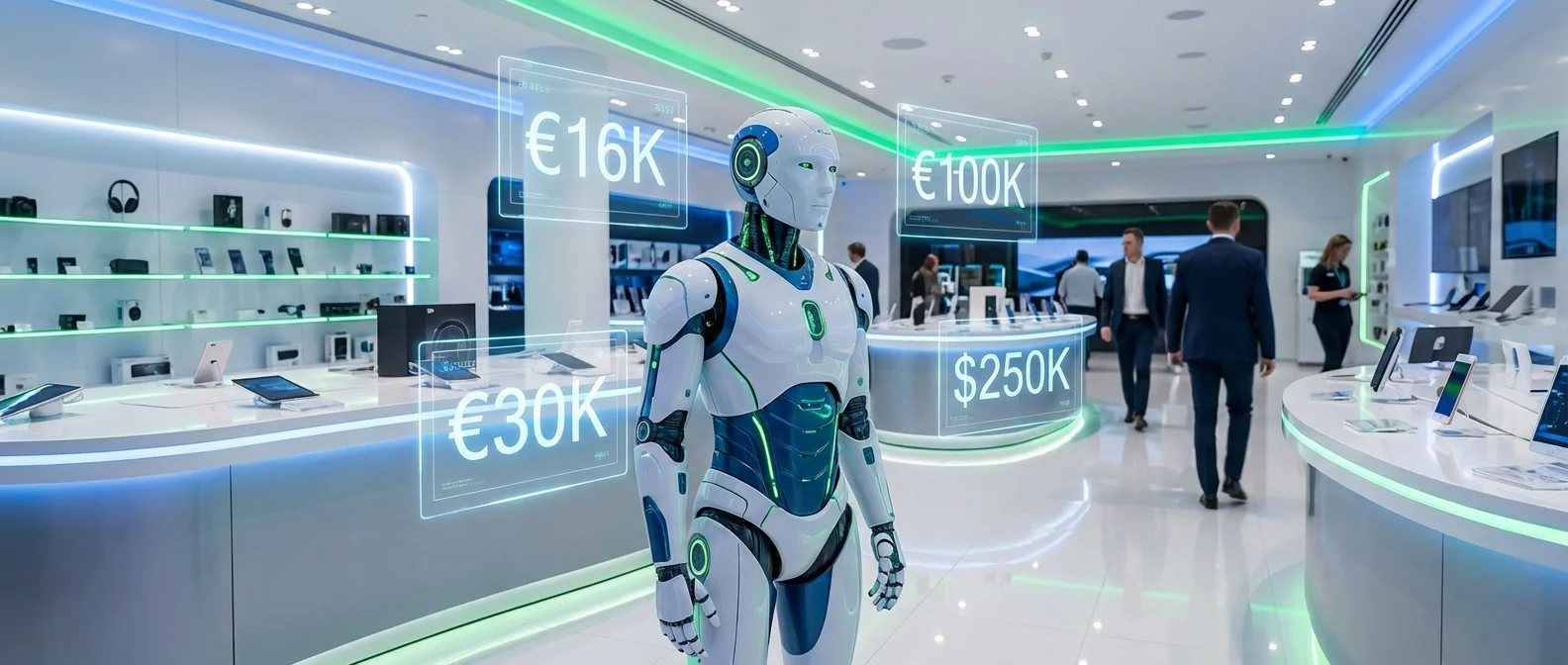
If someone had asked a decade ago how much a humanoid robot costs, the answer would have been “millions of dollars — and it's not for sale.” In 2026, reality looks entirely different. Humanoid robot pricing is in freefall: from the $2.5 million per unit that Honda's ASIMO reportedly cost in the 2000s, we've arrived at the $16,000 Unitree G1 in August 2024. That's a 99.4% price drop in two decades.
The humanoid robot market is projected to exceed $38 billion by 2035, according to Goldman Sachs estimates. But what does that mean for you? Can you actually buy a humanoid robot today? And if so, how much will it set you back?
In this guide, we break down current prices, cost drivers, industrial ROI, and predictions for when a humanoid robot will be as affordable as a car.
What Determines the Price of a Humanoid Robot
The price of a humanoid robot isn't just about raw materials. Five key factors drive the final cost, and understanding them explains why prices vary so dramatically between manufacturers.
Actuators: The motors that power each joint represent by far the largest expense. A typical humanoid requires 20–40 degrees of freedom, meaning that many actuators. Boston Dynamics used hydraulic actuators in the original Atlas — powerful but bulky and expensive. The new generation uses electric ones, with Tesla's Optimus adopting planetary roller screws instead of ball screws for higher shock resistance during walking.
Sensors: Cameras, LiDAR, tactile sensors, accelerometers, gyroscopes, torque sensors — the full sensor suite of a modern humanoid costs thousands of dollars on its own. The Figure 03 from Figure AI features palm-mounted tactile sensors that detect forces as small as three grams, while its upgraded camera system delivers double the frame rate and a 60% wider field of view.
Compute power: Every modern humanoid runs AI models in real time — vision-language-action models that interpret the world and plan movements. The Figure 02 uses Nvidia RTX GPU-based modules with triple the computing power of its predecessor. The Figure 03 packs two GPUs per robot. These chips don't come cheap.
Build and materials: Humanoids are constructed from aerospace-grade aluminum, carbon fiber, multi-density safety foams (on the Figure 03), and even removable, washable textiles. The battery is integrated into the torso with UN38.3 safety certification. 3D printing significantly reduces costs for some components, but critical mechanical parts still require CNC machining.
Research and development: Figure AI is valued at $39 billion after its third funding round (September 2025), Tesla has invested billions in Optimus, and Boston Dynamics spends hundreds of millions annually. These R&D costs are baked into the price of every unit — especially when production volumes are still low.
Humanoid Robot Price Comparison 2026
Which humanoid robots are available today, and how much do they cost? The table below compiles the most notable models, their prices (actual or estimated), and their primary capabilities.
| Robot | Company | Estimated Price | Status |
|---|---|---|---|
| Unitree G1 | Unitree (China) | $16,000 | Mass production |
| Tesla Optimus | Tesla (USA) | ~$30,000 | Pilot production |
| Unitree H1 | Unitree (China) | $90,000–$150,000 | Available |
| Figure 03 | Figure AI (USA) | Not announced | BotQ production starting |
| Atlas (Electric) | Boston Dynamics (USA) | Not for sale | Internal R&D |
| Digit | Agility Robotics (USA) | ~$250,000 (leasing) | Industrial use |
| NAO | SoftBank (France) | $9,000–$16,000 | Educational |
The data paints a striking picture: there's already a price range spanning from a few thousand dollars (for smaller educational models) to hundreds of thousands (for industrial-grade systems). This reveals that there's no single “typical” humanoid price — it depends entirely on the intended use case.
Tesla Optimus: The $30,000 Promise
The boldest price commitment in the space belongs to Elon Musk. At the “We, Robot” event in October 2024, Musk stated that Optimus could eventually cost around $30,000 — less than many cars. The vision is clear: a general-purpose robot that handles the “dangerous, repetitive, and boring” tasks humans don't want to do.
Optimus Generation 3 stands 173 cm tall, weighs 57 kg, features hands with 22 degrees of freedom, and can carry 20 kg. It runs on the same AI system as Tesla Autopilot. However, critics haven't been quiet. The 2024 demo videos were revealed to rely on teleoperation rather than autonomous behavior, which provoked backlash. Robotics researcher Filip Piekniewski called the project a “complete scam,” while Rodney Brooks — co-founder of iRobot — declared in December 2025 that Musk's vision of humanoid robot assistants is “pure fantasy thinking.”
The truth, as usual, lies somewhere in the middle. Tesla plans to build over 1,000 Optimus units for use in its own factories during 2025, with potential sales to third parties from 2026 onward. If it achieves automotive-scale mass production, the $30,000 price point isn't unrealistic — but whether they'll get there remains anyone's guess.
Unitree G1: The Robot That Changed the Game
While Tesla makes promises, Unitree is already shipping. In August 2024, the Chinese company Unitree Robotics — founded in 2016 in Hangzhou by Wang Xingxing — began mass-producing the G1 at a starting price of $16,000. Sixteen thousand dollars. Less than a used car.
The G1 is an upgraded version of the H1, which first turned heads in March 2024 by performing a backflip. Unitree, which started with quadruped robot dogs like the Go1 and Go2, entered the humanoid space with a low-cost strategy. The company now employs 500 people, is preparing for an IPO in Hong Kong, and won the World Intellectual Property Organization's Global Award in July 2025.
Of course, the $16,000 price covers the base model. A fully equipped version could cost significantly more. And the long-term reliability under real working conditions remains unknown — a critical concern for industrial buyers.
Figure AI: $39 Billion Valuation, a Factory Where Robots Build Robots
Figure AI is arguably the most compelling story in the space. Founded in 2022 by Brett Adcock, it raised $675 million in February 2024 from Jeff Bezos, Microsoft, Nvidia, Intel, Amazon, and OpenAI (valued at $2.6 billion). By September 2025, its valuation had skyrocketed to $39 billion after a $1 billion Series C round. Investors include Qualcomm, T-Mobile, Salesforce, and Brookfield.
Figure hasn't announced a public price. Its strategy differs: rather than targeting consumers, it's focused on industrial deployment. Figure 02 robots were tested at a BMW plant in South Carolina, and in March 2025 the company unveiled BotQ — a manufacturing facility designed to produce 12,000 humanoid robots per year, with the robots themselves gradually assisting in building new ones.
The third-generation Figure 03 (October 2025) marks a new era: palm-mounted tactile sensors detecting three-gram forces, embedded palm cameras, wireless inductive charging, removable washable textiles, and multi-density safety foams. It's designed for both factory and home environments — an ambitious leap.
The Hidden US–China Race
The humanoid robot market isn't just a technology competition — it's geopolitical. On one side, American companies (Tesla, Figure AI, Agility Robotics, Boston Dynamics) spend billions on R&D and target premium pricing. On the other, Chinese firms (Unitree, AgiBot, UBTech, Fourier) follow the familiar “build cheap, sell at scale” strategy that proved so effective with electric vehicles.
In May 2025, the US House Select Committee on Strategic Competition with China asked three federal agencies to investigate Unitree over potential ties to the People's Liberation Army and its military-civil fusion programs. In September 2025, security researchers discovered wormable vulnerabilities in Unitree's G1 and H1 that would allow a nearby attacker to take full control, with the ability to chain-infect other robots.
These security concerns could significantly affect pricing. If the US or EU impose tariffs or bans on Chinese humanoids — as they've already done with DJI drones — then the affordable Chinese alternative won't be available. That would keep prices high in the West.
When Will the Average Consumer Buy a Robot?
This is the question everyone is asking. The short answer: not yet, but sooner than you think.
Consider the car analogy. The Ford Model T cost $825 in 1908 (roughly $27,000 in today's money). Within 20 years, mass production drove the price down to $260 — a 68% drop. If humanoid robots follow a similar cost curve — and early signs suggest they'll follow it much faster thanks to digitization — then:
- 2025–2027: Industrial use. Robots in auto factories (BMW/Figure), warehouses (GXO/Agility Digit), and Tesla plants. Prices: $30,000–$250,000.
- 2028–2030: Commercial use. Hotels, hospitals, retail stores. Monthly leasing models. Prices: $15,000–$50,000.
- 2031–2035: Consumer market. Home models for elderly care, disability assistance, household tasks. Prices: $5,000–$20,000.
The key is production scale. Figure AI is targeting 12,000 robots annually at BotQ alone. If Tesla ever reaches automotive production levels (hundreds of thousands per year), the $10,000 price point won't be fantasy. But that might take another decade.
ROI: Is It Worth the Investment for Businesses?
Let's talk numbers. An Agility Digit costs roughly $250,000 on a lease model. It works 24/7, doesn't get sick, and doesn't take vacations. At GXO Logistics warehouses, five Digit robots have been handling merchandise (including Spanx products) since June 2024.
If a warehouse worker costs $40,000 annually and a robot replaces 1.5–2 positions (thanks to round-the-clock operation), payback happens within 2–3 years. If the price drops to $30,000 (as Tesla promises), payback shrinks to mere months. That will trigger a wave of adoption — but also serious questions about the labor market.
Of course, cost doesn't stop at the purchase price. You need to factor in maintenance, software updates, battery replacement, staff training, insurance, and integration costs. These “hidden” expenses can add 20–40% to the total lifetime spend.
Why Boston Dynamics Doesn't Sell the Atlas
Boston Dynamics — now owned by Hyundai — did something dramatic in April 2024: they retired the hydraulic Atlas and unveiled an entirely new electric version with a broader range of motion and greater dexterity. But they don't sell it. Why?
Boston Dynamics has always followed a “develop first, sell later” strategy. The original Atlas reportedly cost over $1 million per unit — a price no regular buyer would pay. Instead, the company uses Atlas as an internal R&D tool while selling its Spot ($74,500) and Stretch robots for practical applications. Hyundai plans to integrate Atlas technologies into its own factories first.
"The idea of humanoid robots as general-purpose assistants is pure fantasy thinking. Robots have coordination problems." — Rodney Brooks, co-founder of iRobot, December 2025
The Greek Perspective
What does all this mean for a Greek consumer or business owner? For now, very few of these robots are directly available for purchase in Greece. The NAO can be obtained through European distributors, and robotic systems for education are already used in Greek universities.
The market will reach Greece through three channels: industrial imports via multinationals already operating in the country, academic purchases through research programs and Horizon Europe funding, and eventually — once prices drop below €20,000 — the consumer market. In the meantime, the most practical option for Greek businesses remains industrial cobots and robotic arms, typically priced between €25,000–€50,000.
What to Expect by 2030
The trends are unmistakable. Costs are falling exponentially, AI is becoming more capable, and factory production lines are scaling up. Humanoid robots currently deployed in pilot projects — five here, ten there — will become a common sight in warehouses, factories, and hospitals within the next 3–5 years.
The real revolution won't happen when a robot can do everything — it will happen when a robot can do enough things, well enough, at a low enough price. And that moment is approaching faster than most people imagine.
For the average consumer, our advice is simple: don't rush to buy. The first generation of consumer humanoids will be expensive and inadequate. Wait for the second or third generation — just like you did with smartphones. In the meantime, follow the developments, do your research, and prepare. The age of robots isn't coming — it's already here. It just isn't cheap enough yet.