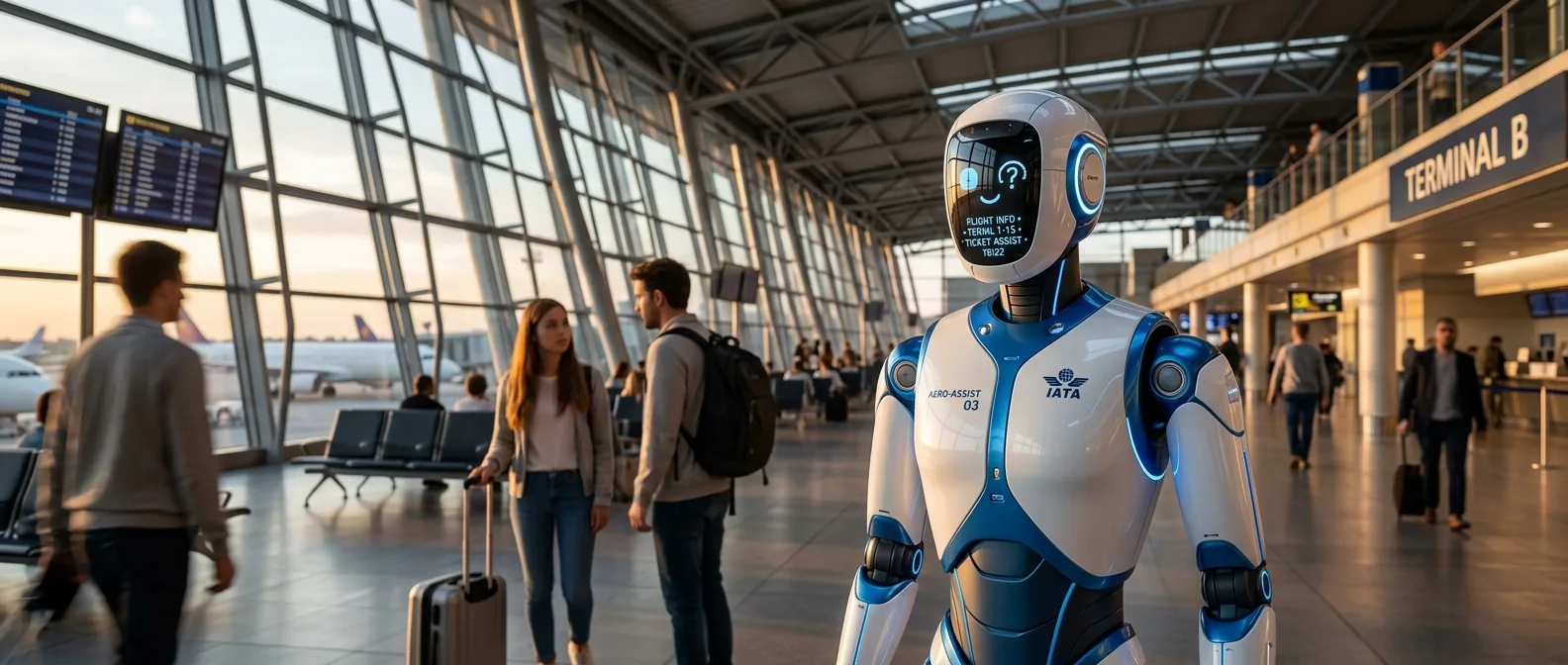
A humanoid robot named Jose just clocked in for his first shift at San José Mineta International Airport. He speaks 50 languages, never takes a coffee break, and might be the answer to America's airport staffing crisis.
This isn't another tech demo gathering dust in a lab. IntBot Jose represents the first fully autonomous humanoid robot deployed in a working airport to serve passengers. While TSA agents call in sick during government shutdowns and spring break crowds pile up at security checkpoints, Jose stands ready at Terminal B, Gate 24 — a Silicon Valley startup's bet that social intelligence can solve real-world problems.
🤖 Physical AI Meets Human Chaos
Jose isn't just a chatbot with legs. IntBot describes him as "social intelligence for physical AI" — a system that combines vision, hearing, and language processing to interact naturally with humans. Stationed near the Zoom Zone, he greets travelers, answers questions, and provides real-time terminal information in whatever language they prefer.
What makes Jose different? His ability to understand human intent and context in real environments. Not scripted responses, but adaptation to each passenger's needs. When a traveler asks "where's gate 15?", Jose doesn't just point — he reads the anxiety, the rush, the preferred language, and responds accordingly.
"San José continues to lead in applying emerging technologies in ways that improve everyday experiences for residents and visitors. Introducing IntBot at SJC reflects our commitment to thoughtful innovation."
Jennifer Maguire, City Manager of San José
Multimodal Intelligence in Action
The technology behind Jose runs on multimodal AI — systems that process visual, audio, and language data simultaneously. Instead of the traditional "input-output" approach, the system observes, understands, and adapts.
In practice, this means Jose can spot a passenger who looks lost, approach them, and offer help before they even ask. He can recognize body language that signals stress or urgency and adjust his communication style accordingly. When someone rushes past speaking rapid Spanish, he switches languages mid-sentence.
📊 Perfect Timing for a Broken System
March 2026. American airports face one of their worst staffing crises in years. TSA agents are calling out during a partial government shutdown, right at the peak of spring break travel season. Lines stretch for hours. Tempers flare in five different languages.
In this environment, Jose isn't just innovation — he's necessity. San José Mineta International Airport, as the gateway to Silicon Valley, is testing something that could become a model for airports worldwide.
The challenge: San José airport expects thousands of international visitors for the FIFA World Cup. Jose will need to handle this pressure in real conditions — chaos, time pressure, multilingual confusion.
Next-Generation Customer Service
According to Lei Yang, CEO of IntBot, the vision is ambitious: "We are defining the category of social intelligence for physical AI, building the foundational layer that enables robots to understand human intent, context, and behavior in real-world environments."
What does this mean practically? Instead of waiting in line for information, instead of hunting for signs in foreign languages, instead of wrestling with apps that don't work — we get a staff member who never gets tired, never loses patience, and speaks our language.
⚡ Social Intelligence: The New Frontier
IntBot isn't just building robots — they're envisioning a new category of AI they call "social intelligence." This approach differs radically from traditional chatbots or industrial robots we've known until now.
Visual Understanding
Recognizes expressions, body language, emotions
Audio Processing
Understands tone, emotion, urgency in questions
Language Flexibility
50+ languages with real context understanding
The interesting part is that this technology doesn't aim to replace humans, but to complement them. When Jose encounters a problem he can't solve — medical emergency, complex security issue — he refers to the appropriate human staff member.
Real-World Testing Ground
San José Mineta International Airport isn't a random choice. As one of the most reliable airports in the US and the closest to Silicon Valley's heart, it serves as a natural testing ground for emerging technologies.
Four-month trial period. Millions of passengers. Dozens of languages. This is the real test of whether social intelligence can work in the real world.
"We expect thousands of visitors from around the world for the FIFA World Cup, and thanks to IntBot, they'll receive clear directions, real-time terminal information, and answers in more than 50 languages."
Matt Mahan, Mayor of San José
🌍 The Bigger Picture
If Jose succeeds, he'll open the door for a new generation of robots in public spaces. Hospitals that need 24/7 patient service. Universities with thousands of international students. Shopping centers that want to offer personalized shopping experiences.
San José, as the world's tech capital, sends a clear message: the era of physical AI agents starts now. Not in some future science fiction scenario, but at the airport next door.
What's Next
IntBot doesn't stop at airports. According to their statements, they're targeting hospitals, universities, retail spaces — any environment where human interaction is critical but staffing is problematic.
But here comes the big question: what happens when these systems become truly smart? When they learn to predict our needs before we express them? When their social intelligence becomes so natural we forget we're talking to a machine?
🎯 Frequently Asked Questions
How much does developing such a robot cost?
IntBot hasn't announced specific prices, but industry estimates suggest costs around €150,000-300,000 per unit, including software development and initial training.
Can Jose handle emergency situations?
Generally, yes — he can detect emergencies and alert authorities. However, for serious security issues or medical emergencies, he refers to the appropriate human staff member.
What data does he collect and how is privacy protected?
IntBot states that Jose operates with "privacy by design" — processing data locally and not storing personal information. However, the specific technical details haven't been fully disclosed.
San José Mineta International Airport becomes the first battlefield where we'll judge whether the next generation of AI can live with us in the real world. Jose isn't just a robot — he's the prototype for what customer service will look like in the coming years. And if everything goes well, he might not be alone for long.