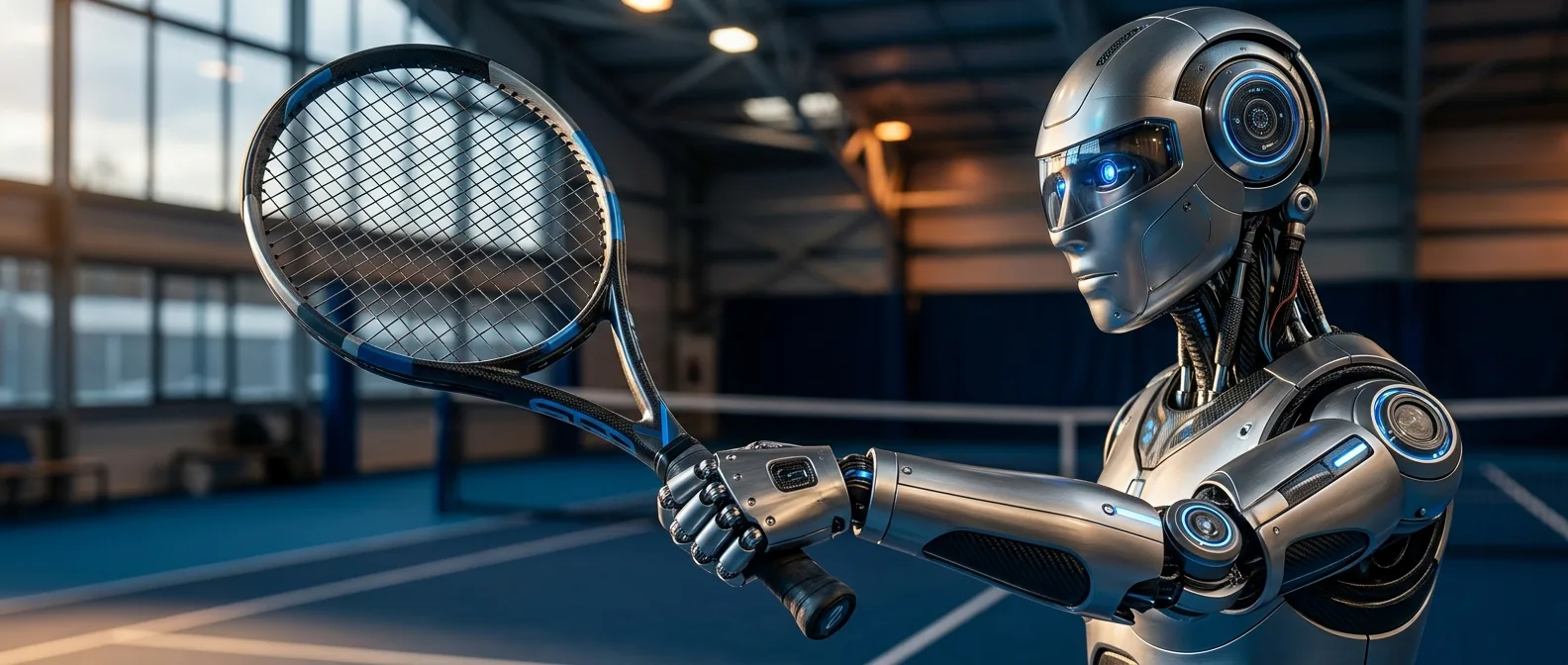
The LATENT system (Learning Athletic humanoid TEnnis skills from imperfect human motioN daTa) turns its back on classical training methods. Instead of perfect motion capture data or complex simulations, it uses "imperfect" movements from amateur players. The results surprised even the researchers.
🎾 How Tennis Training Works with "Broken" Data
Traditional robotics demanded flawless motion data. High-resolution cameras, body sensors, precise mapping of every muscle. If something was missing or flawed — game over.
LATENT changes this philosophy. It takes roughly 5 hours of motion capture from amateurs — not professionals — and learns the basics: forehand, backhand, lateral movements, crossover steps.
The breakthrough lies in the "latent action space." Imagine a space where all basic movements exist as building blocks. The robot doesn't blindly copy — it combines, adapts, improves.
Using reinforcement learning in high-speed simulations, the system explores thousands of variations. Which angle works better? When to use backhand instead of forehand? All this — without ever seeing "perfect" execution.
The Numbers Don't Lie
The Unitree G1 humanoid robot they used for testing returned balls with 96.5% accuracy on forehand shots. Backhand? Just over 80%. These aren't simulation numbers — they're real measurements on actual courts, with real opponents.
⚡ Why This Differs from Previous Robot Tennis Attempts
We've seen robots play ping pong. We've watched Boston Dynamics do parkour. But tennis? Completely different difficulty category.
In ping pong, distances are small, movements fast but limited. In parkour, there's no dynamic opponent. Tennis combines both: large distances, unpredictable ball trajectories, millisecond reaction times.
Previous systems like NVIDIA's Vid2Player3D tried to "read" movements from video footage. Complex, time-consuming, requiring massive technical expertise. LATENT goes elsewhere: less data, more intelligence.
Open Source and Accessible
The researchers did something rare in robotics — they gave everything away for free. LATENT's code is available on GitHub, allowing other teams to experiment and evolve the system.
This practice isn't common, especially for breakthrough technology with commercial applications. But maybe it shows the creators' confidence — or the sense that real value lies in implementation, not ideas.
🔬 The Technology Behind the Success
How exactly does LATENT work? Let's break it into understandable pieces.
First, data collection. Instead of professional tennis players with complex motion capture setups, researchers used "compact" equipment and amateurs. Five hours of movements — forehand, backhand, left-right steps.
"Our method achieves remarkable real-world results and can maintain stable multi-shot rallies with human players"
Zhikai Zhang and research team
Second step: creating the "latent space." Here's the key innovation. The system takes this imperfect data and creates an abstract space where each movement is represented as a point or vector.
Think of it as a giant movement library. The robot doesn't just repeat — it reads, interprets, improvises.
Reinforcement Learning in Action
The third piece is reinforcement learning. Imagine a beginner player trying thousands of shots in simulation. Each successful hit gives "reward," each miss gives "penalty."
The difference? The robot can do this process thousands of times faster than humans. In a few simulation hours, it gains years of experience.
Latent Action Space
Abstract movement representation enabling creative combination of basic skills
Reinforcement Learning
Learning through trial and error across millions of high-speed simulations
🎯 Current Limitations and Future Development
The system has clear limitations. Currently it needs motion capture to function in the real world. Researchers estimate future versions will rely solely on visual data.
Also, the current setup is simplified. The robot returns balls to predetermined spots, doesn't play strategically. To reach "opponent" level will require multi-agent training — robots playing against each other and developing tactics.
What does this mean practically? In a few years, a $12,500 robot could become the best sparring partner you've ever had. Instead of paying a coach $50 per hour, you'd have one available 24/7.
Beyond Tennis Courts
Researchers are clear: LATENT isn't limited to tennis. "The proposed framework has the potential to generalize to a broader range of tasks where complete and high-quality human motion data is not available — such as soccer and parkour."
Robot soccer? Parkour? Maybe even dance or martial arts. The idea that you can teach robots complex skills without "perfect" data creates opportunities across dozens of applications.
🤖 What This Means for 2026 Robotics
We're in a period where humanoid robots are becoming affordable. The Unitree G1 costs less than a decent car. LATENT technology shows we can teach them complex skills without million-dollar equipment.
But let's not get ahead of ourselves. 96.5% forehand accuracy is impressive, but we're still talking controlled conditions. What about wind? Different court surfaces? Opponents who don't just "feed" balls?
The truth: We're still years away from robots beating professional athletes. But progress over the last two years has been stunning.
The interesting part isn't tennis so much as methodology. If you can teach robots athletic skills from "broken" data, what else can you teach? Household tasks from YouTube videos? Surgical techniques from old recordings?
Robotics is moving toward a world where training becomes more accessible, faster, and less dependent on perfect data. What we're seeing on tennis courts might just be the beginning.
🎯 Frequently Asked Questions
Can the robot already beat an average player?
Not yet. The system focuses on returning balls to specific spots, not competitive play with strategy. But it can maintain multi-shot rallies, which is impressive enough for a good training partner.
How much does implementing this technology cost?
The Unitree G1 used costs roughly $12,500. The required motion capture setup is "compact," so significantly cheaper than professional systems. The code is open source, so development costs are minimal.
What other applications could use LATENT?
Researchers mention soccer and parkour as obvious candidates. But the methodology could apply to any skill requiring combination of basic movements — from dance to household chores.