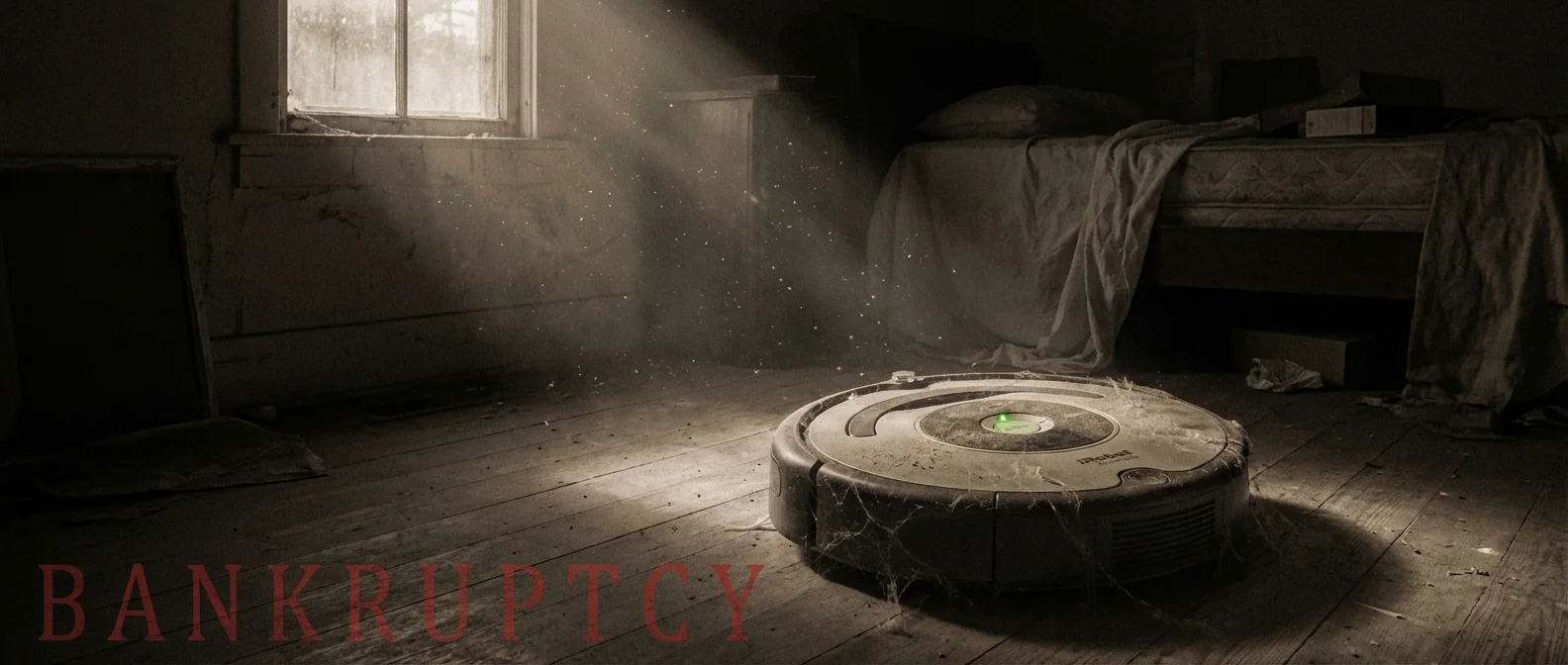
On December 14, 2025, iRobot — the company that put the Roomba robotic vacuum in tens of millions of homes worldwide — filed for Chapter 11 bankruptcy protection. After 35 years of pioneering innovation, the company will be acquired by China's Shenzhen Picea Robotics — ironically, the very manufacturer that had been building Roombas all along. How did it come to this?
📖 Read more: Roborock Saros Z70: The Robot Vacuum With an Arm and Legs
🏫 From a Lab at MIT to Your Living Room
iRobot was founded in 1990 by three researchers from the MIT Artificial Intelligence Lab: Rodney Brooks (a legendary robotics professor), Colin Angle (his student), and Helen Greiner. It started as IS Robotics, Inc. in California, relocated to Massachusetts in 1994, and rebranded as iRobot.
The company's earliest work was military. In 1998 they won a DARPA contract for the PackBot — a bomb-disposal robot. Over 2,000 PackBots were deployed across Iraq and Afghanistan. One even collected radiation data inside Fukushima after the 2011 disaster. The iRobot Seaglider tracked subsea oil plumes after Deepwater Horizon. iRobot was, quite literally, at the frontier of robotics.
But the product that changed everything was the Roomba. Engineer Joe Jones had conceived the idea back in 1989 at MIT, building prototypes from LEGO bricks. Companies like Denning and Bissell turned the concept down in the '90s — nobody believed consumers would buy robot vacuums. Eventually, S.C. Johnson funded the project in 1999 but pulled out after investing just $1–2 million. iRobot pressed on alone. In September 2002, the first Roomba shipped.
By 2004 it had sold 1 million units. By 2020: over 30 million. iRobot went public on NASDAQ in 2005 (ticker: IRBT), acquired Evolution Robotics in 2012 (the Mint floor mopper became the Braava), and sold its military division in 2016 to focus entirely on consumer robotics. The company had single-handedly put the word “Roomba” into the global vocabulary.
💰 The Amazon Deal That Never Was
On August 5, 2022, Amazon announced plans to acquire iRobot for $1.7 billion. The deal looked perfect: Roomba would become part of the Alexa ecosystem, selling at massive scale through Amazon.com.
But regulators disagreed. In September 2022, the US Federal Trade Commission requested additional data, worried about Amazon's market dominance and the privacy implications — Roomba maps users' homes in detail, and that data in Amazon's hands was a troubling prospect.
The timeline of failure:
- June 2023: The UK's CMA clears the deal
- July 2023: The European Commission opens a formal investigation — fearing Amazon would stifle competition
- July 2023: Amazon slashes the offer to $1.42 billion after iRobot takes on $200M in new debt just to survive
- January 2024: The deal is officially abandoned under antitrust pressure from both the EU and US
The fallout was devastating for iRobot. Amazon paid a $94 million reverse breakup fee, but iRobot had already borrowed $200 million just to stay afloat while waiting for approval. 31% of employees were laid off. Co-founder and CEO Colin Angle — who had led the company since its founding — stepped down.
📉 The Downward Spiral
New CEO Gary Cohen took over in May 2024 and inherited a company in freefall. The 2023 numbers were brutal: revenue of $891 million (and falling), a net loss of $305 million, and operating losses of $264 million. With just 1,113 employees — half of what it once had — iRobot was struggling to compete in a market it had essentially invented.
The reason? While iRobot spent 18 months waiting for the Amazon deal to close, Chinese competitors flooded the market. Roborock (backed by Xiaomi), Ecovacs, and other Chinese manufacturers offered robot vacuums with the same or better features at significantly lower prices. Trapped in acquisition limbo, iRobot couldn't invest in innovation or cut prices to compete.
📖 Read more: Chinese Robots: Why China Dominates Humanoid Robotics 2026
Then there was the privacy scandal. In 2020, images captured by development versions of the Roomba J7 — including a photo of a woman on the toilet — were posted to Facebook by Scale AI gig workers in Venezuela. iRobot had shared roughly 2 million images for AI training purposes. MIT Technology Review broke the story. Bad press at the worst possible time.
📜 Bankruptcy: December 14, 2025
On December 14, 2025, iRobot filed for Chapter 11 bankruptcy. This isn't liquidation (that would be Chapter 7) — it's a court-supervised restructuring, with the goal of selling the company to Shenzhen Picea Robotics and Santrum Hong Kong.
The irony runs deep. Picea Robotics is the company that had been manufacturing Roombas for iRobot for years. The factory floor worker buying out the design studio. From the hallowed halls of MIT to the factory floors of Guangdong — and now back to Guangdong for good.
🤔 What Went Wrong?
iRobot's collapse wasn't caused by a single mistake — it was cumulative.
First, the company underestimated Chinese competition. When Roomba launched in 2002, it had the market to itself. By 2020, it had dozens of competitors. Roborock (which went public on Shanghai's STAR Market in 2020, backed by Xiaomi), Ecovacs, and others offered better specs at lower prices.
Second, the pending acquisition froze all strategic decisions. For 18 months (August 2022 – January 2024), iRobot couldn't make any substantial moves — no major investments, no acquisitions, no strategy pivots. It was stuck in limbo while competitors raced ahead.
Third, the premium pricing no longer made sense. The Roomba Combo 10 Max (the 2024 flagship) launched at $1,399. Comparable robot vacuums from Roborock or Ecovacs cost $400–800 with similar or better features.
The 3 Reasons Behind the Fall
- Chinese competition: Roborock, Ecovacs, Dreame — better specs, half the price
- 18 months of paralysis: No meaningful action while waiting for the Amazon deal
- Debt and losses: $200M in new debt + $305M net loss in 2023 alone
🔮 Roomba's Future
The Roomba isn't dying — it's changing hands. Picea Robotics knows the product better than anyone — they've been building it for years. The real question is whether the iRobot brand will retain its premium identity or simply become another Chinese-made product with an American label.
One thing is certain: the iRobot that was born at MIT in 1990, that sent robots into Fukushima, that put a robotic vacuum in tens of millions of living rooms — that iRobot no longer exists. Whatever takes its place will be something different. Better, worse — certainly different.