📖 Read more: Robot Pool Cleaners: Autonomous Water Cleaning in 2026
🚁 From Window Accident to $34M Automation Empire
Andrew Ashur was studying business at Davidson College when he witnessed something that changed his life. Workers cleaning windows on a tall building were fighting unstable equipment in heavy wind. "I immediately realized existing methods expose workers to unnecessary danger," he recalls. That observation birthed Lucid Bots in 2018, but not as a robotics company. Ashur started as a cleaning contractor. For two full years, the company took cleaning contracts to understand what customers actually needed. "We went through trial and error, including minor injuries from cleaning chemicals," the founder admits. The pivot to robotics came in 2020. Five years to sell the first 100 robots. Today they're approaching 1,000 units deployed across the United States. The shift to robotics was deliberate. By working as contractors first, Lucid Bots learned the industry's pain points from the inside. They discovered that most cleaning companies lack the resources to adopt robotics independently.📖 Read more: 5G & Robotics: The Speed That Changes Everything
🤖 Sherpa Drone: The Military-Grade Cleaning Robot
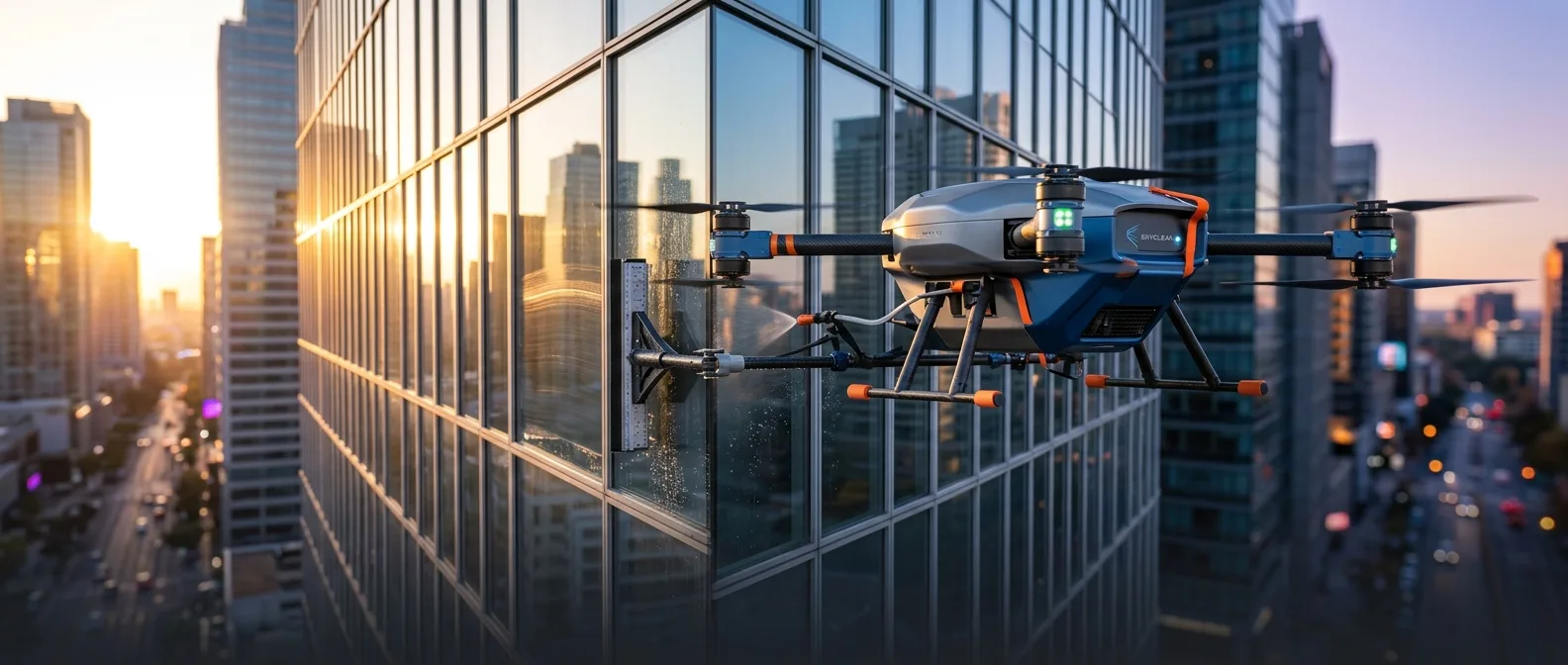
The company's flagship product is the **Sherpa drone** — a machine unlike anything you've seen. It carries high-pressure washing systems up to 4,500 psi and handles flows up to 12 GPM for gentle cleaning. The shocking part? You need just **two hours of online training** to operate it, and setup takes under 10 minutes.Lavo Robot: The 24/7 Ground Worker
Alongside the Sherpa, Lucid Bots developed the **Lavo AI robot** — an autonomous surface washing worker that operates without supervision. Unlike the drone, Lavo is designed for ground-level work and can run continuously, transforming surface work from "low-margin and labor-intensive" into profitable service. The twist? Lavo comes with a mobile app and cloud-based data system. It learns from every job it completes. This ground-based approach tackles a different segment of the cleaning market. While Sherpa handles high-rise and dangerous exterior work, Lavo focuses on large surface areas like parking lots, sidewalks, and building foundations.📊 Lucid Refresh: The Netflix of Cleaning Robots
The business model goes further. Lucid Bots doesn't just want to sell robots — it wants to create a subscription model called **Lucid Refresh**. Think Netflix, but instead of movies you get drones, ground robots, fleet management software, training, and job analysis tools.The model targets the industry's biggest problem: most cleaning companies lack resources to adopt robotics alone. Lucid Refresh gives them access to an entire robotics department without upfront capital investment. This subscription approach solves multiple problems simultaneously. Customers get cutting-edge technology without massive capital expenditure. Lucid Bots gets recurring revenue and deeper customer relationships. The robots get continuous updates and improvements through cloud connectivity."Our customers run cleaning businesses. They don't need a robot — they need a way to take on jobs they couldn't do before"
Vic Pellicano, President of Lucid Bots
The Numbers Don't Lie
Lucid Bots' operator network has generated over $75 million in exterior cleaning revenue. 93% of new business comes from inbound interest — customers find the company themselves. Among them: Disney and Sunbelt Rentals. The company's growth metrics tell a compelling story. From zero to nearly 1,000 deployed units in six years. From cleaning contractor to robotics platform generating eight-figure revenue for its network.📖 Read more: Autonomous Drones 2026: The Evolution of Robotic Flight
🧠 AI That Learns from Real Problems
Lucid Bots' real power isn't the hardware — it's the data. Their systems have logged hundreds of thousands of hours of actual cleaning work. This data continuously trains the robots' AI systems, resulting in improved performance over time. The company is a member of the NVIDIA Inception Program and develops AI capabilities in partnership with NVIDIA. This means access to cutting-edge technology and computational power that would cost millions for a startup to acquire independently. But the really smart part is that every working robot becomes part of a collective "brain." The more machines working, the smarter they all become. This network effect blocks competitors. Competitors starting from scratch face not just the challenge of building hardware, but catching up to years of accumulated operational data.📖 Read more: Edge AI: Robots That Think Without the Cloud
🏭 Made in USA: When Domestic Production Becomes Competitive Advantage
While most tech companies outsource production to Asia, Lucid Bots manufactures all systems in a 25,000-square-foot facility in Charlotte, North Carolina. This isn't accidental — it's strategic. Domestic production gives the company complete control over the production cycle and quality, while making it compliant with federal requirements for American robotics systems. Something that's becoming increasingly important as the U.S. government moves toward "reshoring" critical technologies. The Charlotte facility handles everything from initial assembly to final testing. This vertical integration allows rapid iteration and customization for specific customer needs.The Expansion Paradox
Ashur admits demand has exceeded internal capacity. The company receives more demo requests than it can service. He jokes that even parking space has reached its limits at their factory.
Beyond Cleaning: Expansion into New Markets
Lucid Bots doesn't plan to stay in cleaning. Using the same hardware platform, the company is expanding into painting, waterproofing, and surface sealing. They recently completed waterproofing work at a major university stadium using the same Sherpa frame and software. This "modularity" is perhaps the company's biggest competitive advantage. Instead of building separate robots for each task, they've created a platform that adapts to different applications. The approach reduces development costs while accelerating time-to-market for new services. A single hardware platform with swappable tools and specialized software creates multiple revenue streams from the same core investment.📖 Read more: Exoskeletons: The Robotic Suits Giving Humans Superpowers
💰 The Investors and 2026 Vision
The Series B round raised $20 million with co-leaders Cubit Capital and Idea Fund Partners. Also participating: Taylor Rhodes, WaterStone Impact Fund, and Front Porch Ventures. Total funding reached $34 million — notable for a company that started as a cleaning contractor.Investors point to three converging pressures: aging infrastructure, new more complex construction, and shrinking workforce. Lucid Bots sits at the center of this perfect storm. The funding comes at a crucial time. The robotics industry is maturing beyond proof-of-concept demos toward real commercial applications. Lucid Bots has already proven market demand and operational viability. Ashur describes the next 18 months as "transformative" for the company's product roadmap. The new capital will fund hiring, factory expansion, and acceleration of the RaaS model."The labor crisis in industrial work is real. Lucid has achieved genuine innovation with technology that empowers workers and creates safer workplaces"
Philip Carson, Partner at Cubit Capital