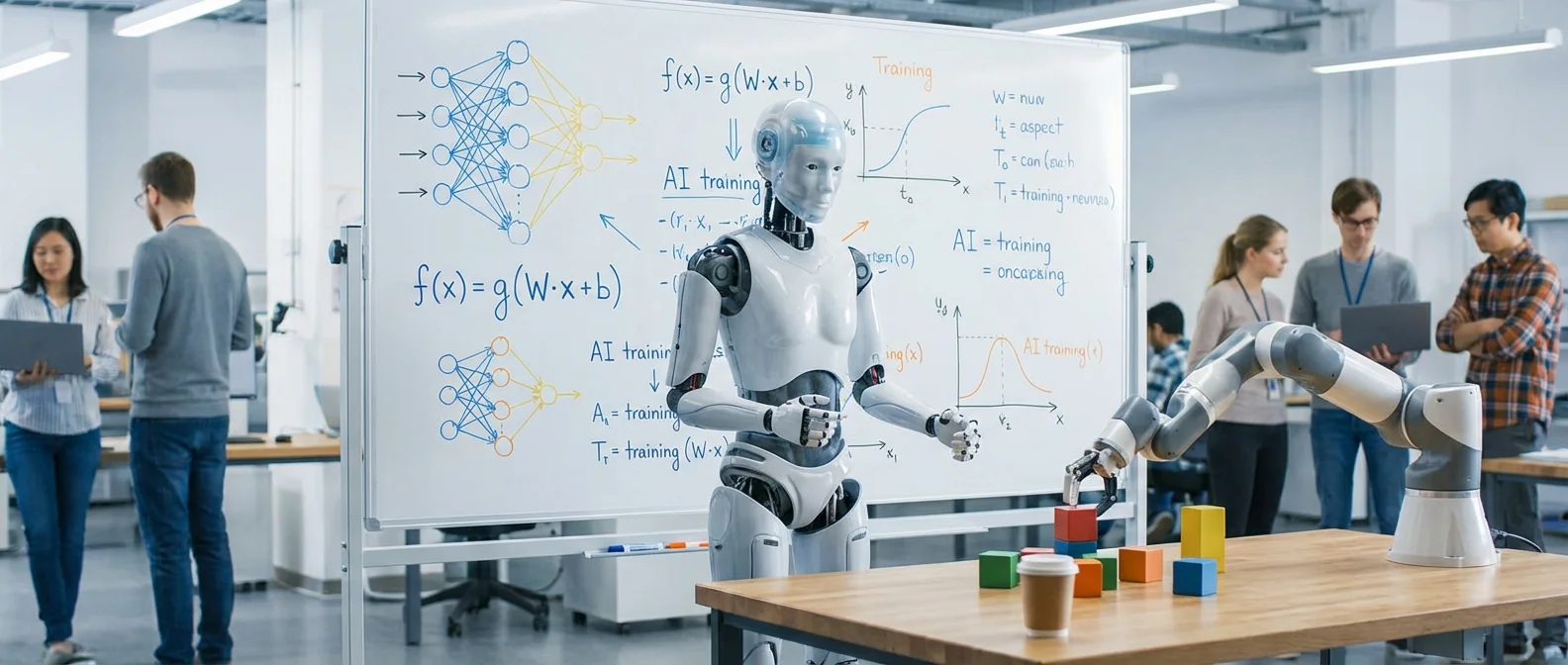
A robot rolls off the assembly line knowing nothing about the world. It can't walk, it can't pick up a glass, it can't avoid an obstacle. A few hours later, after millions of virtual trials in a simulated environment, it executes precise movements as if it were born knowing them. That's the power of machine learning in robotics — and it's changing everything.
📖 Read more: ChatGPT in Robots: The AI Brain Controlling Machines
From the first hard-coded factory robots of the 1960s that followed strict programs, we've reached machines that teach themselves through trial and error, by watching humans, or even by reading instructions in plain language. In this comprehensive guide, we explore the core machine learning methods making robots smarter than ever before.
What Is Machine Learning in Robotics?
Machine learning (ML) is one of the three foundational pillars of artificial intelligence, alongside supervised learning and unsupervised learning. In robotics, ML isn't just about recognizing images or analyzing data — it's about giving a physical machine the ability to acquire new skills through experience.
The physical embodiment of a robot creates unique challenges: high dimensionality (dozens of joints), real-time constraints, physical uncertainty (friction, gravity, material elasticity). At the same time, those very physical properties provide sensorimotor synergies that can actually help the learning process.
Reinforcement Learning: Learning Through Trial and Error
How It Works
In reinforcement learning (RL), an agent interacts with an environment in discrete steps. At each step, it receives a state, performs an action, and receives a reward. The goal: learn a policy that maximizes cumulative reward. Mathematically, it's modeled as a Markov Decision Process (MDP) with state space S, action space A, transition probabilities P, and reward function R.
The critical dilemma: exploration vs. exploitation. Should the robot try new actions (exploration) or stick with what it already knows works (exploitation)? The simplest approach is ε-greedy: with probability ε it tries something random; otherwise, it does whatever it “believes” is best.
Core RL Algorithms
| Algorithm | Type | Action Space | Key Features |
|---|---|---|---|
| Q-Learning | Off-policy | Discrete | Foundational algorithm, Watkins 1989 |
| DQN | Off-policy | Discrete | Neural network-based — Atari games, DeepMind 2015 |
| PPO | On-policy | Continuous/Discrete | Most popular today, used in RLHF |
| SAC | Off-policy | Continuous | Soft Actor-Critic, ideal for robotics |
| DDPG | Off-policy | Continuous | Deterministic policy gradient |
| TD3 | Off-policy | Continuous | Twin Delayed — improved DDPG |
In robotics, RL has enabled robotic hands to solve Rubik's Cubes (OpenAI, 2019, using massive domain randomization), quadruped robots to run over rough terrain, and drones to navigate dense forests. The catch: sample inefficiency — it takes millions of trials before the agent learns anything useful.
Imitation Learning: Learning by Watching
Learning from Demonstration
Instead of searching for the right actions on its own, the robot observes an expert (usually a human) and tries to mimic their behavior. This is called imitation learning or “learning from demonstration.” Demonstrations are recorded as state-action pairs (observation, action) from human teleoperation.
📖 Read more: Tesla Optimus Gen 3: When Is It Hitting the Market?
The most basic form is Behavior Cloning (BC): it uses supervised learning to train a policy so that, given an observation, it outputs an action similar to the expert's. It was first applied to ALVINN (1988), a neural network that drove a van using human demonstrations. The downside: distribution shift — if the robot strays even slightly from the “correct” trajectory, it doesn't know how to recover.
DAgger (Dataset Aggregation) solves this problem. In each iteration, the robot executes its learned policy, the expert provides the “correct” actions at each point, and the data is added to the training dataset. This iterative refinement produces much more robust policies.
More recently, the Decision Transformer (2021) reframes RL as a sequence modeling problem. It uses a Transformer trained on triplets (reward, observation, action) and during inference accepts a high expected reward, outputting actions that would lead to it. With 1 billion parameters, it achieved superhuman performance on 41 Atari games.
Sim-to-Real Transfer: From Virtual to Physical World
Why should a robot learn in the real world — risking damage, slow trials, and massive costs — when it can learn in a simulation? This idea is called sim-to-real transfer and it's the backbone of modern robot learning.
Domain Randomization
The biggest challenge: the reality gap. Simulation doesn't perfectly replicate the real world (friction, lighting, material properties). The solution: domain randomization — randomizing a vast number of parameters (lighting, colors, mass, friction, response times) so the agent learns a policy robust enough to work in the real world too.
Landmark example: OpenAI trained a robotic hand to solve a Rubik's Cube (2019) entirely in simulation with massive domain randomization. The agent never “knew” what world it would face — which is precisely why it generalized so well.
Platforms like NVIDIA Isaac Sim, MuJoCo, PyBullet, and Gazebo provide photorealistic physics-based simulation. NVIDIA Isaac specifically uses GPU-accelerated ray tracing for photorealistic visuals that dramatically reduce the reality gap. Researchers estimate that robots trained via sim-to-real learn 100–1,000x faster than in real environments.
Vision-Language-Action Models (VLAs): The 2023–2026 Revolution
The most impressive development in robot learning is VLA models — foundation models that combine vision, language, and action. They take a camera image and a natural language instruction ("Pick up the red cup") and directly output motor commands for the robot's joints.
📖 Read more: 5G & Robotics: The Speed That Changes Everything
| Model | Creator | Year | Key Features |
|---|---|---|---|
| RT-2 | Google DeepMind | 2023 | First VLA, fine-tuned PaLI-X/PaLM-E, chain-of-thought reasoning |
| OpenVLA | Stanford | 2024 | 7B params, open-source, Open X-Embodiment, outperforms RT-2 |
| Octo | UC Berkeley | 2024 | 27M–93M params, diffusion policy, lightweight |
| π0 | Physical Intelligence | 2024 | Flow-matching, 50 Hz continuous actions, 8 embodiments |
| Helix | Figure AI | 2025 | First humanoid VLA, dual-system, ~500 hours of teleoperation |
| GR00T N1 | NVIDIA | 2025 | Humanoid dual-system, heterogeneous data, synthetic datasets |
| Gemini Robotics | Google DeepMind | 2025 | Built on Gemini 2.0, origami folding, On-Device version |
| SmolVLA | Hugging Face | 2025 | 450M params, open-source, LeRobot community data |
VLA architecture follows two stages: first, a pre-trained Vision-Language Model (VLM) encodes images and language instructions into latent tokens. Then an action decoder converts those tokens into motor commands — typically 6-DoF displacement plus a gripper. Two architectural approaches: single-system (one unified network — RT-2, OpenVLA, π0) and dual-system (separate VLM + motor policy — Helix, GR00T N1).
Knowledge Sharing Between Robots
What if a robot could learn something once and share it with every robot on the planet? This idea — cloud robotics — is becoming reality:
- RoboBrain (Stanford): A freely accessible knowledge engine. It gathers information from the internet, natural language, images, video, and object recognition.
- RoboEarth (EU): A “Wikipedia for robots” — a network and database where robots share experiences. Five universities across Germany, the Netherlands, and Spain.
- Google DeepMind: Google's robots already share experiences among themselves, allowing a robot in London to benefit from something a robot learned in Mountain View.
- Million Object Challenge (Tellex): Robots learn to spot and handle objects, uploading data to the cloud so other robots can use it.
Milestones in Robot Learning
Comparing Learning Methods
| Method | Strengths | Weaknesses | Best For |
|---|---|---|---|
| Reinforcement Learning | Discovers novel strategies | Slow, requires millions of trials | Locomotion, games, exploration |
| Imitation Learning | Fast, leverages human knowledge | Distribution shift, needs demos | Manipulation, teleoperation |
| Sim-to-Real | Safe, parallelizable, cheap | Reality gap, imperfect physics | Large-scale training |
| VLA Models | Generalized, natural language, transfer | Large model, slow inference | Multi-task, generalist robot agents |
| Cloud Robotics | Shared knowledge, scalable | Connectivity dependency, latency | Fleet learning, warehouses |
Challenges and the Road Ahead
Despite tremendous progress, robot learning still faces significant hurdles:
- Sample Inefficiency: RL models need billions of steps in simulation. OpenAI used thousands of years of simulated gameplay just for Dota 2.
- Generalization: A robot trained to grab cups struggles with bottles. Knowledge transfer across tasks remains a challenge.
- Safety: A robot learning through trial and error can make dangerous moves. Safe RL (imposing safety constraints during learning) is an active research field.
- Reward Hacking: The robot finds loopholes in the reward function. Instead of picking up an object, it learns to “hide” its mistakes from the sensors.
- Real-Time Constraints: A humanoid must decide in milliseconds. Large VLA models with billions of parameters need inference optimization (e.g., Gemini Robotics On-Device, SmolVLA's 450M parameters).
The era when every robot needed separate software for every motion is over. Machine learning gives robots something that until recently was exclusively human: the ability to learn from their mistakes, improve with every failure, and adapt to worlds they've never seen before. From Watkins' first Q-tables in 1989 to the generalist VLAs of 2025 that control entire humanoid bodies, the progress is staggering — but we're just getting started.