📖 Read more: SoftBank's Trillion-Dollar Bet on Robotics and AI
🤖 Physical AI: When Artificial Intelligence Learns to Move
Physical AI marks a departure from pure software intelligence. Instead of thinking about AI as a digital entity processing data, NVIDIA proposes systems that perceive, reason, and act in the real world.Think of it this way: a chatbot knows how to describe changing a tire, but Physical AI can actually change one.
The Challenge of Touch and Manipulation
One of the biggest technical barriers remains object handling. As Amazon Robotics' Tye Brady describes it, manipulation is the "holy grail" of robotics. Humans instinctively estimate the weight of a glass of water, perceive its texture, and adjust their grip accordingly. Robots need explicit simulation for weight estimation, slip detection, and contextual reasoning. Developing advanced tactile sensors that provide real-time feedback is key to transitioning from stereotypical movements to adaptive interactions.📖 Read more: Chinese Robots: Why China Dominates Humanoid Robotics 2026
🚶 Humanoid Robots: From Science Fiction to Production Line
Humanoid robots are perhaps the most impressive physical proof of this new era. What was once confined to research labs and futuristic concepts now demonstrates reliability and efficiency in practical applications.Boston Dynamics and Practical Application
Boston Dynamics, in partnership with Hyundai, is moving forward with the production version of the redesigned Atlas robot. After recognition as Best Robot at CES 2026, Atlas is scheduled for deployments in industrial environments, particularly at Hyundai facilities. What's changing isn't just the technology — it's the approach. Humanoids are now designed as force multipliers for human workforces, not replacements. They handle tasks like material handling, inspection support, and intra-factory transport in environments designed for humans.Promise vs. Reality
Despite progress, Rodney Brooks — a recognized figure in robotics — remains skeptical. In his late 2025 essays, he argued that deployable dexterity will remain "pathetic" compared to human hands at least until the mid-2030s. He predicts that billions flowing into humanoid startups will lose most of their value. This divide stems from fundamentally different views on robotics development. Where Jensen Huang sees humanoids as part of a general "Physical AI" banner that will scale quickly, Brooks insists on incremental, domain-specific machines with tightly scoped tasks.📖 Read more: Physical AI: What It Is and Why It Matters in 2026
🔬 Simulation-to-Reality: Virtual Becomes Real
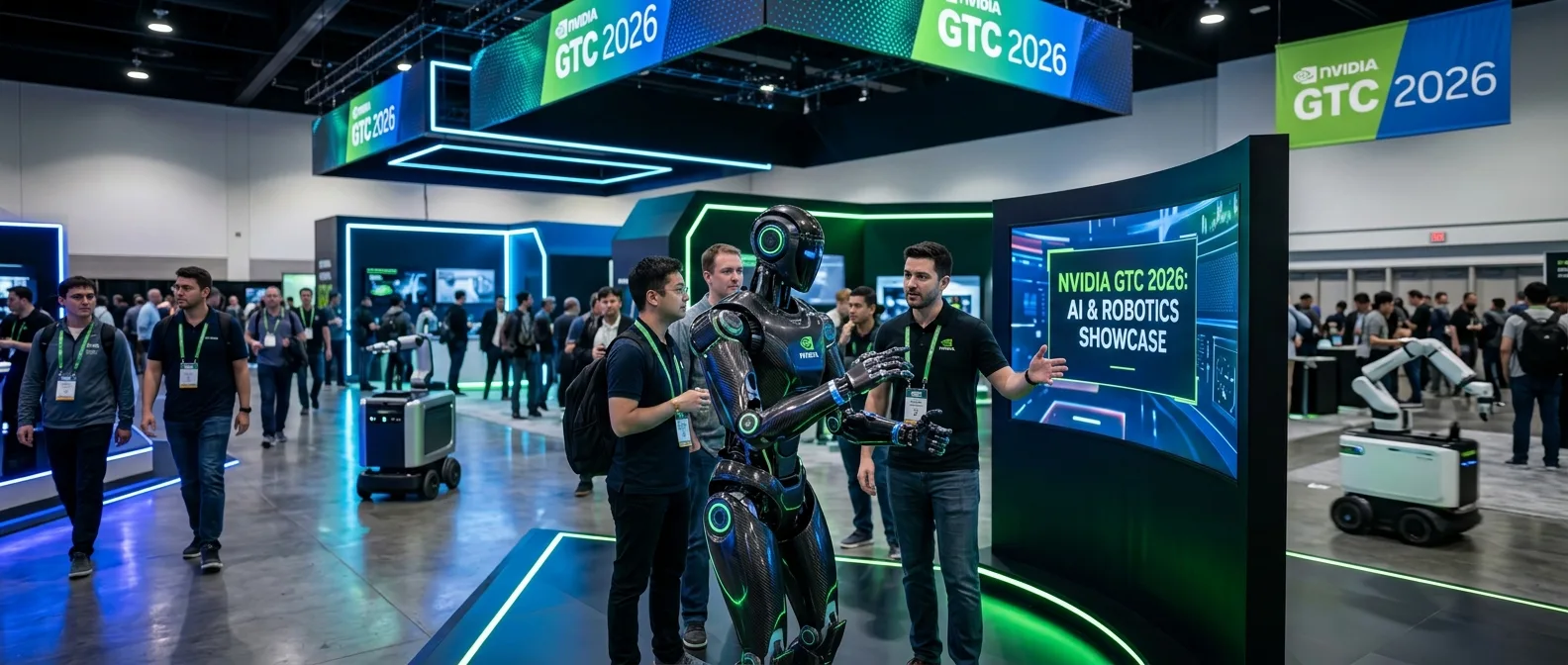
The third trend emerging from GTC 2026 is the evolution of simulation technologies. NVIDIA positions simulation not simply as a visualization tool, but as the primary training ground for Physical AI.The Olaf robot demo was the highlight of this approach. An animated character with Jetson in its "stomach," which learned to walk entirely within Omniverse. The demonstration validated Huang's theory that synthetic environments plus massive compute can bootstrap real-world skills."The most significant thing we witnessed on stage wasn't the robots, but that everything — from humanoids to animated figures — had learned and coordinated entirely through simulation."
Analysis from Tom's Guide
IT/OT Convergence and New Flexibility
A critical enabler of these developments is the accelerating convergence of Information Technology (IT) and Operational Technology (OT). This merger significantly enhances robotics versatility, integrating IT's data-processing prowess with OT's physical control capabilities.Real-time Data Exchange
Continuous data flow between digital and physical worlds
Advanced Analytics
Predictive maintenance and resource optimization
Seamless Automation
Unified systems that adapt in real-time
The Gap Between Simulation and Reality
Despite progress, the simulation-to-reality gap remains a challenge. The dramatic reduction of this gap — as referenced in analysis — doesn't mean complete elimination. Virtual environments can simulate physical and mechanical behavior, but real-world unpredictability (pets, children, dynamic layouts) requires level risk assessment that continues to develop.📖 Read more: Robotics in Greece: Startups Leading Innovation
🎯 Frequently Asked Questions
What exactly is NVIDIA's Physical AI?
Physical AI represents the convergence of digital intelligence with physical actuation. Instead of robots following programmed routines, it creates systems that perceive, reason, and act adaptively in the real world.
When will we see humanoid robots in our homes?
While industrial use is accelerating, highly capable humanoids remain expensive for widespread consumer adoption. Estimates speak of an "innovation curve" that will drastically reduce costs, similar to smartphone evolution. Realistically, mass home use likely after 2030.
How safe are modern robots for human collaboration?
Safety and security are primary concerns. As robots operate increasingly autonomously, ensuring safe interaction is critical. AI-driven systems complicate testing and validation, requiring robust governance frameworks and cybersecurity strategies for cloud-connected systems.
Robotics in 2026 is no longer about technological demos but industrial strategy. NVIDIA appears determined to do for embodied AI what it did for GPU-accelerated deep learning: define the default stack, convince investors and industry that the market is infrastructure-scale, and direct capital and research toward large-scale simulated training and cloud-connected robots. The stakes are high. If this narrative prevails, we'll see aggressive investment in platforms that treat robots as inference endpoints for datacenter-trained world models — possibly at the expense of more heterogeneous, smaller-scale, or non-cloud-centric approaches. This divide between optimists like Huang and skeptics like Brooks will determine where billions in robotics investment flows.