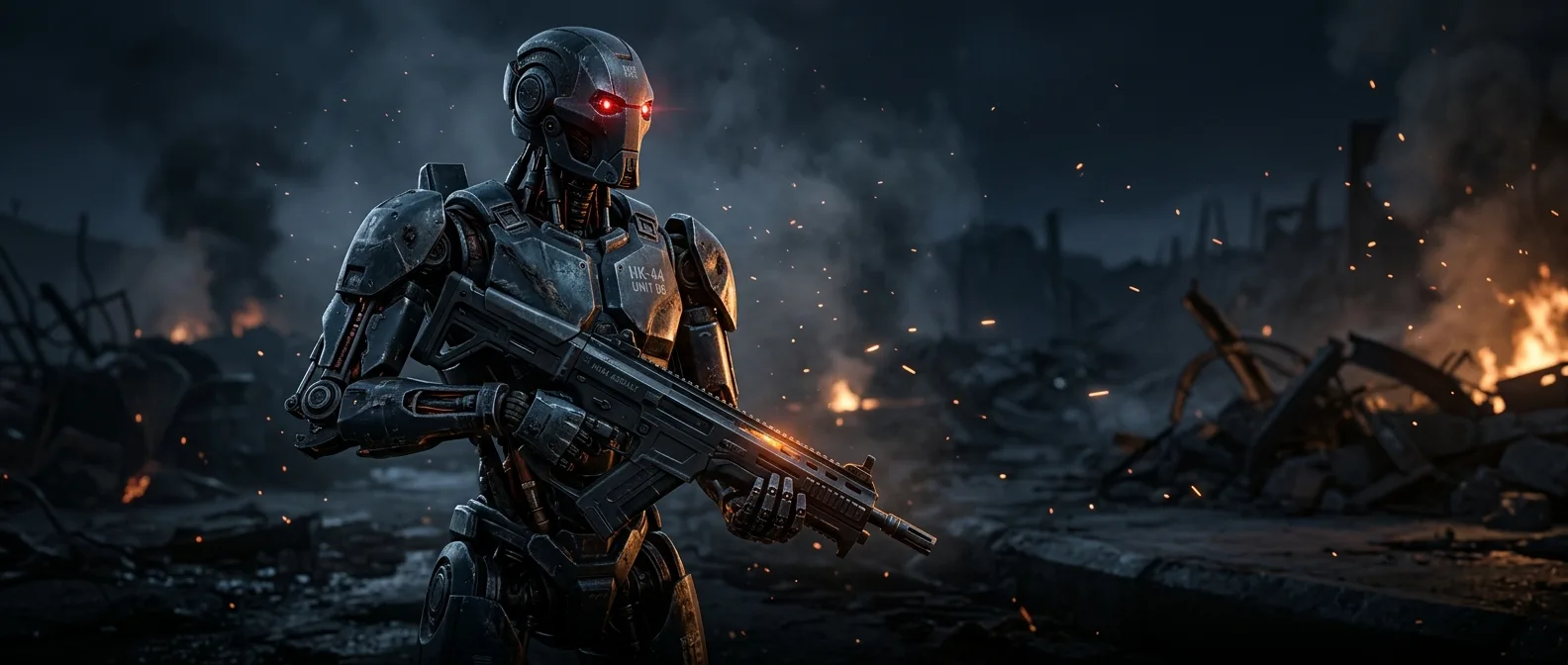
Two Phantom MK-1 robots hit Ukrainian frontlines in February 2026. Black chassis, polished steel, and an arsenal that would make the Terminator look outdated. Foundation claims it has a moral duty to send these machines to war instead of soldiers. The question is: how ready are we for a world where machines make life-and-death decisions in milliseconds?
Wars used to require humans willing to die. That basic fact shaped everything — from recruitment to public support to the political calculus of starting conflicts. Robot soldiers change that equation completely. When machines can fight without fear, fatigue, or families back home, the barriers to warfare collapse. What we're witnessing in Ukraine represents conflict where the human cost that once served as war's natural brake no longer applies. The Phantom MK-1 operates in a reality where autonomous weapons make tactical decisions faster than human oversight can follow. Foundation's humanoid robot can handle any weapon a human soldier can carry, operates continuously without rest, and resists radiation, chemical, and biological attacks. On paper, it delivers the perfect warrior.📖 Read more: Robot Ethics: Should Machines Have Rights?
🤖 Foundation's Phantom MK-1: The New Face of Robot Soldiers
Mike LeBlanc isn't your typical Silicon Valley founder. Fourteen years as a Marine, over 300 combat engagements, and now co-founder of Foundation — the company behind the Phantom MK-1. With $24 million in research contracts from the U.S. military, the Phantom has moved beyond prototypes into real-world testing in Ukraine's war zones. "We believe there's a moral imperative to put these robots in harm's way instead of soldiers," LeBlanc says. The logic sounds compelling — why risk human lives when machines can take the bullets? But this reasoning glosses over a fundamental shift in how wars start and end.The Phantom MK-1 mimics human thermal signatures, operates without fatigue, and can handle standard military weapons. Two units underwent field testing in Ukraine, marking the first deployment of humanoid military AI in active combat.
What LeBlanc witnessed in Ukraine shocked him: "It's a full robot war, where the robot is the primary fighter and humans are in support roles." Ukraine launches over 9,000 drones daily, while uncrewed ground vehicles (UGVs) have begun taking prisoners and engaging Russian forces without human intervention. Oleksandr Afanasiev from the British K-2 squadron — the world's first UGV unit — explains the tactical advantage: "They open fire in battlefields where infantry would be afraid to appear. But a UGV is willing to risk its existence."350,000 Deaths in Ukraine over 5 years
9,000 Daily drone launches by Ukraine
📖 Read more: Boston Dynamics Atlas: Robot Does Parkour Better Than Humans
⚡ The Accountability Problem in Autonomous Weapons
The consequences become clear. When you remove human soldiers from warfare, you remove the last internal resistance that makes governments hesitate before starting conflicts. Wars are politically expensive precisely because they're physically expensive — soldiers die, families grieve, and that unbearable cost acts as a brake on military action. Robot soldiers eliminate that friction. Machines don't have mothers. They don't vote. They don't come home with PTSD and tell uncomfortable stories about what they witnessed. The political cost of war drops dramatically when the human cost disappears.Who's Responsible When Algorithms Kill?
When an algorithm kills a civilian in split-second decision-making, who bears responsibility? The accountability diffuses across software engineers, procurement offices, training datasets, and command chains that were technically "in the loop" but in the way a driver is in the loop when their car's autopilot runs a red light.The training data problem creates systemic issues. Military AI systems learn to distinguish combatants from civilians by consuming historical conflict data. If that data contains systemic biases — and how could it not? — the AI learns those same patterns. Only now it applies them to far more decisions, far faster than any human oversight could correct."These machines are not moral or legal agents, and they will never understand the ethical consequences of their actions"
Peter Asaro, International Committee for Robot Arms Control
The Speed Problem
Modern autonomous weapons operate on machine time, not human time. When engagement happens in milliseconds and machines never asked if they're willing to die for something, the pressure for preemptive strikes becomes overwhelming. The window for diplomacy closes before diplomats even start talking.🎯 The New Cold War: Machine vs Machine
The U.S. isn't alone in this race. Russia and China are developing their own humanoid soldiers, creating an arms race that makes all previous ones look quaint. The logic of mutual deterrence that at least provided decades of anxious stability during the Cold War doesn't translate easily to these autonomous systems.Phantom MK-1 (USA)
Humanoid robot for military applications, field-tested in Ukraine
Kuryer (Russia)
UGV with flamethrower and heavy machine gun, 5-hour autonomy
📖 Read more: DJI Romo: The Drone Giant's First Robot Vacuum
🔬 Technical Challenges and Hacking Risks
Despite the science fiction appeal, humanoid robots face significant limitations. They're heavy, expensive, require regular charging, and will likely break down. How will they handle mud, dust, and torrential rain? Humanoid movement relies on roughly 20 motors, each requiring power and vulnerable to simple malfunctions. Captured drones already provide significant intelligence to enemies. A hacked humanoid soldier presents an entirely new category of risk. An adversary could potentially control a robot fleet through software backdoors, turning an army against its own creators.The Recognition Problem
If a child runs toward you holding open scissors, it's intuitive for humans that the threat level is minimal. Will embedded AI feel the same way? Or, examining the question more fundamentally, does it feel anything at all? These recognition challenges multiply in complex environments. Urban warfare, civilian populations, cultural contexts — all present scenarios where human judgment evolved over millennia to make nuanced distinctions that current AI simply cannot replicate.📖 Read more: Ecovacs vs Roborock: Which Robot Vacuum Wins in 2026?
⚡ The Race to Full Autonomy
In Silicon Valley, Scout AI works to merge AI with existing U.S. weapons systems. In February, they conducted tests where seven AI agents planned and executed coordinated attacks without further human intervention. "There are agents that can replace the entire kill chain," says Scout AI CEO Colby Adcock.Ukraine expects to order approximately 40,000 UGVs in 2026, with 10-15% being armed. Tencore's Maksym Vasylchenko believes future robots will fight in human form: "It won't be science fiction anymore."
The progression toward full autonomy seems inevitable. Each incremental step — better target recognition, faster decision-making, reduced human oversight — brings us closer to weapons that operate entirely without human control. The question isn't whether this technology will advance, but whether we can maintain meaningful human control over life-and-death decisions.