📖 Read more: Robot Lawn Mowers 2026: Autonomous Garden Care
🏠 The Problem Nobody Could Solve
The idea of an autonomous robotic vacuum dates back to the late 1980s, when engineer Joe Jones at MIT began experimenting with prototypes built from LEGO bricks. That concept eventually made its way to iRobot, which unveiled the first Roomba in September 2002. From the very earliest models, the vacuum was equipped with infrared “cliff sensors” that detected edges — preventing it from tumbling down staircases but also making stairs an impenetrable barrier.
This was a logical design choice. A disc weighing 3–4 kilograms, standing just 9 centimeters tall, with no legs or tracks, simply cannot conquer a stair riser measuring 18–20 centimeters. Physics is unforgiving. For two decades, every manufacturer — iRobot, Roborock, Ecovacs, Dreame, Samsung, Neato — designed exclusively for flat floors.
The practical consequence? A two-story home needed two robots, two charging docks, two separate mapping configurations. The setup worked, but it was expensive — and it hardly earned the label “truly autonomous.” A genuinely autonomous cleaning robot should be able to tackle the entire home, regardless of how many levels it has.
📜 The Evolution: From Random Algorithms to LiDAR
Before the industry could address the stair problem, it first had to solve more fundamental challenges: navigation, mapping, and obstacle avoidance.
The earliest Roombas had no map at all. They relied on random algorithms — a philosophy championed by MIT's Rodney Brooks, who believed robots should behave like insects, equipped with simple control mechanisms tuned to their environments. The approach worked, but it was slow: cleaning took many times longer than doing it by hand.
The first major breakthrough came in 2010, when Neato Robotics introduced the XV-11 with a built-in laser scanner. It was the first robot vacuum to create a real-time room map using LiDAR technology. This enabled systematic back-and-forth cleaning — faster, more efficient, and with no redundant passes.
iRobot responded in 2015 with the Roomba 980, which used an upward-facing camera and an optical floor-tracking sensor — a system called vSLAM (visual Simultaneous Localization and Mapping). Instead of lasers, it identified landmarks on the ceiling to correct positional errors. Cheaper to produce, but equally effective.
Roborock, founded in 2014 in Beijing with backing from Xiaomi, combined both approaches: LiDAR for room mapping AND an RGB camera with 3D structured light (ReactiveAI 2.0) for recognizing objects on the floor — socks, cables, pet toys. The company went public in 2020 with a $640 million valuation, and by early 2025, the Roborock S7 had already earned the "Time Best Inventions 2021″ distinction.
In China, Ecovacs Robotics (founded 1998) had captured over 60% of the domestic robot vacuum market by 2013. By early 2023, its market capitalization reached $6.38 billion — roughly five times that of iRobot.
🦾 The Robotic Arm: A First Step Toward the Stairs
In January 2025, at CES, Roborock unveiled the Saros lineup. The Saros 10 came equipped with something unprecedented: an extending robotic arm (the OmniGrip system) capable of picking up small objects from the floor — socks, small toys — and moving them out of the way before cleaning.
It wasn't stair climbing, but it was the first time a consumer robot vacuum physically interacted with its environment beyond just cleaning. The arm uses a gripping mechanism with pressure sensors to lift objects weighing up to 300 grams. The significance wasn't just practical — it proved that robot vacuums can acquire hands.
Around the same time at CES 2025, Dreame showcased home-cleaning robot prototypes equipped with mechanical legs — designed to climb over low obstacles and, potentially, stair risers. The technology was in its early stages, but the direction was unmistakable: the industry is moving toward robots that aren't confined to a single level.
🚀 Roborock Saros Rover: The First Commercial Attempt
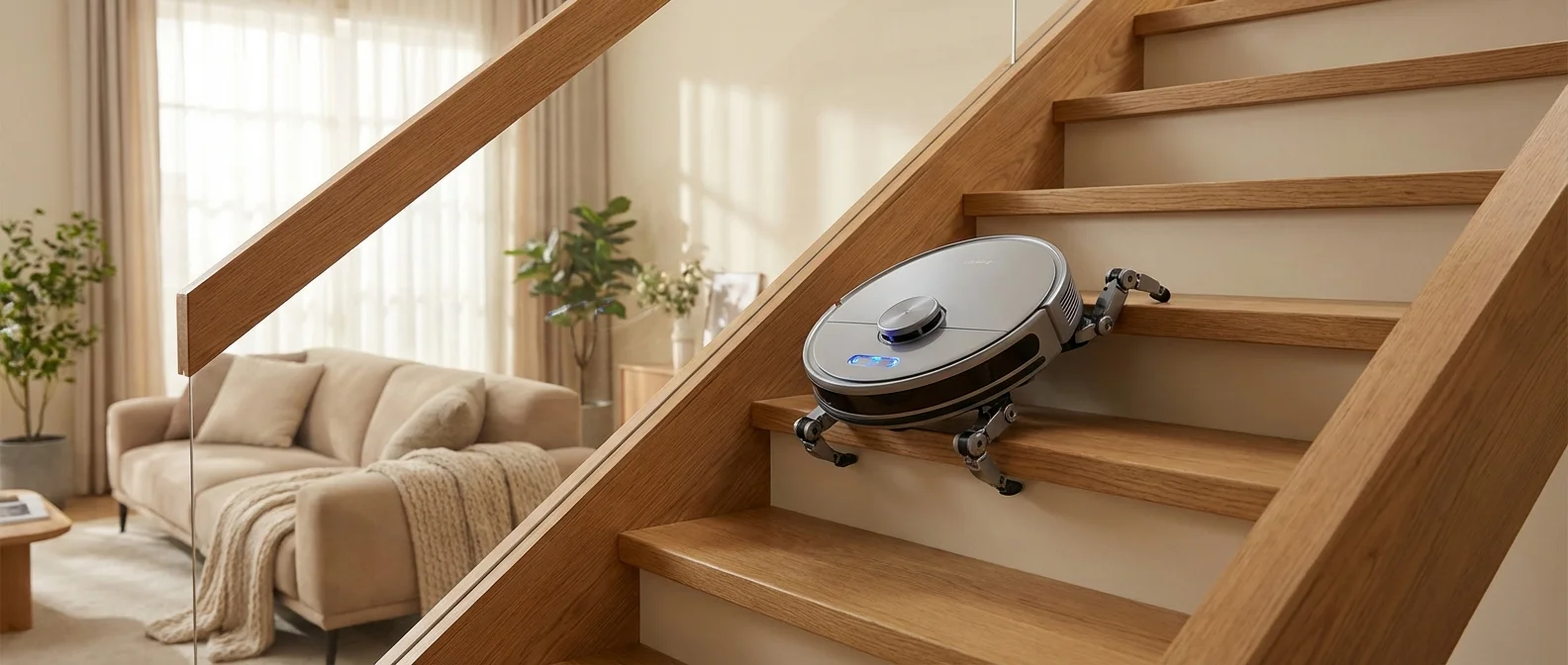
Following the Saros 10, Roborock announced the Saros Rover — a model specifically engineered for stair climbing. The company, generating over 4.5 billion CNY (approximately $620 million) in annual revenue, invested heavily in multi-level mobility research.
Based on published specifications, the Saros Rover features:
- Four articulated legs with small rubber wheels at each tip — they extend only when approaching a staircase
- LiDAR + RGB camera for three-dimensional staircase mapping — detecting the height, width, and number of steps
- Gyroscope and accelerometer for stabilization during transitions — preventing tipping on angled risers
- Enhanced suction system that activates autonomously after each climb to remove dust accumulated during the transition
- High-capacity LiFePO4 battery to handle the increased energy consumption of climbing
The climbing process takes roughly 15–20 seconds per step. On a typical 12-step staircase, moving between floors takes about 3–4 minutes. It's not fast, but it's practical — especially when the alternative is carrying the vacuum yourself.
Why Stair Climbing Is So Difficult
A typical robot vacuum weighs 3.5–4.5 kilograms. A standard stair riser is 18–20 centimeters high. To climb, the vacuum must lift its entire weight across a vertical distance 4–5 times its own height. Beyond raw power, it also needs:
- Precise geometry detection for each individual step
- Stabilization during the climb (especially in narrow stairwells)
- Fail-safes to prevent falls if the battery runs out mid-climb
- Durability of mechanical components under repeated stress
📊 The Robot Vacuum Market: By the Numbers
To appreciate the significance of this development, consider the scale of the market. According to iRobot's own data, by 2016 fully 20% of all vacuum cleaners sold worldwide were robotic models. iRobot, which launched the first Roomba in September 2002 and has now reached its 10th product generation by early 2025, has sold tens of millions of units globally.
The ambitious newcomer, Roborock, started only in 2014 in Beijing. In just six years, it went public with a $640 million valuation. Today, with annual revenues of 4.5 billion CNY, it ranks among the most dynamic players in the space.
📖 Read more: SwitchBot Onero H1: The Humanoid That Does Your Laundry
In this landscape, stair-climbing capability could be an enormous competitive advantage. A single robot that cleans an entire home replaces two or three separate units — a value proposition that easily justifies a significantly higher price tag.
🏡 What This Means for Multi-Level Homes
Multi-story living is extremely common worldwide, but certain markets stand to benefit even more. In Greece, for example, a large proportion of residences — single-family homes, maisonettes, and traditional houses — span multiple levels. Island homes, neoclassical apartment buildings, and urban maisonettes frequently have two or three floors connected by stairs.
Until now, these households faced a dilemma: buy multiple robot vacuums (€600–1,200 each for premium models) or use the robot on one floor and clean the rest with a traditional vacuum. Either way, the promise of full automation remained unfulfilled.
A robot like the Saros Rover could change that equation entirely. Naturally, the initial price will be premium — likely €1,500–2,000. But if it replaces two or three standalone robots, the actual cost per floor drops dramatically.
⚠️ The Obstacles Still Ahead
But this technology comes with real drawbacks that no manufacturer wants to discuss:
Battery life: Stair climbing consumes dramatically more energy than flat-floor cleaning. A typical Roomba draws 30–60 watts during vacuuming. Climbing can demand 100–150 watts due to the elevation motors. This means battery life takes a significant hit on days the robot changes floors.
Noise: Mechanical legs that extend, move, and retract generate additional noise — particularly on marble or tile steps, which are common in Mediterranean and Southern European homes. Sound insulation for these mechanisms is still immature.
Wear and tear: The mechanical components — articulations, servo motors, wheel assemblies — are subject to considerable stress. A robot vacuum that climbs 20 steps daily will need far more frequent maintenance than a conventional model.
Safety: What happens if the battery dies mid-staircase? If the mechanism encounters a cracked step? If the robot tumbles? Safety protocols must be bulletproof — especially in homes with children or elderly residents.
Weight: To accommodate climbing motors, a larger battery, and mechanical legs, the vacuum becomes heavier. Current prototypes weigh 6–7 kilograms — nearly double a conventional model. This impacts energy efficiency even on flat floors.
🔮 What Lies Ahead: 2026–2030
Stair climbing isn't the final chapter of this story — it's just the opening. This evolution opens doors that were previously unthinkable:
Multi-floor autonomy: Robots that map entire buildings, freely moving between floors. The charging dock sits in one location, and the vacuum returns to it on its own regardless of which floor it's currently cleaning.
Smart home integration: Robot vacuums will integrate with Matter/Thread ecosystems, communicating with security cameras, thermostats, and lighting. They'll “know” which floor someone is on and silently clean the unoccupied levels.
Robotic arms: After the Saros 10, robotic arm technology will continue to mature. Dreame showcased extending legs at CES 2025, while Roborock added a gripping arm. In the future, these two capabilities will merge: robots that climb stairs AND pick up objects.
Artificial intelligence: AI drives much of this progress. Current models already use neural networks for object recognition (the Roomba j7 identifies pet waste, cables, shoes). The same technology will be trained to recognize stair types, slip hazards, and optimal climbing paths.
🏁 The New Era Begins
Twenty-four years after the first Roomba, the robot vacuum is becoming more than “a disc that roams around the floor.” The addition of legs, arms, and AI mapping transforms these devices into genuinely autonomous home robots.
Roborock, Dreame, iRobot, and Ecovacs are locked in an open race. The first manufacturer to deliver a reliable, affordably priced stair-climbing vacuum will secure a massive competitive edge — and redefine what “robotic home cleaning” actually means.
For anyone tired of carrying their vacuum upstairs, the wait is nearly over.