📖 Read more: Humanoid Robots at CES 2026: The Highlights
🔴 Perseverance: The Life Hunter on Mars
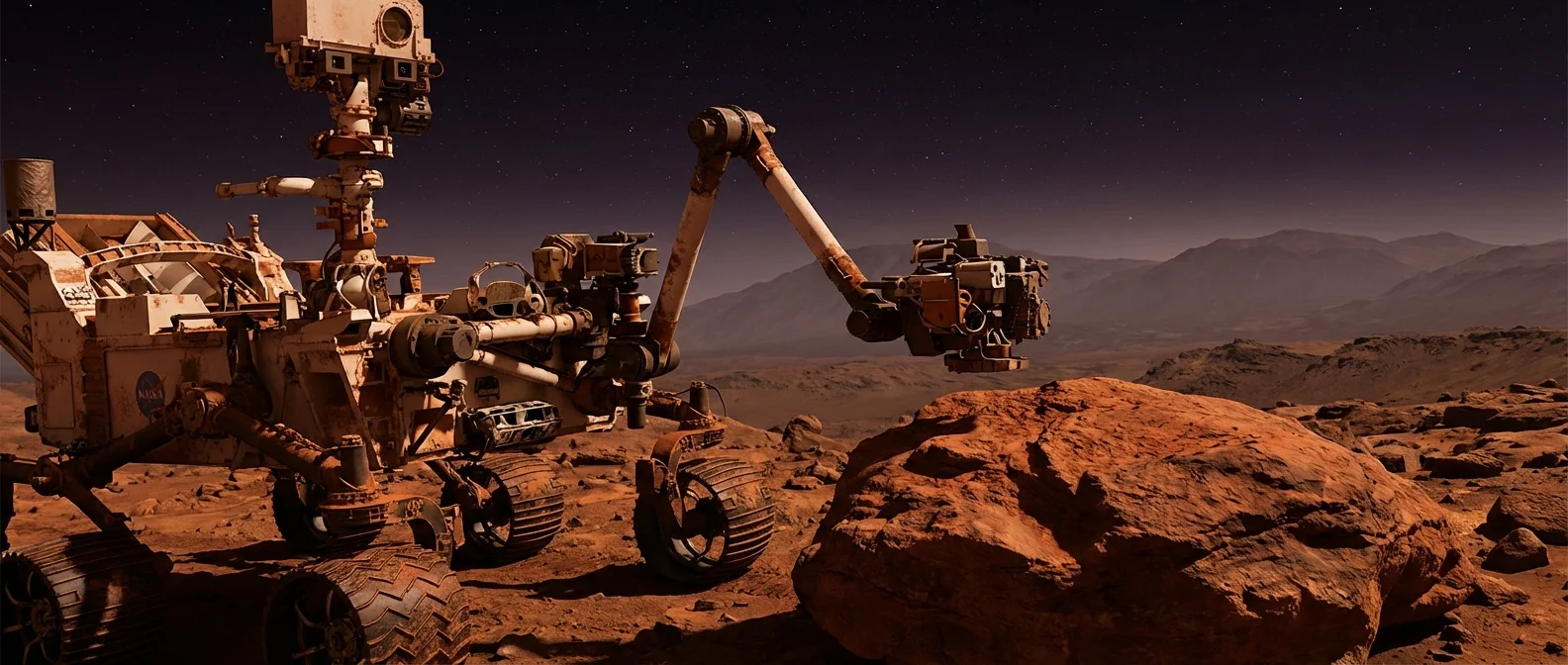
Perseverance is arguably the most advanced robot ever to roam another world. Part of the Mars 2020 mission, it launched on July 30, 2020, aboard an Atlas V rocket and touched down in Jezero Crater on February 18, 2021 — a site chosen specifically for its ancient river delta, which could preserve evidence of microbial life from billions of years ago.
The rover runs on a multi-mission radioisotope thermoelectric generator (MMRTG), producing roughly 110 watts from 4.8 kg of plutonium-238. Its radiation-hardened BAE Systems RAD750 processor with just 128 MB of RAM might seem ancient by smartphone standards, but it's built to withstand the punishing cosmic radiation on Mars.
By January 2026, Perseverance had logged over 1,700 sols (Martian days) of activity. Currently on its fifth science campaign, “Northern Rim,” the rover is exploring the northern edge of Jezero Crater, studying rocks blasted upward by an impact 3.9 billion years ago.
What it's found so far
The discoveries challenge expectations. Rather than finding only sedimentary rocks, the rover uncovered igneous rock formations showing evidence of water interaction. At a rock nicknamed “Wildcat Ridge,” it found evidence of an ancient lake environment — ideal conditions for preserving signs of microbial life. The MOXIE experiment successfully produced 122 grams of oxygen from Mars' carbon dioxide atmosphere. In July 2024, the “Cheyava Falls” rock was discovered with “leopard spot” patterns that may constitute a biosignature.
As of July 2025, 33 of 43 sample tubes have been filled — including igneous, sedimentary, and serpentinite rock samples — ready for a future Mars Sample Return mission to bring them back to Earth.
🚁 Ingenuity: The Wright Brothers Moment on Mars
Tucked beneath Perseverance for the journey to Mars was a tiny, 1.8 kg experimental helicopter called Ingenuity. On April 19, 2021, it achieved the first powered, controlled flight on another planet in human history — a feat on par with the Wright Brothers, but on an alien world with an atmosphere just 1% as dense as Earth's.
Ingenuity by the Numbers
Originally designed for just 3 to 5 test flights over 45 days, Ingenuity crushed every expectation: it completed 72 flights over nearly three years. Its final flight came on January 18, 2024, when a rotor blade broke off during landing. NASA retired it, but the legacy lives on — future plans call for larger aerial scouts on Mars and even Titan.
🌑 VIPER: The Lunar Water Hunter
VIPER (Volatiles Investigating Polar Exploration Rover) has one of the most dramatic backstories in recent space exploration. Developed at NASA's Ames Research Center, its mission is to prospect for water ice in the permanently shadowed craters near the Moon's south pole — resources that could prove critical for establishing future lunar bases.
VIPER — Technical Specifications
About the size of a golf cart (~1.4 × 1.4 × 2 meters), weighing 430 kg, VIPER carries the TRIDENT drill capable of boring 1 meter deep and four scientific instruments (NSS, NIRVSS, MSolo, TRIDENT). Designed for a 100-day mission, it can traverse 20 km and collect 50 drill samples.
VIPER survived cancellation twice. In July 2024, NASA canceled the mission due to cost overruns ($450 million spent) and schedule delays. The rover was already fully assembled and had passed vibration testing. The cancellation drew fierce criticism — over 2,500 signatures of opposition were collected within days.
Then came the reversal. In September 2025, NASA selected Blue Origin to carry VIPER to the Moon. The new mission is targeting 2027, using Blue Origin's Blue Moon MK1 lander launched on a New Glenn rocket. If all goes well, VIPER will become the first rover with its own lighting system, capable of exploring craters in permanent darkness.
🤖 Robonaut: The Humanoid Astronaut
Robonaut 2 (R2) represents a unique experiment: a humanoid robot designed to work shoulder-to-shoulder with astronauts. Developed by NASA's Johnson Space Center in partnership with General Motors, it launched to the International Space Station aboard STS-133 in February 2011 — the first American-built robot on the ISS.
Packing over 350 sensors, 38 PowerPC processors, hands with 12 degrees of freedom, and touch sensors at its fingertips, R2 could move its arms at 2 m/s and handle payloads up to 18 kg. Its key innovation: it didn't require constant supervision — it could receive tasks and execute them autonomously, a critical capability for deep-space missions where communication delays rule out real-time control.
Unfortunately, R2 developed an electrical fault and returned to Earth in May 2018 for repairs. As of 2024, it's on display at the Smithsonian's Steven F. Udvar-Hazy Center. But the technology lives on in Valkyrie (R5), NASA's next-generation humanoid designed for planetary exploration.
📖 Read more: Exoskeletons: The Robotic Suits Giving Humans Superpowers
🐝 Astrobee: The Free-Flying Cube Robots of the ISS
Three small cubes — Bumble, Honey, and Queen — float through the International Space Station performing tasks autonomously, from inventory tracking to experiment documentation. Built by NASA's Ames Research Center, the Astrobee robots represent a pioneering platform for zero-gravity robotics.
Each Astrobee is a 12.5-inch cube equipped with cameras, sensors, a touchscreen, and a laser pointer. They maneuver using electric fans that pressurize air and vent it through 12 nozzles — enabling full freedom of movement in three dimensions. Their flight software runs on ROS (Robot Operating System) and can be upgraded in orbit.
Launched in two waves — Bumble and Honey in April 2019, Queen in July 2019 — all three charge at a docking station in the Japanese Kibo module. Beyond practical duties, they serve as a research platform: scientists on Earth can access the ISS through these robots without needing astronauts as intermediaries.
📊 NASA Space Robot Comparison
| Robot | Location | Mass | Status (2026) |
|---|---|---|---|
| Perseverance | Mars (Jezero) | 1,025 kg | ✅ Active — 5th campaign |
| Curiosity | Mars (Gale) | 899 kg | ✅ Active since 2012 |
| VIPER | Moon (south pole) | 430 kg | 🔜 Launch 2027 |
| Astrobee ×3 | ISS (interior) | ~10 kg each | ✅ Active |
| Robonaut 2 | Earth (Smithsonian) | ~150 kg | ⏸️ On display |
| Ingenuity | Mars (surface) | 1.8 kg | 🏁 Retired (72 flights) |
🔮 The Next Generation of Space Robots
NASA's next robotic missions target sample return and deep space. The Mars Sample Return (MSR) program aims to bring back samples collected by Perseverance — via a Mars Ascent Vehicle (MAV) that would mark humanity's first rocket launch from another planet. The mission faces significant technical and budgetary challenges, but the scientific payoff could be transformational.
On the Moon, beyond VIPER, the Artemis program envisions the Lunar Gateway — a small station in lunar orbit where robots like Astrobee could serve as “caretakers” during crew absences. Valkyrie (R5), the successor to Robonaut, is already being tested on Earth for future planetary missions.
Further out, the Europa Clipper mission (launched 2024) is heading toward Jupiter's moon Europa, searching for evidence of a subsurface ocean beneath its icy crust — one of the most promising locations for extraterrestrial life in our solar system.
🌍 Why Robots Before Humans?
Robots don't need oxygen, food, or sleep. They can withstand extreme temperatures (from -125°C on Mars to -230°C in the Moon's shadowed craters), cosmic radiation, and years of isolation. Curiosity has been working on Mars for 14 years — no crewed mission could last that long.
Yet human presence remains essential. An astronaut geologist could accomplish in a single day what a rover takes months to do. NASA's approach is direct: robots go first to scout and build infrastructure, humans follow for deeper exploration. That's exactly what NASA is doing with Artemis — rovers map the terrain, robots prepare the habitat, and astronauts arrive last.
Mars by the Numbers (February 2026)
- 6 rovers have explored Mars: Sojourner (1997), Spirit (2004), Opportunity (2004), Curiosity (2012), Perseverance (2021), Zhurong/China (2021)
- $2.75 billion — Perseverance mission cost
- 39.4+ km — distance traveled by Perseverance (Dec. 2025)
- 122 g of oxygen — produced by MOXIE from Mars CO₂
- 33/43 — sample tubes filled so far
💡 Technologies That Transformed Space Robotics
Every mission brings technological leaps. Perseverance's Terrain Relative Navigation — which compared descent images against stored maps for automatic course corrections — achieved a landing accuracy of just 5 meters from its target, the most precise in history. MOXIE proved we can produce breathable oxygen directly from the Martian atmosphere. The Astrobee robots pioneered autonomous navigation without GPS in microgravity.
These innovations extend far beyond space. Autonomous navigation, teleoperation, real-time sample analysis, and extreme-condition resilience find applications across terrestrial robotics: from underwater exploration to surgical robots, from nuclear facilities to archaeological digs.
In 2026, NASA's robot fleet isn't just a collection of machines scattered across distant worlds. It represents the early steps of a plan to make humanity a multi-planetary species — and the robots, faithful mechanical pioneers, will always get there first.