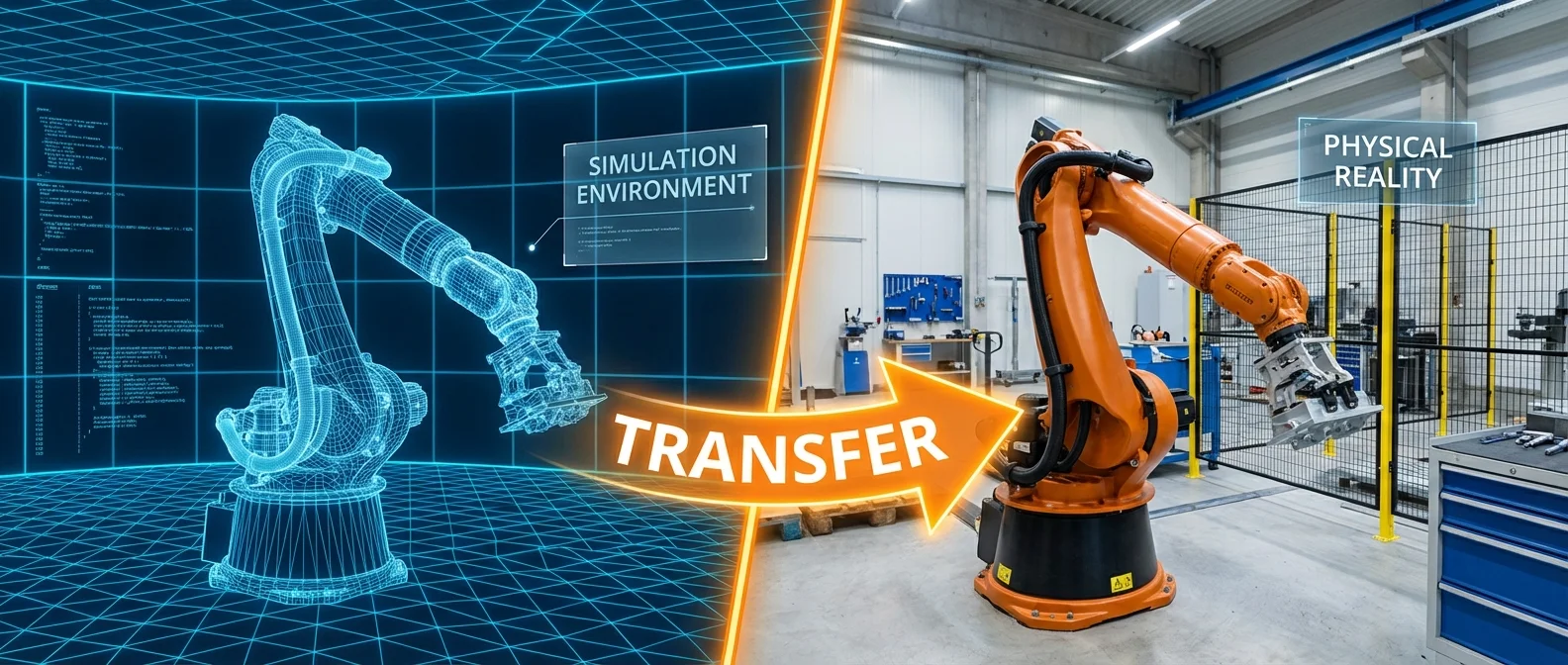
Imagine a robot that learns to walk, grasp objects, or fly — without ever setting foot in the real world. That is the promise of Sim-to-Real transfer: training artificial intelligence inside virtual simulation environments first, then deploying those learned skills onto physical robotic hardware. This approach has revolutionized robotics by slashing training time, costs, and the risk of expensive equipment damage during the learning phase.
What Is Sim-to-Real Transfer?
The term Sim-to-Real (Simulation-to-Reality) refers to the process of training an AI model inside a virtual simulation and then deploying it on a physical robotic system. The core idea is straightforward: instead of testing thousands of movements on an expensive robot that could break, you run billions of trials in a virtual environment — faster, cheaper, and safer.
The biggest obstacle is known as the Reality Gap: the differences between the simulator's physics and the real world. Friction, gravity, material elasticity, lighting — nothing is exactly the same. If a robot is trained on perfect simulation physics, it will fail spectacularly in reality. The solution? Techniques that make training deliberately “messy” — in other words, resilient to uncertainty.
The Evolution of Sim-to-Real
Training in simulation is not a new concept — the aviation industry has used flight simulators since the 1950s. In robotics, however, the breakthrough came with deep reinforcement learning in the mid-2010s.
Key Milestones
- 2012: Emanuel Todorov introduces MuJoCo (Multi-Joint dynamics with Contact) at the University of Washington — a physics engine purpose-built for robotics and machine learning. It quickly becomes the standard tool for sim-to-real research.
- 2016: OpenAI creates OpenAI Gym, a standardized platform for reinforcement learning algorithms, with built-in MuJoCo integration.
- 2017: The Domain Randomization technique is formally introduced — randomizing physics parameters and visual properties during training. The idea: if a robot learns to handle thousands of “wrong” worlds, the real world becomes just another one.
- 2018: OpenAI unveils Dactyl — a robotic hand (Shadow Dexterous Hand) trained entirely in simulation to manipulate objects. The training required ~100 years of virtual experience, completed in a matter of days thanks to parallel GPU computing.
- 2019: Dactyl solves a Rubik's Cube one-handed — arguably the most impressive sim-to-real demonstration of its era. It used Automatic Domain Randomization (ADR) with billions of randomizations.
- 2021: Google DeepMind acquires MuJoCo and open-sources it in May 2022 under Apache 2.0. The move democratizes sim-to-real research worldwide.
- 2022–2023: NVIDIA launches Isaac Sim on the Omniverse platform — photorealistic rendering, GPU-accelerated physics via PhysX 5, and built-in domain randomization. It becomes the go-to platform for industrial sim-to-real training.
- 2024: NVIDIA releases Isaac Lab (replacing Isaac Gym), while Foundation Models for Robotics (Google RT-2, NVIDIA GR00T) promise zero-shot sim-to-real transfer — robots that generalize without task-specific training.
- 2025–2026: The age of World Models — neural networks that learn to simulate real-world physics, gradually closing the Reality Gap.
Core Sim-to-Real Techniques
Bridging the gap between virtual and physical worlds relies on a combination of techniques. The three most important:
1. Domain Randomization
The most popular technique by far. During training, simulation parameters are randomized in every episode: surface friction (0.1–1.5), object mass (±30%), bright or dim lighting, material colors, sensor noise. The outcome: a model that doesn't “memorize” the simulator, but instead learns general strategies that work everywhere — including the real world.
2. System Identification
The opposite approach: instead of randomizing everything, you measure the actual physical properties (friction, mass, elasticity) and calibrate the simulator to replicate them precisely. This requires measurement equipment but yields more accurate results in controlled environments.
3. Progressive Networks & Fine-Tuning
The robot trains in simulation first, transfers to the real world, and then improves (fine-tunes) using real-world data. DeepMind's Progressive Networks keep simulation knowledge “locked” and add new neuron columns for reality, avoiding catastrophic forgetting.
Time: A robot needs months of real-world practice. In simulation, the same training takes hours.
Cost: Every fall means potential damage worth thousands of dollars. In simulation, nothing breaks.
Scale: You can run 4,096 virtual robots in parallel on a single GPU cluster. You cannot buy 4,096 Atlas units.
Safety: A robot learning to fly should not crash into a wall before it learns to steer.
The Leading Simulators
The quality of the simulator directly determines the quality of sim-to-real transfer. Each platform serves different needs:
| Simulator | Developer | Physics | Rendering | Specialization | License |
|---|---|---|---|---|---|
| MuJoCo | Google DeepMind | Excellent (contact dynamics) | Basic | Manipulation, locomotion | Apache 2.0 (free) |
| NVIDIA Isaac Sim | NVIDIA | PhysX 5 (GPU-accelerated) | Photorealistic (RTX) | Industrial robots, warehouses | Free (commercial) |
| PyBullet | Erwin Coumans | Good (Bullet engine) | Basic | Education, prototyping | Zlib (free) |
| Gazebo | Open Robotics | ODE/DART/Bullet | Medium (OGRE) | ROS integration | Apache 2.0 (free) |
| Unity ML-Agents | Unity Technologies | PhysX (medium) | High (HDRP) | Vision-based tasks | Personal/Pro |
| Isaac Lab | NVIDIA | PhysX 5 (GPU) | Photorealistic | RL training at scale | BSD-3 (free) |
Landmark Sim-to-Real Examples
OpenAI Dactyl (2018–2019)
The Shadow Dexterous Hand was trained in MuJoCo using reinforcement learning and Automatic Domain Randomization. It learned to manipulate objects and ultimately solve a Rubik's Cube entirely through sim-to-real transfer. The training was equivalent to ~13,000 years of virtual experience, compressed into a few weeks of real time on 6,144 CPU cores and 8 GPUs.
ANYmal by ETH Zurich (2019–2024)
The quadruped robot ANYmal from ETH Zurich was trained in Isaac Gym for locomotion across challenging terrain — stairs, ice, gravel. The sim-to-real transfer achieved a >95% success rate on real-world stairs without any fine-tuning. The key technique is teacher-student training: a privileged “teacher” model with full state information trains a “student” model that only sees what real sensors provide.
Google RT-2 & RT-X (2023–2024)
Google DeepMind combined Vision-Language Models (VLMs) with robotic action in the RT-2 and RT-X models. Rather than training on a single task, these models understand natural language commands ("pick up the red object") and translate them into motion. RT-X was trained on data from 22 different robot types, demonstrating cross-embodiment transfer — knowledge sharing between robots of different designs.
NVIDIA Project GR00T (2024–2025)
NVIDIA's GR00T Foundation Model was built specifically for humanoid robots. It trains in Isaac Sim across thousands of tasks (walking, manipulation, interaction) and transfers to physical hardware through zero-shot or few-shot adaptation. NVIDIA provides dedicated hardware (Jetson Thor SoC) for on-device inference.
ETH Zurich — Agile Drone Racing (2023)
ETH Zurich researchers trained an autonomous drone in simulation to race against human FPV pilots. The sim-to-real drone beat three world champion pilots on a physical course, reaching speeds up to 80 km/h. The breakthrough was a low-latency sensorimotor policy trained entirely in simulation.
NVIDIA's Role in the Ecosystem
NVIDIA has become the de facto leader of the sim-to-real ecosystem, providing both hardware (GPUs) and software (simulation platforms):
- Isaac Sim: Built on the Omniverse platform. Photorealistic rendering with ray tracing, accurate physics through PhysX 5, and built-in domain randomization. Used by Amazon, BMW, and Siemens for warehouse robot training.
- Isaac Lab: Replaced Isaac Gym in 2024. A modular framework for large-scale reinforcement learning, optimized for GPUs — running 10,000+ parallel robots on a single A100.
- Omniverse: The parent platform — Universal Scene Description (OpenUSD) standard, factory-scale digital twins. BMW simulates entire facilities before placing a single robot on the floor.
- GR00T: A foundation model for humanoid robots, trained in Omniverse/Isaac Sim. It aims to be the “ChatGPT of robotics” — a single model that understands natural language and translates it into physical actions.
NVIDIA Isaac Sim can run 4,096 parallel robots on a single H100 GPU. A training run that would take 3 years on a physical robot completes in ~10 hours. BMW uses Omniverse digital twins for 31 factories worldwide.
Technical Deep Dive: How It Works
Reinforcement Learning (RL)
The vast majority of sim-to-real training uses Reinforcement Learning: the robot tries actions, receives rewards for correct moves (e.g., “walked 1 meter without falling = +10 points”), and gradually learns an optimal policy. PPO (Proximal Policy Optimization) and SAC (Soft Actor-Critic) are the most widely used algorithms in modern sim-to-real pipelines.
Photorealistic Rendering for Vision Tasks
For robots that rely on cameras (vision-based control), the simulator's rendering quality is critical. NVIDIA Isaac Sim employs RTX ray tracing for photorealistic images — shadows, reflections, and lighting that closely mimic reality. When the simulation image looks real enough, the vision policy transfers seamlessly.
The Sim-to-Real Pipeline
- URDF/MJCF design: Create a 3D model of the robot (joints, links, collision meshes)
- Environment setup: Place objects, terrain, obstacles
- Reward function design: Define what gets rewarded (e.g., distance to target, stability)
- Domain Randomization: Randomize physics, visuals, and sensor noise
- Parallel training: Thousands of instances running on GPUs
- Evaluation: Test on the physical robot
- Fine-tuning (optional): Minor adjustments using real-world data
The Future: World Models & Foundation Models
The next generation of sim-to-real won't require hand-designed simulators at all. World Models — neural networks that learn the laws of physics by watching video — will automatically generate realistic simulations. Meta, Google DeepMind, and NVIDIA are all actively researching this direction.
Meanwhile, Foundation Models for Robotics (GR00T, RT-X, Octo) will train once on massive datasets (virtual + real) and transfer to any robot with zero-shot or few-shot adaptation. Imagine a “robotics GPT” that receives a command in plain English and executes physical actions without task-specific training.
Furthermore, digital twin technology will turn every factory, warehouse, and hospital into a living simulation — robots will continue learning while working, drawing on real-time data to refine their policies.
The open-sourcing of MuJoCo (2022) and the release of Isaac Lab under BSD-3 have lowered the barrier to entry dramatically. University labs that once couldn't afford commercial licenses now run cutting-edge sim-to-real research. The open-source community contributes environments, baselines, and benchmarks that accelerate the entire field.
Frequently Asked Questions
Can a robot be trained entirely in simulation without any real-world testing?
Yes — this is called “zero-shot sim-to-real transfer” and represents the gold standard. OpenAI achieved it with Dactyl (2019), and ETH Zurich demonstrated it with drones and ANYmal. However, in most commercial applications, a brief fine-tuning phase (minutes to hours) significantly improves performance.
Which simulator should I use if I'm just getting started?
For learning the basics, PyBullet (free, easy setup) or MuJoCo (free since 2022, excellent documentation). For industrial applications or warehouse robots, NVIDIA Isaac Sim. For ROS integration, Gazebo.
How much GPU do I need?
For basic sim-to-real training, an NVIDIA RTX 3070 is sufficient. For large-scale training (thousands of parallel robots), you'll need A100 or H100 GPUs — or cloud access via AWS, Azure, or GCP. NVIDIA offers free Isaac Sim access through the cloud.
What is the biggest unsolved challenge in sim-to-real today?
Deformable objects (soft materials, fabrics, food) remain extremely difficult to simulate accurately. Their physics are chaotic and computationally expensive. This is why robots still struggle to fold laundry or cook — simulation-based training for these tasks lags significantly behind rigid-body manipulation.