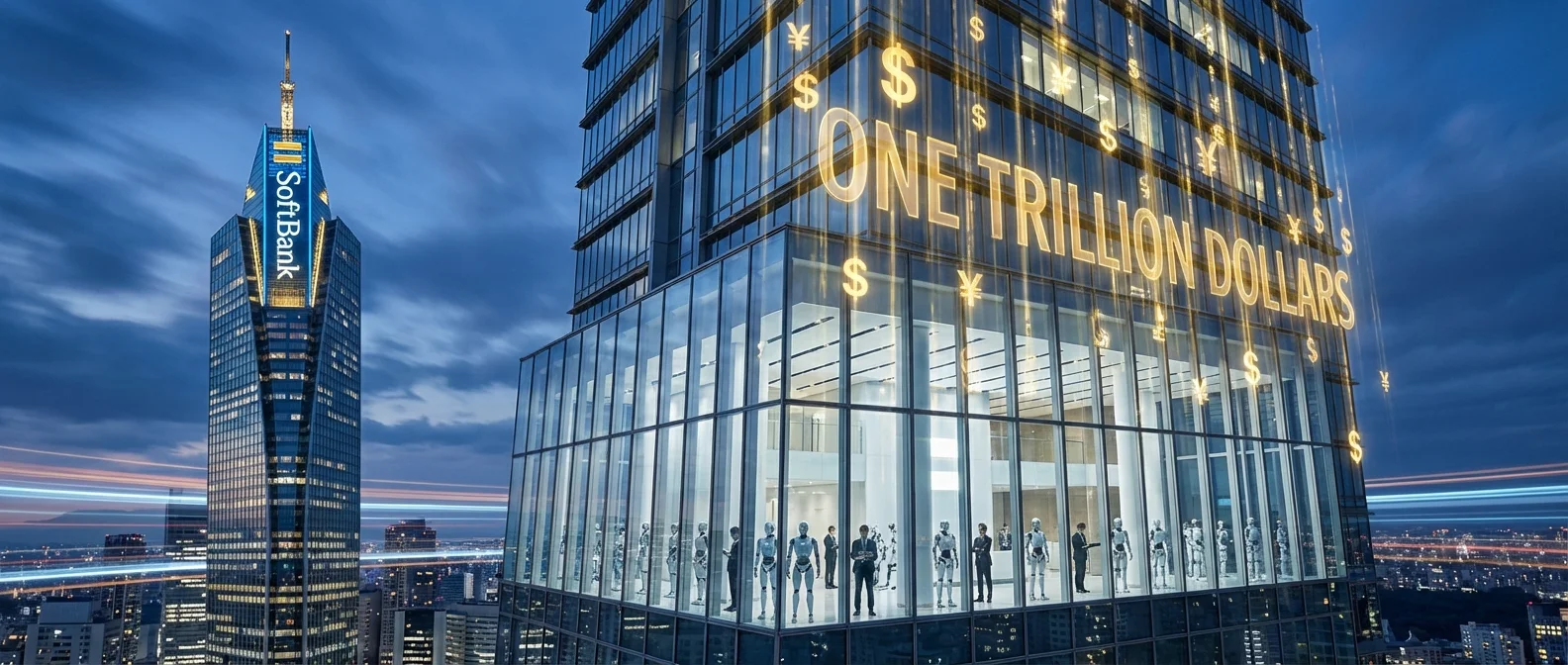
When Masayoshi Son founded SoftBank in 1981 as a 24-year-old software distributor in Tokyo, nobody could have imagined he would reshape the landscape of global tech investment. Forty-five years later, SoftBank Group has become a colossus pouring tens of billions into robotics, artificial intelligence, and AI infrastructure — investments that cumulatively approach the trillion-dollar mark.
📖 Read more: Foundation Models: The AI Revolution in Robotics 2026
From Software Distributor to Tech Titan
SoftBank's story starts in a small warehouse in Tokyo. Son, born to a family of Korean immigrants in Japan, founded SOFTBANK Corp as a software distribution company. His first major move was publishing — the Oh! PC and Oh! MZ magazines covering NEC and Sharp computers had a circulation of 140,000 copies by 1989.
The company went public in 1994 at a $3 billion valuation. But the defining moment came in 2000, when Son invested a mere $20 million in a scrappy Chinese startup called Alibaba. That bet turned into $60 billion when Alibaba went public in 2014 — one of the most profitable investments in the history of technology.
Entering Robotics: Aldebaran and Pepper
In 2013, SoftBank made a landmark move: it acquired a controlling stake in French robotics firm Aldebaran Robotics, which specialized in humanoid robots. Two years later, it raised its stake to 95% and rebranded the company as SoftBank Robotics.
The result of that acquisition was Pepper — a semi-humanoid robot standing 1.20 meters tall, unveiled on June 5, 2014 in Tokyo by Son himself. Pepper could recognize emotions through facial expression analysis and voice tone detection — a groundbreaking capability for its time.
Despite the initial fanfare, Pepper never went mainstream. It saw use in banks, hospitals, airports, and restaurants across Japan, but demand steadily declined. SoftBank suspended production in June 2021. To make matters worse, Aldebaran Robotics entered receivership in 2025 — effectively spelling the end for Pepper.
Boston Dynamics: Buying and Selling Robotics History
On June 8, 2017, SoftBank announced it was acquiring Boston Dynamics from Alphabet (Google's parent company). Boston Dynamics was a legend in the robotics world, known for its jaw-dropping quadrupeds and humanoid robots — BigDog, Spot, and Atlas.
The move seemed strategic: SoftBank would consolidate the world's most advanced mobile robots under a single umbrella. But in December 2020, SoftBank sold 80% of Boston Dynamics to Hyundai Motor Group for approximately $880 million, retaining just 20% through a subsidiary.
The sale was interpreted as a signal that SoftBank was backing away from robotics hardware and pivoting exclusively to AI software. But the years that followed proved something entirely different.
📖 Read more: Physical AI: What It Is and Why It Matters in 2026
Vision Fund: The Biggest Tech Investment Vehicle Ever
In May 2017, SoftBank partnered with the Public Investment Fund of Saudi Arabia to create the SoftBank Vision Fund — with an initial capital of $93 billion, the largest technology-focused venture capital fund in history. Saudi Arabia contributed $45 billion, Mubadala put in $15 billion, and other backers included Apple, Qualcomm, Foxconn, and Larry Ellison.
Son declared he would invest in every company developing AI technologies, from finance to transportation. The investments were staggering: $10 billion in Uber, $4.4 billion in WeWork, $2.5 billion in Flipkart, $1.4 billion in Paytm.
But the ride was far from smooth. The collapse of WeWork's IPO in 2019 dealt a serious blow. By May 2023, the Vision Fund had accumulated record losses of $32 billion — casting a long shadow over the initial euphoria. SoftBank found itself on the verge of crisis, and many of Son's closest associates departed.
ARM Holdings: The Hidden Powerhouse
Amid the losses, SoftBank held an ace up its sleeve: ARM Holdings, the British chip design company it had acquired in July 2016 for $32 billion. ARM's chip architectures power virtually every smartphone on the planet, along with a growing number of servers and AI devices.
In September 2023, ARM went public on the Nasdaq, raising $4.87 billion at a valuation of $54.5 billion. SoftBank retained 90.6% of the company. This move proved to be the group's lifeline — ARM wasn't just an investment, it was the core around which the entire “Physical AI” strategy would be built.
2024–2026: The AI and Robotics Investment Tsunami
Starting in late 2024, Masayoshi Son launched a wave of acquisitions and investments unprecedented in the history of corporate technology spending:
The “Physical AI” Strategy: What It Means
"Physical AI" — artificial intelligence embedded in physical objects, robots, and machines — has become the core of Son's strategy. The acquisition of ABB Robotics in October 2025 was the clearest declaration of this direction.
📖 Read more: Robot Dogs at the 2026 World Cup: High-Tech Stadium Guards
The logic is straightforward: SoftBank is building a vertically integrated ecosystem. ARM provides the chip designs, Ampere Computing supplies energy-efficient processors, OpenAI delivers the AI models, ABB Robotics offers the robotic bodies, and DigitalBridge provides data center infrastructure. Every piece connects to the others in a unified system.
The SoftBank Puzzle Pieces
- Chip Design: ARM Holdings (90.6% ownership) — architectures powering smartphones, servers, and AI
- AI Processors: Ampere Computing ($6.5B) — energy-efficient CPUs for cloud and AI
- AI Software: OpenAI (11% stake, $30B) — the world's most advanced language models
- Robotic Bodies: ABB Robotics ($5.375B) — industrial robots, cobots, and automation systems
- Infrastructure: DigitalBridge ($4B) + Stargate ($500B) — data centers, networks, and cloud
The Risks: Will It Work This Time?
SoftBank's story is not solely a tale of success. The WeWork implosion, the record Vision Fund losses, the Pepper failure — all show that Son doesn't always hit the mark. His “go big or go home” philosophy means the mistakes are just as colossal as the wins.
The $20 million Alibaba bet returned $60 billion — possibly the most profitable venture investment of all time. But the $9 billion Uber investment, the $4.4 billion WeWork debacle, and dozens of failed startups prove that the scatter-gun approach doesn't always work.
Now, Son is going all-in on AI. Liquidating the $5.8 billion Nvidia position to fund even more OpenAI shares signals total commitment. In February 2026, SoftBank reported a return to profitability, driven largely by the revaluation of its OpenAI stake.
What It Means for Robotics Worldwide
The scale of SoftBank's investments is reshaping the entire robotics industry. The ABB Robotics acquisition means an AI titan now controls thousands of industrial robots — and plans to make them “smart” with AI.
If the strategy succeeds, factory robots won't merely follow pre-programmed instructions. They'll learn, adapt, and make decisions autonomously — which is precisely what “Physical AI” means. The convergence of ARM chips, Ampere processors, OpenAI models, and ABB bodies could give rise to an entirely new generation of robots.
SoftBank by the Numbers (2026)
- Founder: Masayoshi Son — 29.68% stake (71.36% voting rights)
- Headquarters: Tokyo PortCity Takeshiba, Minato, Tokyo
- Employees: 65,352 (2023)
- Total Assets: ¥46.72 trillion (~$312B)
- Key Holdings: ARM (87.1%), OpenAI (11%), Stargate (40%), Alibaba (14.2%), T-Mobile US (7.6%), Coupang (26.7%)
- Forbes Global 2000: #130 largest public company worldwide (2025)
Conclusion: A Trillion-Dollar Gamble on the Future
Masayoshi Son is often likened to a gambler — and the comparison isn't accidental. From the $20 million Alibaba bet to the $500 billion Stargate Project, Son always plays at colossal scale. The difference now is that he's not just betting on software — he's betting on the entire artificial intelligence stack, from chip design to robotic bodies.
If the pieces come together, SoftBank will become the first company in history to control every layer of the robotic AI stack — chip architecture, processor manufacturing, AI models, robotic bodies, and cloud infrastructure. If it fails, it will rank among the biggest investment busts the world has ever seen. Either way, the gamble is worth trillions — and is well worth watching.