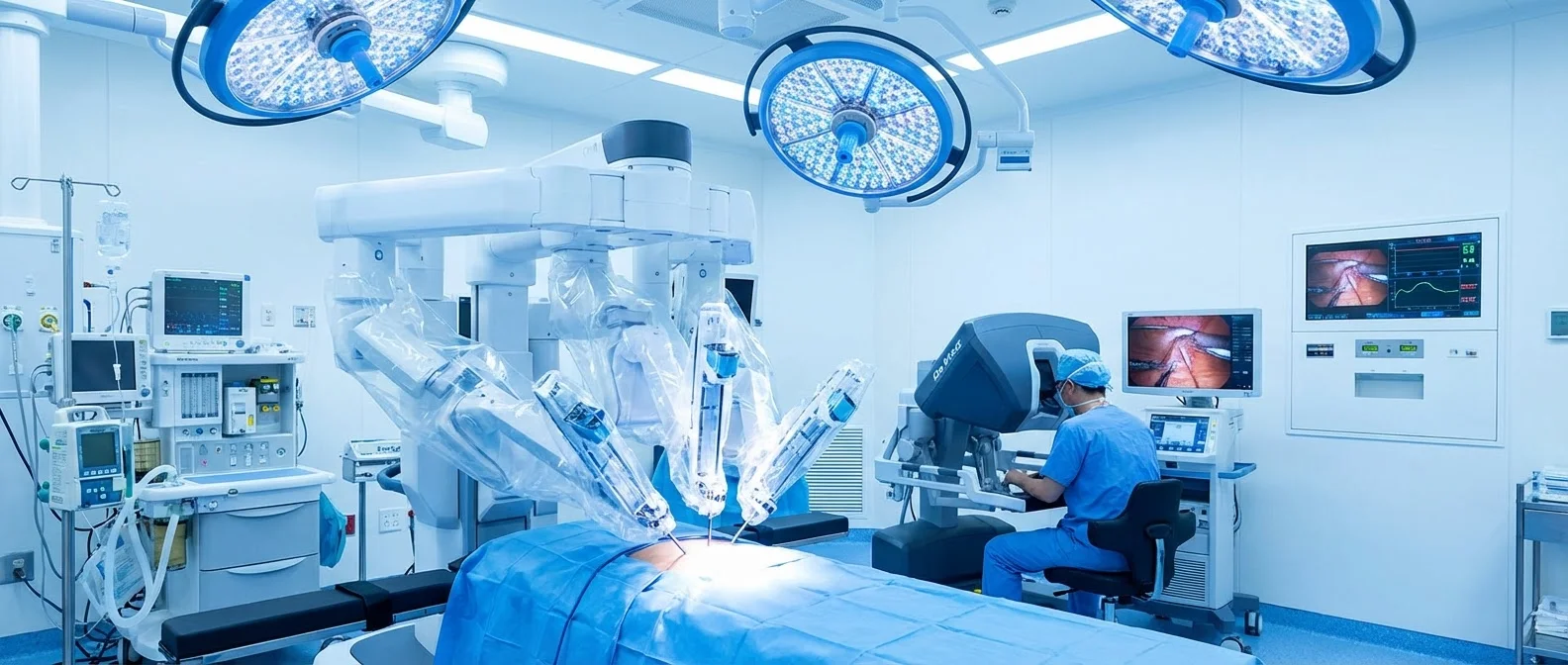
A robotic arm with sub-millimeter precision enters a patient's body through an incision smaller than a coin. The surgeon sits at a console meters away, viewing organs in magnified 3D, while their finger movements translate into motions no human hand could ever replicate. This isn't science fiction — it's the daily reality in thousands of operating rooms worldwide. Robotic surgery has already transformed how we treat cancer, heart disease, and orthopedic conditions — and now it's taking the next leap: fully autonomous procedures with no human intervention at all.
📖 Read more: Exoskeletons: The Robotic Suits Giving Humans Superpowers
🏥 What Is Robotic Surgery?
Robotic surgery — or robot-assisted surgery — doesn't mean a robot “decides” what to do on its own. In practice, the surgeon controls every movement through a specialized console. The robotic arms translate their hand motions into microscopic, extraordinarily precise gestures inside the patient's body.
The key advantages over traditional surgery are significant: incisions are tiny (typically 8-12mm instead of 15-30cm for open surgery), blood loss drops dramatically, pain is substantially reduced, and recovery time can be cut by 50% or more. The system also automatically filters out hand tremors — something impossible during manual surgery.
3D magnification (10-15x) gives the surgeon a view far clearer than the naked eye, while instruments with 7 degrees of freedom can bend and rotate in ways the human wrist simply cannot. This makes it possible to operate in areas that previously required massive incisions.
📜 History: From Arthrobot to Da Vinci 5
The story began long before anyone could have imagined it. Robert Heinlein had described remote-controlled mechanical hands for brain surgery in his novel “Waldo” back in 1942 — four decades before the first surgical robot was ever built.
In 1983, in Vancouver, Canada, the Arthrobot became the first robot used in a surgical procedure. Built by biomedical engineer James McEwen and orthopedic surgeon Dr. Brian Day, the Arthrobot positioned and manipulated the patient's leg via voice commands during an orthopedic procedure at UBC Hospital.
Two years later, in 1985, the PUMA 560 robot was used for the first robot-guided brain biopsy under CT guidance. By the late 1980s, Imperial College London had developed PROBOT for prostate surgery.
In 1992, the ROBODOC system (IBM/Integrated Surgical Systems) began performing hip replacement procedures — it was the first robot capable of precisely milling a femur for implant placement, replacing hammer and broach. It ultimately received FDA clearance in 2008.
In the mid-1990s, Computer Motion created two landmark systems: AESOP (1994), the first FDA-approved robotic laparoscopic camera holder, and ZEUS (1998), which introduced telesurgery. Using ZEUS, surgeons performed the legendary Lindbergh Operation in September 2001 — a remote cholecystectomy with the surgeon in New York and the patient in Strasbourg, France.
But the true king arrived in 2000: Intuitive Surgical's Da Vinci system, originally based on technology funded by DARPA and NASA for battlefield surgery. It received FDA clearance for general laparoscopic procedures and quickly came to dominate the global market.
🤖 Da Vinci: The Undisputed King
Intuitive Surgical (NASDAQ: ISRG) is the dominant force in robotic surgery, commanding roughly 70-80% of the global market. The company's numbers are staggering: from 60 systems sold in 2002, it reached 6,730+ installed systems worldwide by late 2021, while revenue skyrocketed from $1.41 billion (2010) to $10.1 billion (2025).
The Da Vinci family spans multiple generations. The Da Vinci Si (2009), initially priced at $1.75 million; the Da Vinci Xi, which remains the workhorse multiport system; and the Da Vinci SP (Single Port), designed for single-incision surgery through a single cannula.
In March 2024, Intuitive Surgical unveiled the Da Vinci 5 — the most advanced surgical robot in the world. The critical innovation? For the first time in Da Vinci's history, it incorporates force feedback (haptic sensing) — the surgeon can now actually feel the tissue, the resistance, the pressure. It's like going from “driving with gloves” to “bare hands.” The system features enhanced 3D visualization, connects to a cloud ecosystem, and supports 10,000+ compatible instruments. Estimated price: $2.0-2.5 million per unit.
📖 Read more: Fauna Sprout: The Soft Humanoid Robot You Can Actually Hug
⚔️ The Challengers: Hugo, Versius, and Senhance
Until recently, Intuitive Surgical had no serious competition. That's changing rapidly.
Hugo RAS — Medtronic
Medtronic (NYSE: MDT), a medical device giant with $33.54 billion in 2025 revenue, developed the Hugo RAS (Robot-Assisted Surgery) system. Hugo's key innovation: a modular design — 4 independent robotic arms on separate carts, so surgeons use only what they need for each procedure. Its “open” console, unlike Da Vinci's enclosed design, enables better situational awareness and collaborative training. Hugo operates in 30+ countries, thousands of surgeons have used it, and it integrates Touch Surgery — an AI-powered platform for surgical video analytics. US FDA clearance is still in progress.
Versius — CMR Surgical
British-based CMR Surgical, founded in 2014 in Cambridge, achieved unicorn status ($3 billion valuation in 2021) with the Versius system, launched in 2019. Versius stands out for its independent modular arms, compact size (fits virtually any operating theater), and significantly lower cost than Da Vinci — estimated around $1-1.5 million. By March 2024, it had completed 20,000+ procedures across 20 NHS hospitals and many countries (Australia, India, Europe, Latin America). In February 2024, it added ICG fluorescence imaging — indocyanine green-guided surgery for enhanced precision.
Senhance — Asensus Surgical / Karl Storz
The Senhance system (formerly TransEnterix) was a pioneer in one critical area: haptic feedback. The surgeon could physically feel the tissue — something the original Da Vinci systems lacked. It also featured eye-tracking camera control and lower consumable costs. However, Asensus Surgical ran into severe financial difficulties, and in 2024 it was acquired by German endoscopy giant Karl Storz, which integrated the Senhance technology into its portfolio.
⚖️ Surgical Robot Comparison 2026
| Feature | Da Vinci 5 | Hugo RAS | Versius |
|---|---|---|---|
| Manufacturer | Intuitive Surgical | Medtronic | CMR Surgical |
| Price (est.) | $2.0-2.5M | ~$1.5-2.0M | ~$1.0-1.5M |
| Haptic Feedback | ✅ Yes (new!) | ❌ Partial | ❌ No |
| Modular Arms | Integrated | ✅ Independent | ✅ Independent |
| FDA Status | ✅ Cleared | Pending | CE Mark |
| Installations | 6,730+ | 30+ countries | 20+ NHS |
🔬 Applications: Where They're Used Today
Surgical robots are no longer confined to a single specialty. Today's systems are deployed across a remarkable range of procedures:
Urology: Radical prostatectomy (prostate cancer removal) was the original “killer app.” The first robotic radical prostatectomy was performed in 2000, and it remains the most common robot-assisted procedure worldwide. Robotic cystectomy (bladder removal) has shown fewer complications compared to conventional approaches.
Gynecology: The first report of robotic gynecological surgery was published in 1999 by the Cleveland Clinic. Today, hysterectomies, myomectomies, and lymph node biopsies are routinely performed with robotic assistance. In March 2021, the FDA approved the Hominis system — the first robot cleared specifically for transvaginal procedures.
Cardiac Surgery: Robotic mitral valve repair, atrial septal defect correction, and coronary artery bypass are all performed robotically. The first robot-assisted cardiac bypass was performed in Germany in May 1998.
Orthopedics: Femoral implant placement, spinal surgery (Mazor X system), and knee/hip arthroplasty (Stryker's Mako, Zimmer Biomet's ROSA) are increasingly performed robotically.
Transplants: The first fully robotic kidney transplant was performed in January 2009, while the first robotic lung transplant took place in 2021 at Cedars-Sinai Medical Center in Los Angeles — a historic milestone.
Dentistry: Miami-based Neocis developed the YOMI system, which received FDA clearance in 2017 for robot-assisted dental implant placement. In September 2017, China saw the first fully autonomous dental implant — performed entirely by a robot with zero human intervention.
🧠 AI and Autonomous Surgery: The Future Is Already Here
In May 2006, the first documented autonomous robotic surgery on a live human took place: an AI-powered robot corrected a cardiac arrhythmia in a 34-year-old patient without human assistance, drawing on a database of 10,000 similar operations. The outcome was rated as superior to an above-average human surgeon.
The watershed moment came in January 2022, when researchers at Johns Hopkins University unveiled STAR (Smart Tissue Autonomous Robot). STAR performed laparoscopic intestinal anastomosis on a pig without any human help — the first autonomous laparoscopic robotic surgery ever. Intestinal anastomosis (reconnecting severed ends of intestine) is considered one of surgery's most demanding tasks because soft tissue behaves unpredictably. Dr. Axel Krieger's team used 3D near-infrared fluorescence imaging for real-time tissue tracking, and the robot outperformed human surgeons across several metrics.
AI in the Operating Room: Key Applications
- Computer Vision: Real-time tissue identification, cancer margin detection, and anatomical mapping
- Touch Surgery (Medtronic): AI-powered surgical video analysis, performance metrics, and training analytics
- Cloud Ecosystem (Da Vinci 5): Cloud-connected data-driven insights, technique optimization, and machine learning
- ICG Fluorescence Imaging: Indocyanine green fluorescence for tissue perfusion assessment (Versius, Da Vinci)
- Pre-operative AI Planning: Procedure planning using algorithms trained on CT/MRI data
📖 Read more: Firefighter Robots: Saving Lives in the Flames
🧬 Neuralink R1: The Brain Surgery Robot
Elon Musk's Neuralink developed an entirely different kind of surgical robot: the R1. It doesn't operate on hearts or intestines — it inserts ultra-thin neural threads (4-6 μm wide — thinner than a human hair) into the brain with precision impossible for any human hand.
The R1 uses a 25 μm tungsten-rhenium needle and can insert 6 threads (192 electrodes) per minute, targeting up to 3,072 electrodes per implant array. Each thread is made from polyimide (a biocompatible polymer) with gold/platinum conductors.
The first human implant was performed on January 28, 2024, at Barrow Neurological Institute in Arizona, on Noland Arbaugh, a 29-year-old quadriplegic. Arbaugh went on to control a computer cursor, play chess, and use apps purely through thought. The second patient (code-named “Alex,” August 2024) managed to create 3D CAD designs and play first-person shooter games. By September 2025, 12 patients had received implants, accumulating 2,000+ days and 15,000 hours of use. In October 2025, the first implant was performed in the United Kingdom (UCL Hospital).
🇬🇷 Robotic Surgery in Greece
Greece, while trailing the major European countries, has embraced robotic surgery. Large private hospitals — YGEIA, Metropolitan, Athens Medical Center — were the first to install Da Vinci systems, followed by university hospitals like Evangelismos in Athens and hospitals in Thessaloniki.
An estimated 10-15 Da Vinci systems are currently installed across Greek hospitals. The most common applications are urology (radical prostatectomy), gynecology (hysterectomy), and general surgery. However, cost remains a barrier: robotic procedures run €3,000-8,000 more than their laparoscopic equivalents, mainly due to disposables (~$1,500/procedure) and equipment amortization.
"Robotic surgery doesn't replace the surgeon — it makes them better. It gives them hands that don't tremble, eyes that see in magnified 3D, and instruments that move with precision the human body simply cannot achieve."
— Intuitive Surgical, Da Vinci 5 documentation⚠️ Criticism and Risks
Despite its advantages, robotic surgery is far from criticism-free. The learning curve is steep: surgeons need 150-250 procedures to become fully proficient, according to a New England Journal of Medicine study. During the training phase, minimally invasive operations can take twice as long as traditional surgery.
A study of 1,797 robotic surgeries (2005-2008) at a single institution reported a 2.4% mechanical failure rate — 1.3% system malfunction and 1.1% instrument malfunction. Only 0.17% (3 cases) required conversion to open or laparoscopic surgery.
The American Congress of Obstetricians and Gynecologists (ACOG) issued a statement (2013) emphasizing the lack of long-term outcome studies. A JAMA study (2013) found that robotic hysterectomy was significantly more expensive than laparoscopic, with no meaningful improvement in outcomes. The FDA itself, as of 2019, had not cleared robotic surgery specifically for cancer treatment based on oncological outcomes.
There's also criticism of Intuitive Surgical's proprietary approach: the software cannot be modified by surgeons, consumables are exclusive (and expensive), and dependence on a single manufacturer raises competition concerns.
🔮 2026-2030: What's Coming
The surgical robotics market is surging. From an estimated $7.5-8.5 billion (2024), it's projected to reach $18-20 billion by 2030, growing at a 14-17% CAGR.
Johnson & Johnson is developing the Ottava system, its own Da Vinci challenger. Stryker dominates robotic orthopedics with the Mako system. Zimmer Biomet competes with ROSA for knee and spine surgery. And Medtronic, which acquired Mazor Robotics for $1.64 billion (2018), leads in robotic spinal surgery.
The next few years will bring three critical shifts. First, smaller and cheaper robotic systems reaching every hospital — not just large academic centers. Second, AI-driven autonomy — robots performing routine surgical tasks (suturing, anastomosis) without human intervention, while the surgeon supervises. Third, 5G telesurgery — real-time remote operations that can save lives in remote areas, islands, and battlefields.
The goal isn't to replace the human surgeon — it's to make them superhuman. And given what robotic surgery has achieved in just 25 years, the next 25 could completely redefine what the word “surgery” even means.