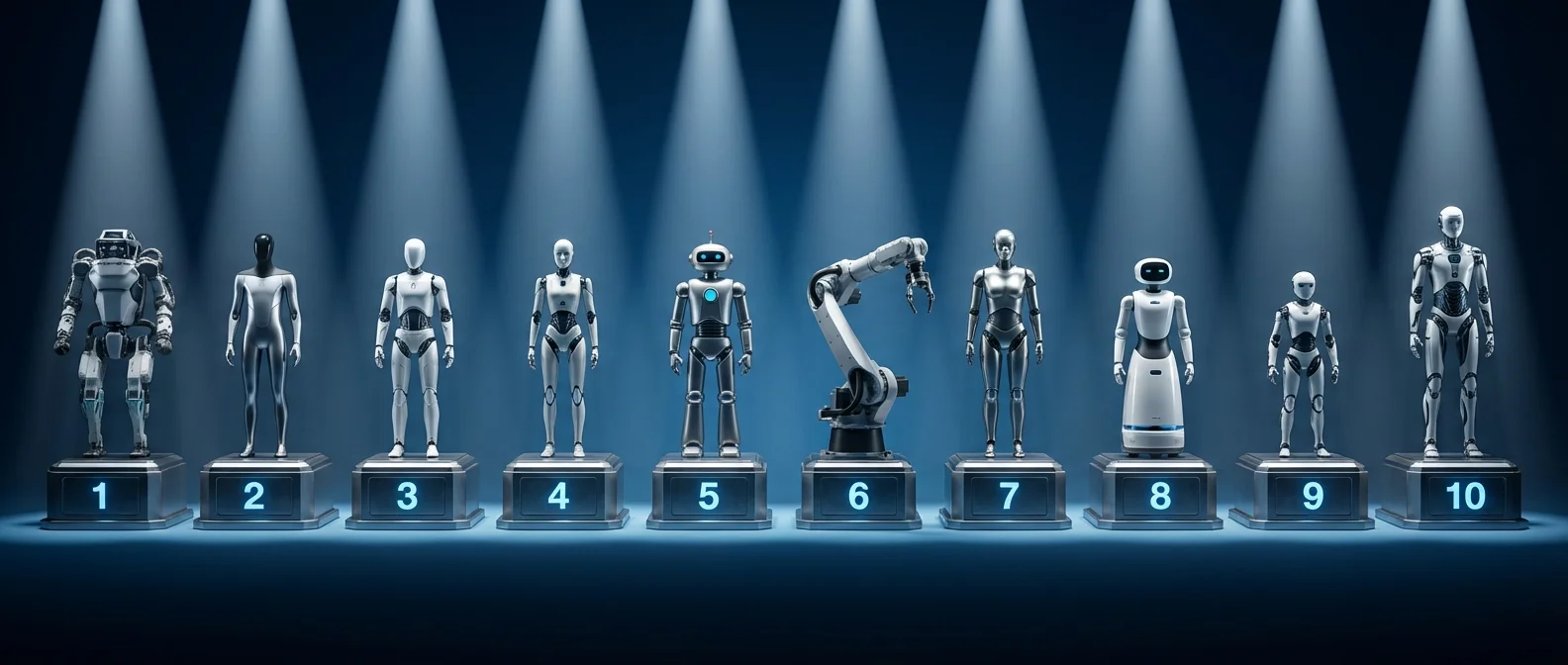
Humanoid robots are no longer lab prototypes — they're products shipping to factories, warehouses, and soon, homes. 2026 marks a historic year: at least 10 companies worldwide have humanoid robots either commercially available or in active pilot deployments.
Here's our definitive ranking of the 10 best humanoid robots of 2026 — scored on technology, commercial maturity, and real-world impact.
🏆 The Ranking
Tesla Optimus Gen 3
Tesla's third-generation humanoid is the most commercially ambitious robotics project on the planet. Optimus is already performing basic tasks inside Tesla's own factories, and mass production through Foxconn is underway. Elon Musk is targeting a price point of $20,000–30,000 and eventual production in the millions. Its 22-degree-of-freedom hands can handle objects with remarkable precision, and the entire platform leverages Tesla's autonomous driving AI stack.
Boston Dynamics Atlas (Electric)
The transition from hydraulic to fully electric in April 2024 transformed Atlas. With a 360° rotating head, joints that exceed human range of motion, and over 30 years of foundational locomotion research, Atlas remains the most dynamic humanoid in existence. It's currently being piloted in Hyundai and Kia automotive facilities, handling tasks too complex for conventional industrial robots.
Figure AI Figure 02
Backed by a jaw-dropping $675M Series B from Jeff Bezos, Microsoft, NVIDIA, and OpenAI, Figure AI has rocketed to the top tier. The Figure 02 integrates an OpenAI language model for natural interaction, is being piloted at BMW's manufacturing facility, and learns new tasks through observation learning. Few startups in history have assembled this caliber of investor lineup or technology stack.
Unitree G1
The G1 shattered every price record: just $16,000 for a fully capable humanoid robot. Don't let the price fool you — this Chinese powerhouse uses reinforcement learning, performs acrobatic maneuvers, self-recovers from falls, and ships with a developer SDK. That price point means research labs and startups worldwide can access humanoid technology without multi-million-dollar budgets.
Agility Robotics Digit
Digit holds a unique distinction: it's the first humanoid robot with genuine commercial traction at scale. It operates in Amazon warehouses, works the floor at a Spanx facility through GXO Logistics, and Agility has opened RoboFab — the first humanoid robot factory in the US, with capacity for 10,000 units per year. Spun out of Oregon State University in 2015, Agility now offers Robot-as-a-Service (RaaS), flipping the ownership model on its head.
1X Technologies NEO
This Norwegian startup, backed by the OpenAI Fund, designed NEO specifically for the home. At just 30 kg, it's the lightest full-size humanoid on the market — safe enough to coexist with people in domestic settings. The “embodied AI” philosophy means NEO learns through physical interaction, not just data. If any robot is poised to become the home companion of the future, it's this one.
Apptronik Apollo
Apollo traces its DNA to NASA research at the University of Texas. Built for industrial logistics, it's being piloted alongside Mercedes-Benz on factory floors. Modular hot-swappable batteries enable near-continuous operation, and its force-controlled joints allow safe human-robot collaboration. Apollo represents the aerospace-to-industry pipeline at its finest.
Sanctuary AI Phoenix
The Canadian company describes itself as building “the world's first human-like intelligence in robot form.” Phoenix runs on Carbon — a proprietary AI control system designed specifically for general-purpose object manipulation. Rather than training robots on isolated tasks, Sanctuary built a system capable of learning anything. It's the closest thing to a truly general-purpose robot brain on the market today.
Fourier Intelligence GR-2
Fourier started in medical rehabilitation robotics before pivoting to humanoids. The GR-2 blends medical-grade precision with industrial durability, and its open-platform approach means developers can customize it freely. It bridges the gap between medical robotics and general-purpose humanoids — a niche no other company occupies.
XPENG Iron
Chinese EV giant XPENG entered the humanoid space with Iron, unveiled at CES 2026. The company brings its autonomous driving expertise and custom AI chips directly to robotics. The strategy is clear: leverage massive EV production scale to manufacture robots at competitive prices. If Tesla's approach works, XPENG's might work even faster in the Chinese market.
📊 Head-to-Head Comparison
| # | Robot | Company | Country | Height | Weight | Focus |
|---|---|---|---|---|---|---|
| 1 | Optimus Gen 3 | Tesla | 🇺🇸 | 173cm | 57kg | Factory / Home |
| 2 | Atlas Electric | Boston Dynamics | 🇺🇸 | 150cm | 89kg | Industrial |
| 3 | Figure 02 | Figure AI | 🇺🇸 | 168cm | ~60kg | Industrial / AI |
| 4 | G1 | Unitree | 🇨🇳 | 127cm | 35kg | Research / Dev |
| 5 | Digit | Agility | 🇺🇸 | 175cm | ~65kg | Logistics |
| 6 | NEO | 1X Technologies | 🇳🇴 | 165cm | 30kg | Home |
| 7 | Apollo | Apptronik | 🇺🇸 | 172cm | 73kg | Industrial |
| 8 | Phoenix | Sanctuary AI | 🇨🇦 | 170cm | N/A | General Purpose |
| 9 | GR-2 | Fourier | 🇨🇳 | 175cm | 63kg | Medical / General |
| 10 | Iron | XPENG | 🇨🇳 | 178cm | 70kg | Consumer |
🔍 Key Trends
📌 5 Takeaways From the 2026 Humanoid Landscape
- China dominates on price: With the Unitree G1 at $16,000, China is making humanoids accessible. Three of the 10 companies on this list are Chinese.
- Robot-as-a-Service (RaaS) is here: Agility Robotics pioneered the rental model for humanoid robots — reducing risk for adopting companies and opening the market wide.
- AI is the new battleground: Figure with OpenAI, 1X with OpenAI Fund, Sanctuary with Carbon — artificial intelligence now separates the best robots from the rest, not hardware alone.
- EV makers are coming in hot: Tesla and XPENG are leveraging their automotive production lines for robot manufacturing — their scale is unmatched by pure robotics startups.
- The home is the ultimate prize: Optimus, NEO, and Iron all target consumers. The first company to ship a reliable home humanoid wins the biggest market in history.
🏁 Who Will Win?
No single robot dominates every category. Each robot serves a different need. Atlas is unmatched in agility, the G1 in affordability, Digit in commercial readiness, NEO in home safety, and Optimus in sheer ambition and scale.
What's certain is this: by 2028–2030, humanoid robots will be as commonplace as industrial robotic arms are today. This list will look dramatically different in just two years — but as of February 2026, these are the 10 robots making history.