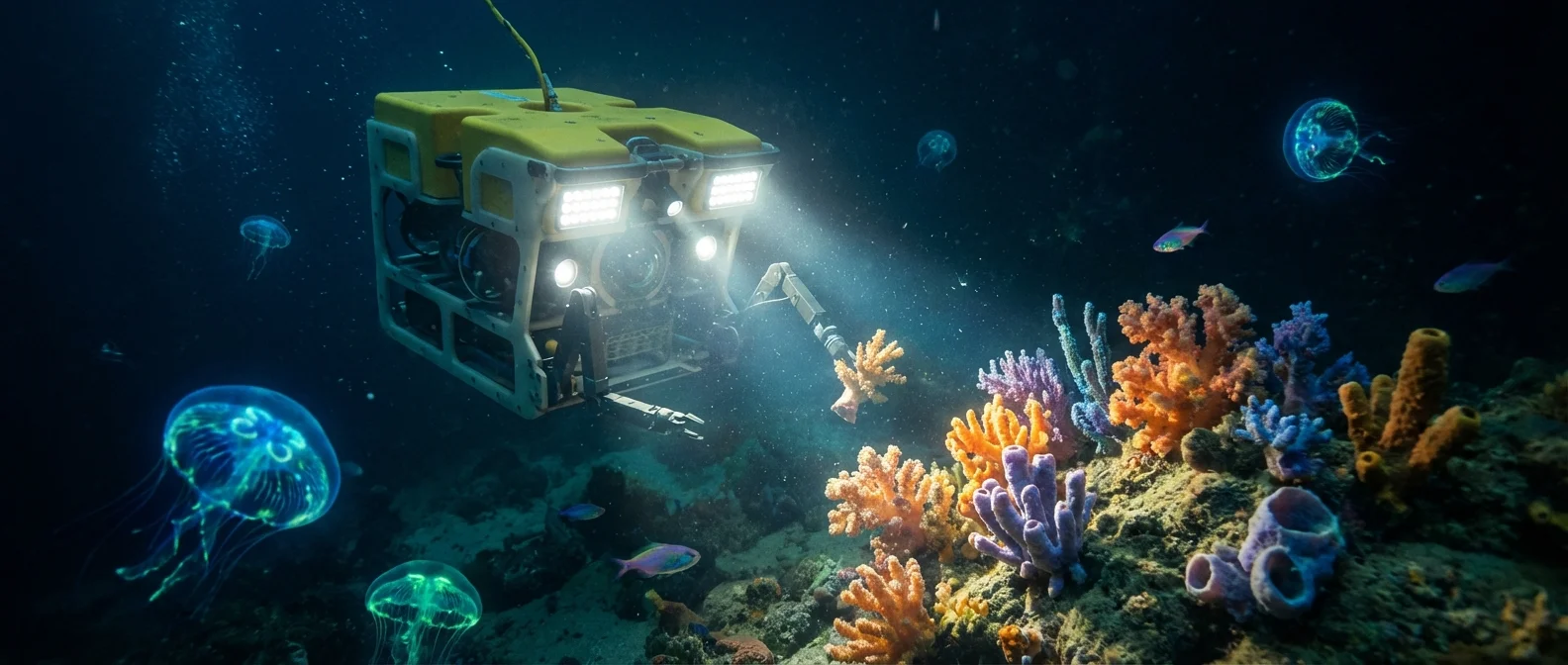
We know more about the surface of Mars than we do about the bottom of our own oceans. Over 80% of the ocean floor remains unmapped, and only robotic systems can survive the crushing conditions thousands of meters below the surface. Underwater robots — ROVs, AUVs, and soft robots — serve as our eyes and hands in the deepest places on Earth.
📖 Read more: Fauna Sprout: The Soft Humanoid Robot You Can Actually Hug
Types of Underwater Robots
Underwater robotics falls into three main categories, with a fourth — soft robots — rapidly emerging in recent years. Each type serves different needs, from industrial inspection to scientific exploration of uncharted depths.
Remotely Operated Vehicle — Tethered
ROVs connect to their surface ship via an umbilical cable that carries power, video, and data. They're primarily used in the oil and gas industry, as well as scientific expeditions. Work-Class ROVs reach depths of 3,500 meters and carry hydraulic arms, sonar arrays, and high-definition cameras.
- Continuous power supply through tether
- Real-time live video feed
- Robotic manipulator arms for physical tasks
- Limited range due to tether length
Autonomous Underwater Vehicle — Untethered
AUVs travel without any cable, following pre-programmed routes. They rely on lithium batteries, inertial navigation systems (INS), and Doppler Velocity Logs (DVL) to track their position on the seafloor. The first AUV — SPURV — was built at the University of Washington back in 1957.
- Full freedom of movement
- Capable of mapping vast areas of ocean floor
- 10–80 hours of endurance (depending on class)
- Cannot transmit live video in real time
Hybrid ROV — Shape-Shifting
Hybrid vehicles — like the legendary Nereus built by WHOI — can switch modes: autonomous navigation for surveying wide areas, or remote control via a fiber-optic tether (as thin as a human hair) for detailed exploration. They weigh about 3 tons and carry roughly 2,000 lithium-ion batteries.
- Dual mode (autonomous + remotely operated)
- 40 km of fiber-optic cable in compact canisters
- Ceramic flotation spheres instead of syntactic foam
- Expensive to build and maintain
Soft Robots — Nature-Inspired
Inspired by octopuses, jellyfish, and rays, soft robots are made from flexible materials (silicone, polymers) instead of metal. In 2021, Chinese researchers deployed a self-powered soft robot to the Mariana Trench at 10,900m depth, proving these machines can withstand extreme pressure thanks to their distributed electronics embedded within a silicone body.
- Outstanding resilience under extreme pressure
- Bio-inspired locomotion (artificial muscles/fins)
- Won't startle marine wildlife
- Still largely in the research phase
Historic Missions That Changed Everything
From the 1960s to today, underwater robots have made history by discovering shipwrecks, probing uncharted depths, and transforming our understanding of deep-sea life.
CURV — Nuclear Bomb Recovery
The U.S. Navy's Cable-Controlled Underwater Recovery Vehicle retrieved a nuclear bomb from the Mediterranean Sea after a B-52 crash near Palomares, Spain — the first major ROV mission in history.
📖 Read more: Home Security Robots: AI Guards That Never Sleep
Discovery of the Titanic
Robert Ballard used ROVs to locate the wreck of the RMS Titanic at a depth of 3,800m in the North Atlantic. ROVs have since recovered artifacts from the site — most recently in July 2024 using a magnetometer.
Kaikō — First Unmanned Vehicle at Challenger Deep
Japan's Kaikō ROV, operated by JAMSTEC, became the first unmanned vehicle to reach the deepest point on Earth (10,994m) in the Mariana Trench. It was later lost in a typhoon in 2003.
Nereus — Hybrid Marvel at Challenger Deep
WHOI's Nereus descended to 10,902m — only the third vehicle to reach the bottom after the Trieste (1960) and Kaikō. Its hybrid design with ceramic flotation spheres was groundbreaking. It hovered over the trench for 10+ hours. In May 2014, it imploded at 9,900m depth in the Kermadec Trench.
Bluefin-21 — Searching for Air France Flight 447
The AUV ABYSS located the wreckage of Air France Flight 447 in the Atlantic, while the Bluefin-21 was later deployed in the search for Malaysia Airlines Flight MH370.
Soft Robot in the Mariana Trench
Chinese researchers published a Nature study featuring a self-powered soft robot that swam at 10,900m depth — using artificial muscles and distributed electronics in a silicone body, with no rigid pressure hull whatsoever.
Operating Depths: Which Goes Deepest?
Maximum Depth Comparison
The Technology: How They Work
Thousands of meters below the surface, radio waves are absorbed almost instantly by seawater. Every technological solution must tackle three fundamental challenges: extreme pressure, the absence of GPS, and total darkness.
📖 Read more: How Much Does a Humanoid Robot Cost in 2026?
Navigation
Inertial Navigation Systems (INS) + Doppler Velocity Logs (DVL) + acoustic beacons (LBL/USBL). AUVs periodically surface for GPS fixes.
Power
Lithium batteries (ROV/AUV), aluminum-based semi-fuel cells, and experimental hydrogen fuel cells. Underwater gliders change buoyancy with no motor at all.
Communication
Acoustic modems (~80 BPS via JANUS/NATO protocol), optical, inductive, or RF systems. ROVs use fiber optics through their tether cable.
Sensors
4K cameras, side-scan sonar, magnetometers, CTD sensors (conductivity–temperature–depth), fluorometers, pH probes, and Raman spectrometers.
Applications: From Oil Rigs to Archaeology
Underwater robots aren't just for scientists. The oil and gas industry represents the largest user of ROVs worldwide, while new applications keep emerging every year.
🛢️ Oil & Natural Gas
Work-Class ROVs install, inspect, and maintain subsea pipelines and platforms at depths exceeding 3,000 meters. Since the 1980s, they've replaced human divers at depths beyond human limits. In recent years, mini ROVs have slashed inspection costs dramatically.
🔬 Scientific Research
Institutions like MBARI (Monterey Bay), WHOI (Woods Hole), and IFREMER (France) deploy ROVs and AUVs to explore hydrothermal vents, discover new species (like the jellyfish Stellamedusa ventana), study Arctic sea ice, and monitor ocean chemistry. The Schmidt Ocean Institute's ROV SuBastian has been operating since 2016 at depths of up to 4,500m.
⚓ Military Operations
The U.S. Navy uses the AN/SLQ-48 Mine Neutralization Vehicle for mine clearance at depths up to 610m. Boeing's Orca AUVs (ordered in 2019) are the first unmanned submarines with combat capability. In the Ukraine–Russia conflict, autonomous surface vessels (USVs) shifted the balance at sea, accelerating development of fully submersible AUVs.
📖 Read more: Hugging Face: Build a DIY Robot Arm for €100
🏺 Underwater Archaeology
The ROV Hercules from the Nautilus Exploration Trust explores shipwrecks worldwide, while the CoMAS project has mapped ancient wrecks across the Mediterranean. The excavation of the “Mardi Gras Shipwreck” at 4,000 feet in the Gulf of Mexico stands as the deepest archaeological dig ever undertaken.
🎬 Filmmaking & Documentation
ROVs star in documentaries (Nat Geo, BBC Wildlife) thanks to their ability to stay submerged indefinitely. Notable examples include “Shark Men,” “The Dark Secrets of the Lusitania,” and CBS's CSI franchise.
The Future: Bio-Inspired Robots & AI
The next generation of underwater robots won't look like yellow submarines — they'll resemble octopuses, jellyfish, and manta rays. Bio-inspired design, combined with Artificial Intelligence, promises robots that explore our oceans silently, efficiently, and fully autonomously.
Biomimetic AUVs
Robot fish from MIT, Festo (AquaJelly), and EvoLogics (BOSS Manta Ray) mimic natural swimming for superior energy efficiency.
On-Board AI
Next-gen AUVs process data while diving, with no need for operator commands. They identify objects, dodge obstacles, and reroute themselves autonomously.
Deep-Sea Mining
AUVs are being designed to harvest polymetallic nodules from the ocean floor — a multi-trillion-dollar frontier, though one fraught with environmental questions.
Ocean Internet
Networks of AUVs and gliders serving as communication and navigation nodes. NASA is even looking into soft robots to explore the ocean beneath Europa's ice shell.
Key Takeaway
Underwater robots are our only gateway to a world that covers over 70% of the Earth's surface. From the first nuclear bomb recovery mission (1966) to soft robots swimming through the Mariana Trench (2021), the technology has advanced at a staggering pace. With ROVs, AUVs, hybrids, and soft robots probing depths of 10,000+ meters, the 21st century belongs to deep-sea exploration — the last truly unexplored frontier on our planet.