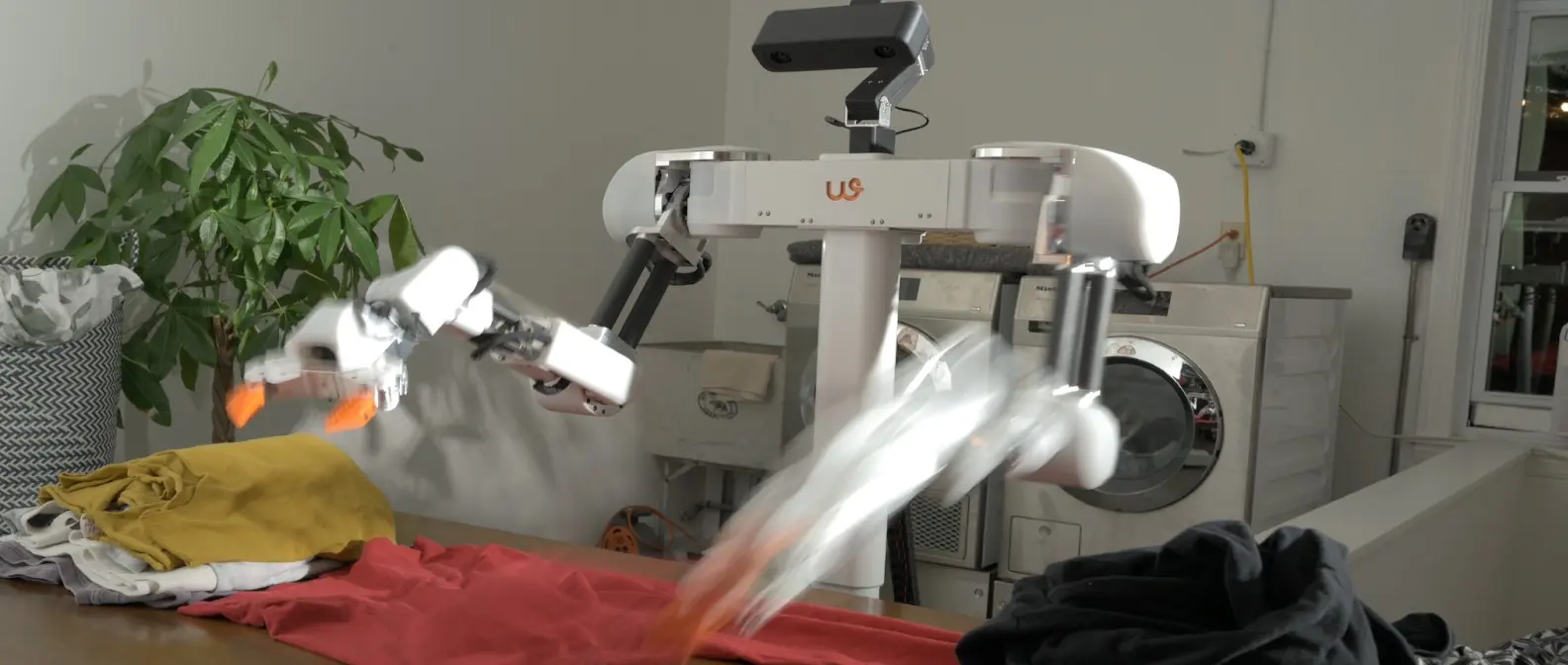
For decades, the laundry-folding robot was the tech industry's running joke — a promise made at every consumer electronics show, followed by bankruptcy filings instead of shipping dates. Companies like FoldiMate and Seven Dreamers (Laundroid) spent millions, showcased prototypes on stage, and ultimately disappeared without delivering a single working product. Weave Robotics claims this time is different — and for the first time, the evidence backs them up.
📖 Read more: LG AI Agent: The Robot That Cleans and Folds Clothes
🧺 A History of Broken Promises
The quest for a household laundry-folding robot isn't new. American startup FoldiMate was founded in 2010 and showcased prototypes at CES three times — in 2016, 2017, and 2018. The machine accepted garments manually from the top, folded them, and returned neat stacks at the bottom. The company promised a commercial launch by late 2019, but in July 2021, it quietly shut down operations.
Japan's Laundroid met a similar fate. An ambitious all-in-one system designed to wash, dry, iron, and fold clothes, it debuted at the CEATEC exhibition in 2015 and was marketed as “the world's first robot that washes and folds laundry.” Backed by major Japanese corporations including Daiwa House and Panasonic, the project aimed for a 2017 launch — later pushed to 2019. Instead, its parent company Seven Dreamers filed for bankruptcy in 2019, leaving behind a $16,000 machine that never reached a single customer.
This track record created well-earned skepticism. When Weave Robotics announced the Isaac 0 in February 2026, the immediate reaction was predictable: “Why should this time be any different?” The answer lies in the approach — and an unusually realistic level of ambition.
🏠 What Exactly Is the Isaac 0
The Isaac 0 is a stationary laundry-folding robot designed exclusively for the home. Unlike the overambitious prototypes of the past that promised to do everything — wash, dry, iron, fold — the Isaac 0 focuses on one thing: folding clothes. And according to Weave, it does it well.
Setup is straightforward. The robot sits on a table (recommended dimensions: 48" × 30″), plugs into a standard 120V wall outlet, and is ready to work within a few hours. No special training is required, no professional installation — Weave handles the setup on delivery day.
Using it is equally simple: drop a load of laundry on the table, hit start, and walk away. In 30 to 90 minutes, depending on the load size, you'll return to find neat stacks of folded clothes. The Isaac 0 handles t-shirts, long-sleeve shirts, sweaters, hoodies, pants, and towels — and its repertoire grows daily.
📖 Read more: SwitchBot Onero H1: The Humanoid That Does Your Laundry
🧠 AI in Service of Laundry
What sets the Isaac 0 apart from the failed prototypes of the past is its learning architecture. This isn't a “dumb” machine running pre-programmed motions. The Isaac 0 runs AI models that are updated weekly, making each fold faster and more precise than the last.
When the robot encounters a particularly tricky garment or makes a mistake it doesn't yet know how to correct, a Weave specialist can step in remotely — taking over for just 5 to 10 seconds, fixing the issue, and handing control back to the robot. This blend of autonomy and human oversight means the Isaac 0 can handle virtually any laundry load from day one, without the user needing to “train” the machine.
Every correction becomes training data. The AI models are updated weekly, which means the same difficulty won't arise twice. Over time, human interventions decrease steadily — the robot literally learns from every garment it folds.
⚙️ Technical Specifications
Despite its minimalist design philosophy, the Isaac 0 packs serious engineering under the hood. Its frame includes 19 degrees of freedom: 4 in the neck, 6 in each arm, 1 in each hand, and 1 in the torso. This gives it movements flexible and precise enough to handle different fabrics, shapes, and garment types.
| Specification | Detail |
|---|---|
| Power | 600W (120V wall outlet) |
| Connectivity | Ethernet or WiFi (2.4/5 GHz) |
| Footprint | 18" × 19" (W × D) |
| Height | 2'6" – 5'7″ |
| Degrees of Freedom | 19 (Neck 4, Arms 2×6, Hands 2×1, Torso 1) |
| Table | Recommended 48" × 30″ |
| Folding Time | 30–90 minutes per load |
| Garment Types | T-shirts, long sleeves, sweaters, pants, towels |
The design philosophy is "safety through simplicity": a stationary base, low center of gravity, custom-designed arms, carefully selected motors and materials, and as few components as possible. Nothing superfluous — only what's needed to fold laundry reliably.
💰 Pricing: Premium, but Actually Real
Let's address the elephant in the room: $7,999. Yes, it's not cheap. But there's an alternative: a $450-per-month subscription, cancelable at any time. Either way, the deposit is $250 — fully refundable.
For perspective: the Laundroid was announced at $16,000 and never shipped. FoldiMate never even got far enough to announce a price before shutting down. The Isaac 0 costs less than half what the Laundroid would have, and it actually exists. It actually works. It actually ships.
📖 Read more: Top 5 Robot Vacuums 2026: Complete Buying Guide
Deliveries begin in February 2026, initially limited to San Francisco Bay Area residents. Early customers receive preferred upgrade pricing for future products, custom engraving on their Isaac 0, and direct access to the Weave team to help shape the product roadmap.
🔮 Beyond Laundry: The Bigger Picture
Weave Robotics isn't stopping at folding clothes. The product is called Isaac "0″ for a reason: it's the first, stripped-down version of a larger vision. The company is simultaneously developing Isaac — a mobile robot that will move through the home, fold laundry, tidy up messes, and essentially serve as a “second caretaker” for your household.
Founded in the summer of 2024, Weave took an approach that inverts the logic of most robotics startups: instead of starting with an impressive demo that might someday become a product, they started with a real problem — laundry — and worked backward toward the solution. The results speak for themselves: a fleet of Isaac 0 units has been operating for months at commercial clients, folding thousands of pounds of laundry every month.
"Product categories are built collaboratively, through an ongoing conversation between companies and customers. That conversation for the next generation of home robots hasn't really started yet. The next couple of years will set the foundation." — Weave Robotics, February 2026
The comparison to the early days of personal computers is deliberate. In 1981, an IBM PC cost around $1,500 (roughly $5,000 in today's money), was extremely limited in capability, and few believed it would change the world. Forty years later, every household has multiple computing devices. Weave is betting that home robots will follow a similar trajectory — and the Isaac 0 is where that story begins.
📊 Is It Worth the Investment?
The honest answer is: it depends. If laundry is a significant pain point in your daily life — large family, mountains of clothes, time you can't afford to lose — then $450 a month may be worth every penny. Consider the math: if you spend 5 to 6 hours a week folding laundry (entirely realistic for a family of four), that adds up to over 280 hours a year. Hours the Isaac 0 could give back to you.
If you live alone and your laundry amounts to two loads a week, then $7,999 is a tough sell — at least at this stage. But technology matures fast. Prices drop. Robots improve. What's a premium product today could cost as much as a dishwasher in five years.
The Isaac 0 isn't perfect — Weave says so openly. It's first-generation, limited in availability, and will continuously improve through software updates. But for the first time in history, a laundry-folding robot isn't stuck in the prototype stage. It's designed and built in California, shipping to real homes, and folding real clothes. That alone is a milestone.