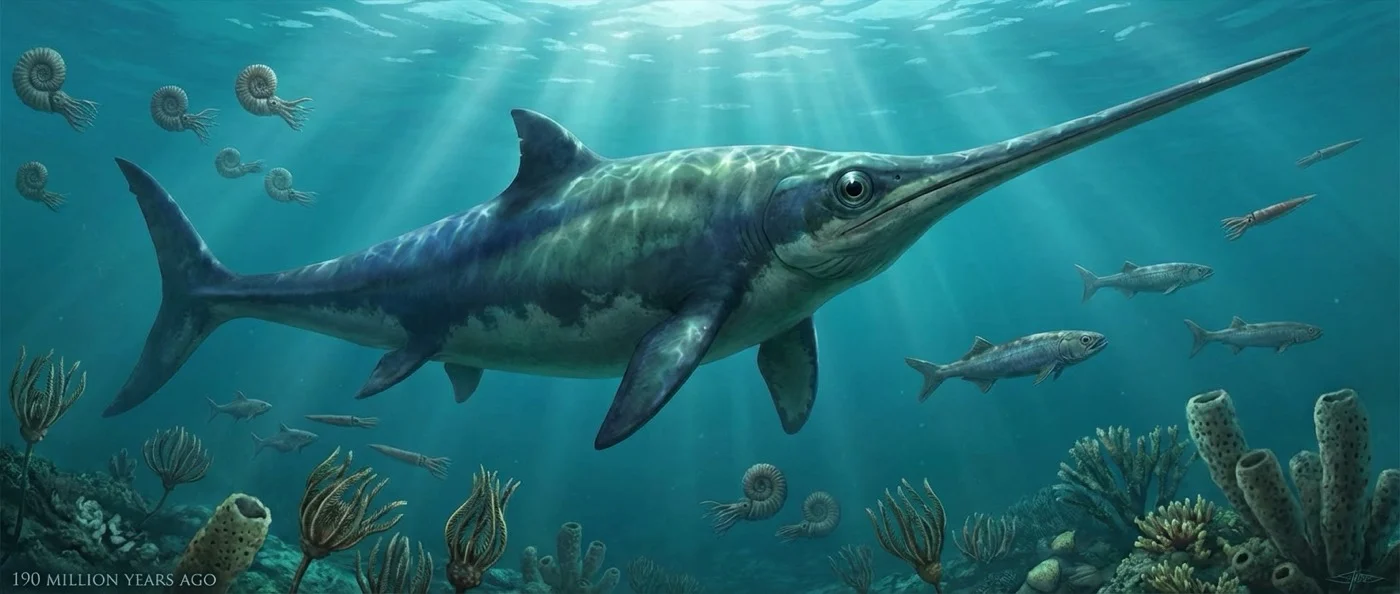
A fossilized jawbone that spent 20 years in a museum collection has turned out to be one of the decade's most significant paleontological finds: Xiphodracon goldencapensis, a new genus of ichthyosaur from 190 million years ago, discovered in the cliffs near Dorset's Golden Cap with a remarkable sword-like snout — the genuine “Sword Dragon of Dorset.”
📖 Read more: 95-Million-Year-Old Spinosaurus: New Sahara Desert Discovery
🐢 The Discovery — From Museum Shelf to New Genus
In 2001, amateur fossil hunter Chris Moore spotted the specimen eroding out of the shale cliffs near Golden Cap — the highest point on the south coast of England. The fossil was transferred to the Royal Ontario Museum in Toronto, where it sat in the collection untouched for 15 years. Dr. Dean Lomax of the University of Manchester took the specimen into study in 2016 and spent nearly a decade identifying it as an entirely new genus of ichthyosaur unknown to science.
The paper was published in Papers in Palaeontology (DOI: 10.1002/spp2.70038) on February 24, 2026, co-authored by Judy Massare (SUNY Brockport) and Erin Maxwell (Stuttgart State Museum of Natural History).
🦕 Key Facts: Xiphodracon goldencapensis
Name: Xiphodracon = sword dragon (Greek: xiphos + drakon), goldencapensis = from Golden Cap, the discovery site. It lived during the Pliensbachian stage of the Early Jurassic (~190 million years ago), measured approximately 3 meters long, and was distinguished by a slender, elongated, sword-like snout and large eyes. It was the first new Early Jurassic ichthyosaur genus from the Jurassic Coast in over 100 years.
📖 Read more: Arctic Lakes Releasing 14,000-Year-Old Ancient Carbon
🔍 Scientific Importance: Filling a Chronological Gap
Marine ichthyosaurs from the Pliensbachian stage (193–184 million years ago) were exceptionally poorly known from fossils — one of the most significant chronological gaps in the ichthyosaur record. Xiphodracon fills this gap, providing a key reference point for the evolutionary history of Mesozoic marine reptiles.
Just before the Pliensbachian, ichthyosaurs were relatively small and differently shaped. The geological upheaval that led to their decline at the end of the Pliensbachian was followed by a successful re-diversification in the Toarcian and Jurassic — a story Xiphodracon now helps tell from the inside.
📖 Read more: 40,000-Year-Old Signals: The Precursor to Writing Is Proven
🔎 Injuries and Bite Marks — A Life of Peril
Xiphodracon did not live a peaceful existence. The limb bones showed signs of joint disease or injury, and the teeth displayed structural abnormalities. Most strikingly: the skull bore visible bite marks from a larger ichthyosaur — evidence that it was attacked by an apex predator of its time. This shows not just that cannibalism occurred, but that ichthyosaurs occupied multiple levels of the food web, both as hunters and as prey.
"This animal fills a significant chronological gap in our understanding of Pliensbachian ichthyosaurs."
— Dr. Dean Lomax, Paleontologist, University of Manchester🏹 Paleontological Legacy — The Jurassic Coast Keeps Delivering
Ichthyosaurs first appeared in the seas of northern Europe shortly after the end-Permian mass extinction (~252 million years ago) and are considered among the most successful marine reptile lineages ever to evolve. Knowledge of Pliensbachian species — one of the chronologically emptiest windows in the ichthyosaur fossil record — will help researchers understand how the group entered one of the most productive radiations in early marine vertebrate history.
The Jurassic Coast, a UNESCO World Heritage Site stretching 95 miles along Dorset and East Devon, continues to produce world-class fossil discoveries — often thanks to amateur collectors like Chris Moore, whose observations regularly bring new species to science's attention.
🌊 Summary: Xiphodracon goldencapensis
- Age: ~190 million years (Pliensbachian, 193–184 Ma)
- Length: ~3 meters
- Discovery site: Golden Cap, Jurassic Coast, Dorset, England
- Found: 2001 by Chris Moore
- Now housed: Royal Ontario Museum, Toronto (future public display expected)
- Distinctive features: Elongated sword-like snout, large eye sockets, bite marks on skull