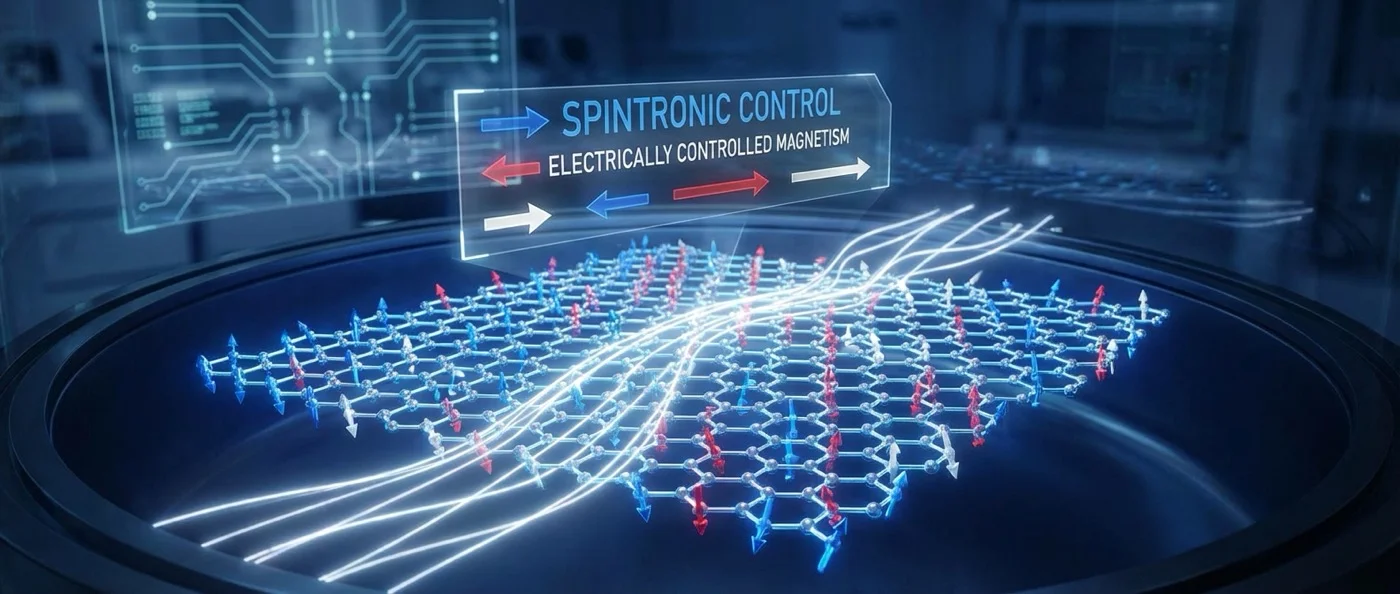
Two-dimensional (2D) magnetic materials — crystals just a few atoms thick — are at the cutting edge of spintronics research, a technology that harnesses the spin (angular momentum) of electrons instead of their charge. Two extraordinarily recent discoveries are fundamentally changing what we knew: one creates magnetic vortex-"ghosts" in twisted 2D materials, the other overturns a theory that dominated for decades.
📖 Read more: The World's First Triple Superconductor Discovered
🌀 Skyrmions: Magnetic Vortices in Twisted Chromium Iodide
An international research team led by Professor Jörg Wrachtrup at the University of Stuttgart achieved something unprecedented: they created and directly observed skyrmions — nanoscale topologically protected magnetic structures — in a twisted two-dimensional magnetic material, for the first time. The study was published in Nature Nanotechnology (February 2026).
The material? Chromium iodide (CrI₃) — a 2D antiferromagnetic material just four atomic layers thick. The critical innovation was simple yet ingenious: the team slightly rotated two CrI₃ bilayer sheets relative to each other, creating a “moiré pattern” — an interference geometry at the atomic scale.
🔑 What Are Skyrmions?
Skyrmions are microscopic magnetic vortices — “whirlpools” of spin — that behave like particles. They are topologically protected (exceptionally stable) and can be moved using electric current. They are considered the smallest and most durable information storage units in magnetic systems — each skyrmion can represent a single “bit.”
This microscopic twist triggered an entirely new magnetic state. Dr. Ruoming Peng, a postdoctoral researcher at Stuttgart's 3rd Physics Institute, explained: "We can selectively control this magnetism by tuning the interactions between electrons in the individual layers. What is particularly remarkable is that the observed magnetic properties are robust against environmental perturbations."
The detection was equally impressive: the team used NV-center quantum sensors in diamond — a technology developed at Stuttgart's Center for Applied Quantum Technologies — to “see” the extremely faint magnetic signals.
📖 Read more: Quantum Materials Hit 40% Efficiency in Solar Hydrogen
⚡ The Upheaval: A New Explanation for Magnetoresistance
Meanwhile, a second discovery is shaking the foundations of spintronics. Professor Lijun Zhu (Chinese Academy of Sciences) and Professor Xiangrong Wang (Chinese University of Hong Kong) published findings in National Science Review (February 2026) that overturn the Spin Hall Magnetoresistance (SMR) theory — the dominant explanation for a mysterious phenomenon for decades.
The phenomenon is called Unusual Magnetoresistance (UMR): the electrical resistance of a heavy metal changes when placed next to a magnetic material. SMR theory explained this through spin currents. But researchers kept observing UMR everywhere — even in systems without spin Hall materials, where SMR shouldn't apply at all.
— Professor Jörg Wrachtrup, University of Stuttgart
The new explanation — the "two-vector magnetoresistance" model — is far simpler: resistance changes because electrons scatter at material interfaces under the combined influence of magnetization and electric field. No spin currents required — a dramatic simplification.
📖 Read more: Scientists Created Time Crystal from Styrofoam Material
💾 What Changes for Data Storage
Creating skyrmions in 2D materials opens the path to ultra-high-density memories. Unlike traditional magnetic bits, skyrmions can be “written” and “erased” with small electric voltages — ideal for low-power devices. Simultaneously, the overthrow of SMR theory means spintronics engineers can now design devices based on a single, universal model, instead of dozens of conflicting explanations.
🔮 Future Prospects
The convergence of these two discoveries paints an impressive future:
Next-generation quantum memories: 2D skyrmion memories could replace hard drives, storing hundreds of times more data in the same space — with zero standby power.
Spintronic logic gates: Instead of classical electronics (charge), future chips may use spin — dramatically reducing power consumption and heat.
Quantum sensing: The use of NV-centers in diamonds as sensors shows that quantum technologies are entering practical applications for measuring magnetic fields.
Prof. Wrachtrup emphasized: "Our results are directly relevant for next-generation data storage technologies. At the same time, they are of fundamental importance, as they provide new insights into magnetic interactions in atomically thin materials." The collaboration included teams from the UK, Japan, USA, Canada, and Germany.