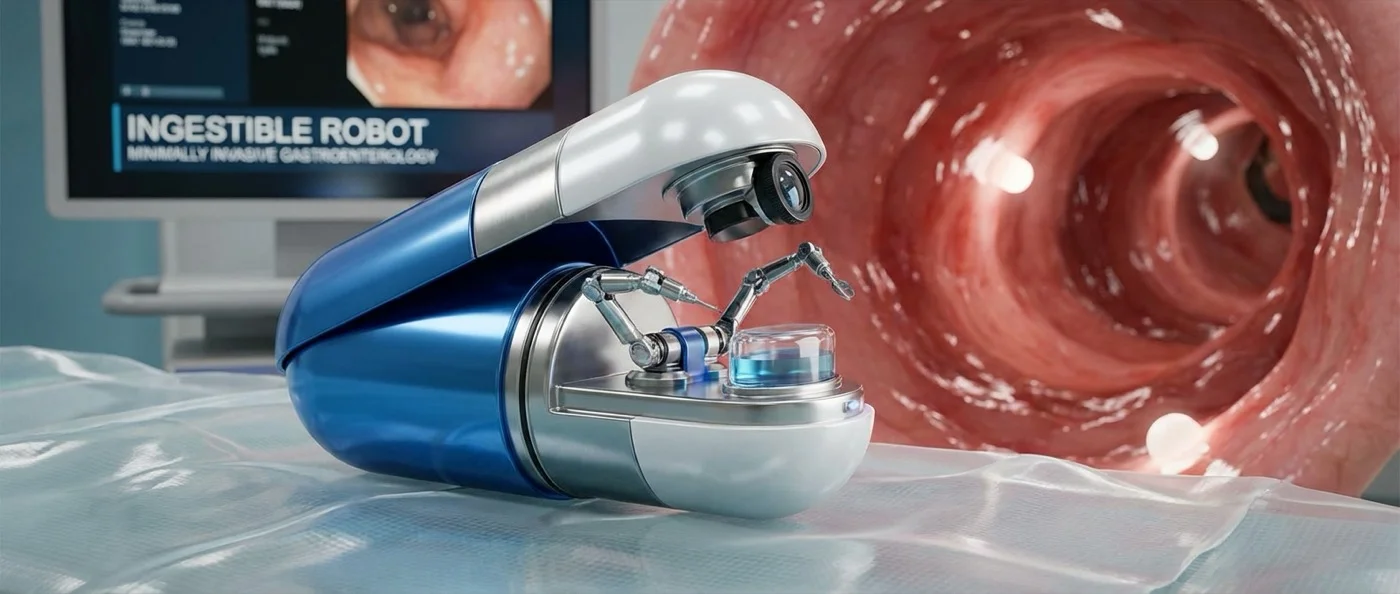
Imagine a colonoscopy without the tube, without anesthesia, without disrupting your routine. A tiny pill-sized robot — with a 3D-printed shell and magnetic navigation — is swallowed like a capsule and autonomously explores the entire gastrointestinal tract, transmitting high-resolution video in real time.
📖 Read more: Insulin Without Needles: The Gel That Changes Everything
The Problem: Why We Avoid Colonoscopies
Colonoscopy remains the most effective way to detect colorectal cancer — the second leading cause of cancer death worldwide. Yet the procedure requires sedation, is uncomfortable, and many patients postpone it indefinitely. By some estimates, over 30% of people who should undergo a colonoscopy never actually do so.
At the same time, cancers of the gastrointestinal (GI) tract — esophageal, stomach, and intestinal — are among the most common globally. Early detection dramatically increases survival rates — but requires an examination that patients today actively avoid.
3D-Printed Shell, Magnetic Propulsion
Behind this medical revolution are two parallel research efforts. At the Chinese University of Hong Kong (CUHK), engineers at the Institute of Precision Engineering created the “Tadpole Endoscope” — a tadpole-shaped endoscope with a 3D-printed shell. The device houses control electronics, a slot for a wireless video camera, and a flexible tail that flaps like a fish fin, propelling it through the stomach.
The propulsion mechanism relies on two permanent magnets of opposing polarity and a coil. When the coil is energized via external magnetic fields — generated by coils outside the body — the tail flaps rhythmically, like a tadpole, and the capsule navigates autonomously through the GI system.
🖨️ 3D-Printed Shell
Customizable size and shape, lightweight, biocompatible — produced in hours instead of weeks.
🧲 Magnetic Navigation
External magnetic fields guide the device without wires or large batteries.
📹 Wireless Video
Live image transmission to the doctor — with recording capability for AI analysis afterward.
📖 Read more: New Perovskite Solar Cell Produced Without Toxic Solvents
From Camera to Surgeon-Capsule
At Vanderbilt University and the University of Leeds, researchers took it a step further. Dr. Keith Obstein's team developed an 18 mm robotic capsule that not only captures images but also performs therapeutic actions — tissue biopsies and polyp removal — thanks to an ultra-thin tether, far smaller than a conventional endoscope.
The capsule is guided by a robotic arm with an external magnet. In 30 successful trials in a pig's colon, the device even completed the difficult “retroflexion” maneuver — a 180° turn to view the intestinal wall in reverse.
❌ Traditional Colonoscopy
- ⚠️ Requires sedation/anesthesia
- ⚠️ Unpleasant patient experience
- ⚠️ Large flexible scope (>10mm)
- ⚠️ Recovery time after procedure
- ⚠️ Risk of bowel perforation
✅ Robotic Capsule
- ✔️ Zero anesthesia
- ✔️ Swallowed like a pill
- ✔️ 18mm — vitamin-sized
- ✔️ Patient goes home immediately
- ✔️ Biopsy + polyp removal capable
The Evolution: AI, New Materials, Clinical Trials
Capsule endoscopy technology isn't new. Since 2001, the PillCam (Given Imaging, now Medtronic) introduced passive capsule cameras that simply transmitted images as they passed through the digestive tract. However, they couldn't be steered, stop at suspicious areas, or take tissue samples.
Modern robotic capsules overcome these limitations. With 3D printing, each shell can be customized to the patient's needs. AI integration in image analysis enables automatic detection of polyps and suspicious lesions in real time. And magnetic navigation gives the doctor full control, transforming a passive camera into an active diagnostic — and therapeutic — tool.
After successful animal trials, researchers are advancing to human trials. If approved, this technology could dramatically increase screening rates — saving thousands of lives annually from cancer that could have been caught early.