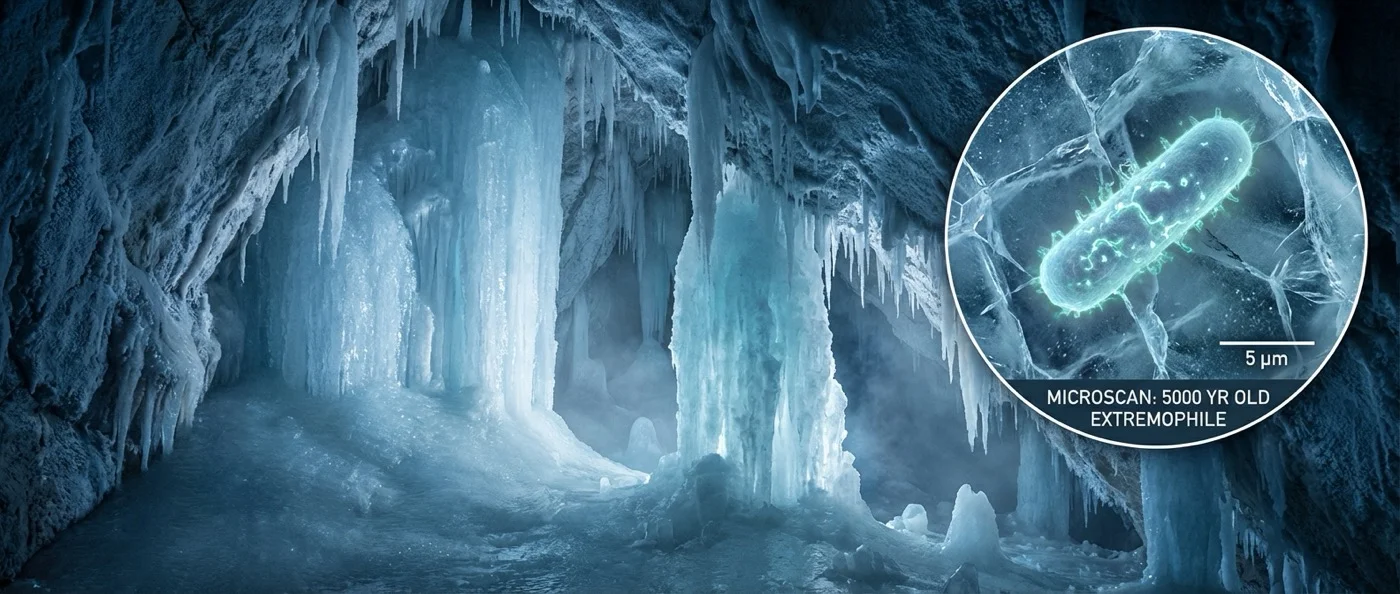
Deep inside Romania's Scarisoara Ice Cave, scientists have just awakened a bacterium that has been sealed in 5,000-year-old ice — and what they found has startled the scientific community. The microbe, named Psychrobacter SC65A.3, is not only resistant to ten modern antibiotics, but also carries more than 100 antibiotic resistance genes. Even more remarkably, it actively suppresses drug-resistant superbugs.
The research was led by Dr. Cristina Purcarea of the Institute of Biology Bucharest (Romanian Academy) alongside co-authors Victoria Ioana Paun, Corina Itcus, Paris Lavin, and Mariana Carmen Chifiriuc. Their findings were published in Frontiers in Microbiology (DOI: 10.3389/fmicb.2025.1713017).
📖 Read more: Bacteria Invade Cancer Cells and Destroy Them from Within
25 Meters of Ice, 13,000 Years of History
The Scarisoara Ice Cave hosts one of Europe's oldest cave glaciers, formed over at least 13,000 years. Purcarea's team drilled a 25-meter ice core from the cave's “Great Hall” and isolated bacteria from layers corresponding to different historical periods.
The sample that yielded Psychrobacter SC65A.3 came from ice dated to approximately 5,000 years ago — a period of early human civilization, before the development of modern medicine.
Resistant Without Ever Meeting Modern Medicine
The most striking finding is this: the bacterium evolved antibiotic resistance entirely on its own, with no exposure to the antibiotics we use in medicine. It resists rifampicin, vancomycin, ciprofloxacin, trimethoprim, clindamycin, metronidazole — and more.
In total, researchers identified over 100 resistance genes in its genome, along with approximately 600 genes of unknown function — which could represent entirely novel biological mechanisms.
Antimicrobial Arsenal
Far from being merely a threat, Psychrobacter SC65A.3 may be an ally. The bacterium carries 11 genes associated with antimicrobial, antifungal, and antiviral activity. In laboratory tests, its secretions inhibited the growth of notorious superbugs — including methicillin-resistant Staphylococcus aureus (MRSA) and drug-resistant Pseudomonas aeruginosa.
"It suppresses superbugs," Purcarea's team noted in their publication — a property that makes this ancient microbe a candidate for future antibiotic drug development.
Why Bacteria Evolve Resistance Naturally
This finding challenges the assumption that antibiotic resistance is primarily a modern, human-caused problem. In reality, bacteria have been engaged in chemical warfare with each other for hundreds of millions of years. The antibiotics we use were originally produced by soil fungi and bacteria as weapons against competitors — and microbes evolved resistance long before humans discovered penicillin.
The Scarisoara discovery is powerful confirmation: bacteria sealed inside ancient ice can harbor resistance profiles that mirror — or exceed — those we see in today's clinical settings.
A Frozen Library of Unknown Biology
Beyond antibiotic resistance, the 600 genes of unknown function represent a largely unexplored frontier. Psychrobacter bacteria are already known for extraordinary cold-adaptation, but the SC65A.3 strain appears to operate with biological mechanisms unlike any previously characterized.
The research team plans to investigate these unknown genes systematically — potentially unlocking new biochemical pathways with applications in medicine, biotechnology, and our understanding of life's limits in extreme environments.