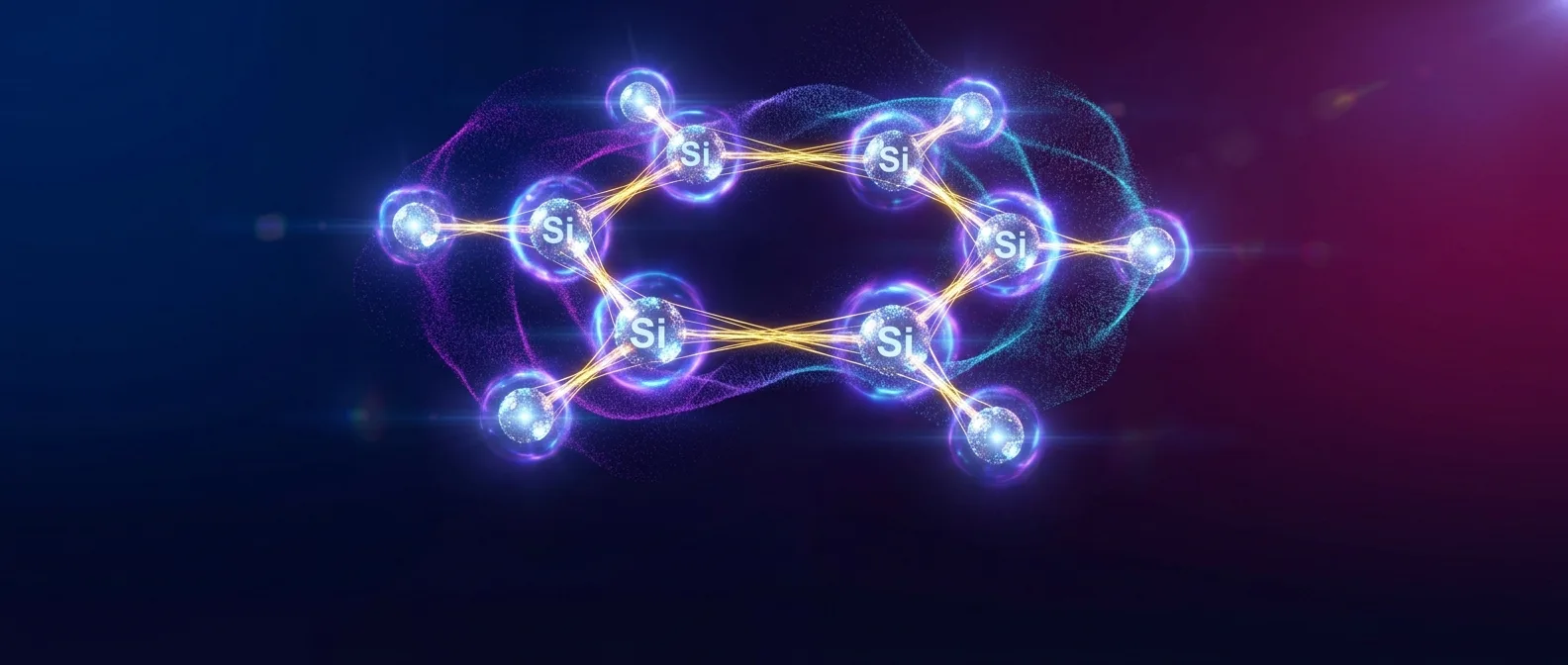
For half a century, chemists kept trying — and failing. The goal seemed straightforward in theory: replace the carbon atoms in a classic aromatic ring with silicon, creating the silicon equivalent of the cyclopentadienyl anion. But silicon, despite sitting just one row below carbon in the periodic table, refused to cooperate. Every attempt either produced an unstable intermediate or collapsed before isolation was possible.
Now, in a landmark result published in Science journal (DOI: 10.1126/science.aed1802), a team at Saarland University in Germany led by Professor David Scheschkewitz has succeeded. They synthesized the world's first stable five-membered fully silicon aromatic ring — a compound called pentasilacyclopentadienide. In a remarkable coincidence, a Japanese team led by Professor Takeaki Iwamoto at Tohoku University independently achieved the same milestone; both papers appeared in the same issue of Science.
📖 Read more: Scientists Created Time Crystal from Styrofoam Material
What Makes a Ring “Aromatic”?
The concept of aromaticity is one of chemistry's most powerful organizing principles. First explained by German physicist Erich Hückel in the 1930s (Hückel's rule), aromaticity refers to a special stability that arises when a cyclic molecule has a particular number of delocalized electrons — typically 4n+2 — circulating continuously around the ring.
The most famous aromatic compound is benzene, a six-membered carbon ring. But five-membered aromatic rings also exist — the cyclopentadienyl anion, for example, which has been a staple of organometallic chemistry for decades.
The question that tormented chemists for fifty years: can you build such a ring with silicon instead of carbon? Silicon is more metallic than carbon, holds its electrons less tightly, and forms weaker π-bonds. Most attempts produced silicon clusters that were either too reactive to isolate or didn't exhibit the tell-tale electronic properties of true aromaticity.
The Saarland Breakthrough
The Scheschkewitz group at Saarland achieved the synthesis by carefully choosing bulky stabilizing substituents — large molecular groups attached to each silicon atom in the ring that physically prevent the molecule from reacting with itself or collapsing. PhD student Ankur and researcher Bernd Morgenstern played key roles in devising the synthetic strategy.
The resulting pentasilacyclopentadienide anion is a negatively charged five-membered ring in which all five atoms are silicon, and the electrons are delocalized around the entire ring in true Hückel aromatic fashion. Nuclear magnetic resonance spectroscopy (NMR) and computational analysis confirmed the aromatic character — the compound behaves chemically as a silicon-based aromatic, not just a structural lookalike.
"This is the silicon version of a molecule that has been in chemistry textbooks for generations," Scheschkewitz explained. The compound breaks a conceptual barrier: silicon aromatics at the five-membered scale are not just theoretical curiosities — they can actually be made, isolated, and studied.
📖 Read more: Forests Are Changing Rapidly and Scientists Are Worried
One Day Apart, Two Breakthroughs
The simultaneous discovery by Iwamoto's team at Tohoku University underscores how much the field was ready for this achievement. Both groups, working independently in Germany and Japan, arrived at essentially the same solution within what appears to be weeks of each other. The editors of Science chose to publish both papers together, framing them as a conceptual pair.
While the approach and specific molecular structure differ slightly between the two papers, both confirm the same core fact: a stable, isolable five-membered silicon aromatic ring is possible. The 50-year quest is over.
The only previous silicon aromatic established before this work was a three-membered ring — a cyclotrisilene — demonstrated in 1981. That compound used three silicon atoms. The jump from three to five is not merely quantitative: five-membered rings are far more versatile for chemical synthesis and more directly comparable to the workhorse carbocyclic aromatics used throughout chemistry and industry.
Why Silicon Aromatics Refused to Form
Silicon's reluctance to form stable aromatic rings comes down to fundamental differences in how it bonds. Carbon forms strong, rigid double bonds (π-bonds) relatively easily, which is what gives aromatic rings their delocalized electron sky. Silicon's π-bonds are weaker and much more reactive — they tend to be attacked by other molecules or collapse into other structural arrangements before a stable ring can form.
Silicon also has larger atomic orbitals than carbon, which means the spatial overlap needed for delocalization is harder to achieve. For decades, these factors made the target compound seem almost chemically forbidden, even as theory predicted it should be stable if the right conditions were met.
The key insight in both teams' design was that large, bulky groups attached to the silicon atoms could shield the reactive π-system from attack, giving the ring enough time — and thermodynamic space — to settle into its aromatic ground state.
📖 Read more: Greenland Sharks: Living 500 Years Defying Aging
Potential Applications: Catalysts and Electronics
The practical implications are already generating excitement. Silicon aromatic compounds could open new routes to industrial catalysts. Currently, enormous quantities of polyethylene and polypropylene — the world's most widely produced plastics — are manufactured using organometallic catalysts based on carbon cyclopentadienyl rings. Silicon analogues could lead to catalysts with different or improved selectivity for specific polymer architectures.
In electronic materials, silicon aromatics could serve as building blocks for novel semiconducting or conducting organic layers. The electronics industry already depends on silicon at the atomic scale for chips; having silicon aromatic molecules as designer molecular-scale components could create entirely new classes of hybrid organic-inorganic materials.
Neither team claims ready-to-use applications yet — the pentasilacyclopentadienide is still a laboratory compound requiring specialized handling. But the proof of principle is now established, and the chemistry community has a new playground to explore.
A Milestone Written in Silicon
The history of chemistry is punctuated by long-sought milestones: the synthesis of urea in 1828 (disproving vitalism), the first isolation of noble gas compounds in 1962, the creation of superheavy elements. The synthesis of a stable silicon aromatic ring belongs in this category — a conceptual barrier broken through patience, ingenuity, and the steady advance of synthetic technique.
For Professor Scheschkewitz and his team in Saarbrücken, and for Professor Iwamoto's group in Sendai, the 50-year wait is over. For the rest of chemistry, it is just the beginning.