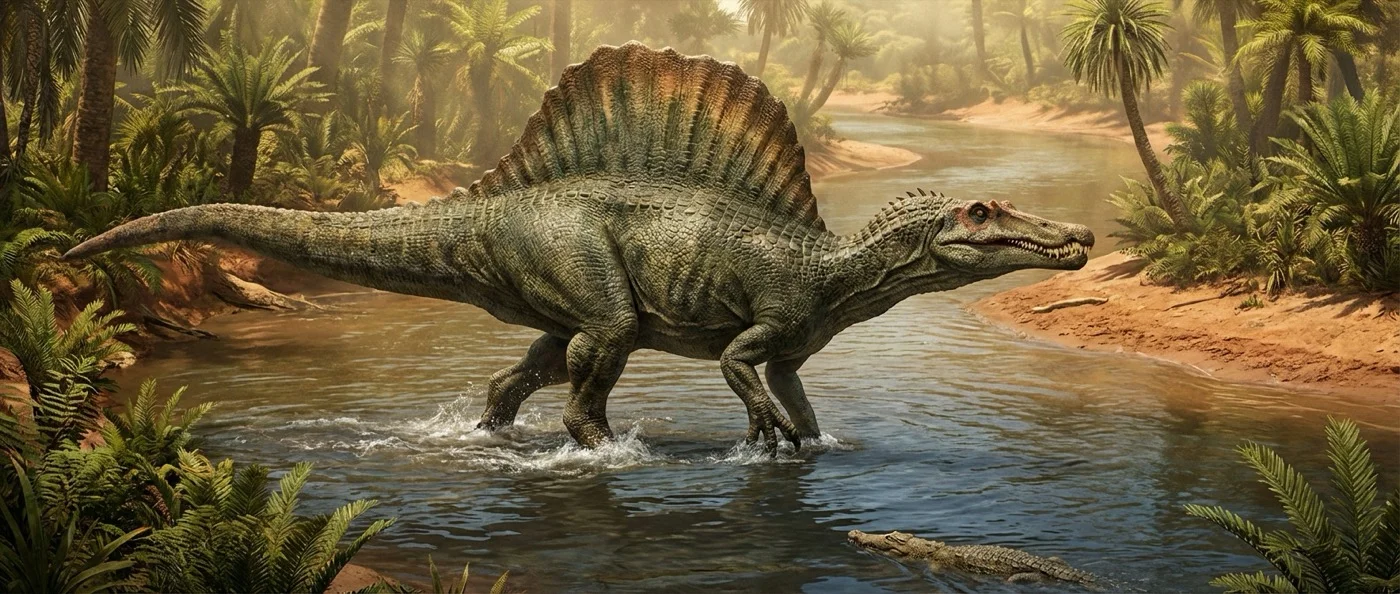
Spinosaurus was the largest carnivorous dinosaur that ever lived — bigger than T. rex. For decades, exactly how it lived remained deeply controversial: was it a full-time swimmer or a land predator? New fossils from Niger's Sahara desert, found far inland from any ancient sea, are settling the debate — and the answer reveals a creature unlike anything in popular imagination.
📖 Read more: 190-Million-Year-Old 'Sword Dragon' Found in Dorset
🦕 The Spinosaurus Mystery — And the Decades-Long Gap
Spinosaurus mirabilis was first described from Egyptian fossils in 1912 by German paleontologist Ernst Stromer. His original specimens were destroyed during World War II bombing in Munich, leaving a 70-year knowledge vacuum. With only drawings and notes, scientists argued intensely about whether Spinosaurus was aquatic — swimming and hunting fish like a massive crocodile — or whether it stalked riverbanks like a giant heron.
By the 2000s, new finds in Morocco and Egypt revived the debate. Some analyses of bone density suggested Spinosaurus could have swum. Others pointed to anatomy inconsistent with sustained aquatic locomotion. The question remained open — until now.
🔍 New Discovery: Spinosaurus in the Sahara Interior
Paleontologist Paul Sereno of the University of Chicago and his team excavated new Spinosaurus mirabilis material in Niger — in the heart of the Sahara desert, at least 500-1,000 km from any ancient shoreline. The findings were published in Science (DOI: 10.1126/science.adx5486) on February 23, 2026.
📖 Read more: One Stem Cell Produces 14M NK Cells Against Cancer
🌵 A “Hell Heron” in the Desert Interior
The new find challenges the fully-aquatic hypothesis directly: a Spinosaurus of this size could not have lived exclusively in rivers 500+ km from the sea. Instead, the Sereno team proposes that Spinosaurus was foremost a wading inland fish-hunter — analogous evolutionarily to a giant modern heron or egret that stalks shallow riverbeds for prey.
A 1950 French monograph proved to be the critical lead: it referenced large reptile bones from Niger that had never been properly analyzed. Sereno traced these references during an archival research phase and decided to excavate the original specimens. Initial finds came in 2019; a full excavation team returned in 2022 and recovered extensive material.
The fossils underwent CT scanning and were translated into 3D digital models. Paleoartist Dani Navarro produced the reconstruction that appeared on the cover of Science — showing a Spinosaurus that looks very different from previous depictions.
📖 Read more: Bacterial Sugar: A New Weapon Against Superbugs
🦷 The Crest and Teeth — Key New Details
Among the most striking features of the new Spinosaurus material is the giant scimitar-shaped cranial crest — a sail-like curved ridge covered in keratin (the same material as horn and fingernails in modern animals). It was likely brightly colored, used for display or communication between individuals.
The teeth showed a remarkable interlocking design: when the jaws closed, upper and lower teeth meshed together like a cage — exactly the kind of trap structure seen in modern fish-eating animals. This confirms a fish-hunting lifestyle with high precision.
The limb proportions and the inland discovery context suggest that Spinosaurus moved primarily on land, wading into rivers and shallow floodplains to catch fish, rather than actively swimming. This model better explains the anatomy — including the relatively small hindlimbs that would make sustained swimming inefficient.
"This dinosaur was a river heron — built to wade in shallows and snatch prey, not to swim like a crocodile."
— Paul Sereno, Professor of Paleontology, University of Chicago📖 Read more: Diamonds Have Ice-Like Water Layers at Room Temperature
🏛️ The Discovery Backstory — From Archive to Excavation
The discovery began not in the field but in a library. A 1950 French geological monograph referenced reptile bones from Niger classified as “unidentified large predator.” Sereno identified these as potentially spinosaurid during archival research and spent years planning an expedition to re-examine them in their original geological context.
The 2019 reconnaissance confirmed the stratigraphic layer. The 2022 full excavation yielded vertebrae, cranial fragments, teeth, and importantly — portions of the distinctive crest. Fossils were transferred to the Museum of the River in Niger, a zero-energy museum Sereno co-founded to keep African paleontological heritage on African soil.
🔬 Significance for Paleontology
The new fossils do more than solve a fossil anatomy puzzle — they reframe the entire ecological context of African Cretaceous predators. Spinosaurus didn't dominate rivers by swimming — it dominated them by standing in them. This has significant implications for understanding the predator ecology of Cretaceous Africa and how large-bodied dinosaurs partitioned aquatic and terrestrial resources.