📖 Read more: DNA On-Off Switch: A New Era of Nanotechnology
🦕 The Problem That Has Plagued Paleontology for a Century
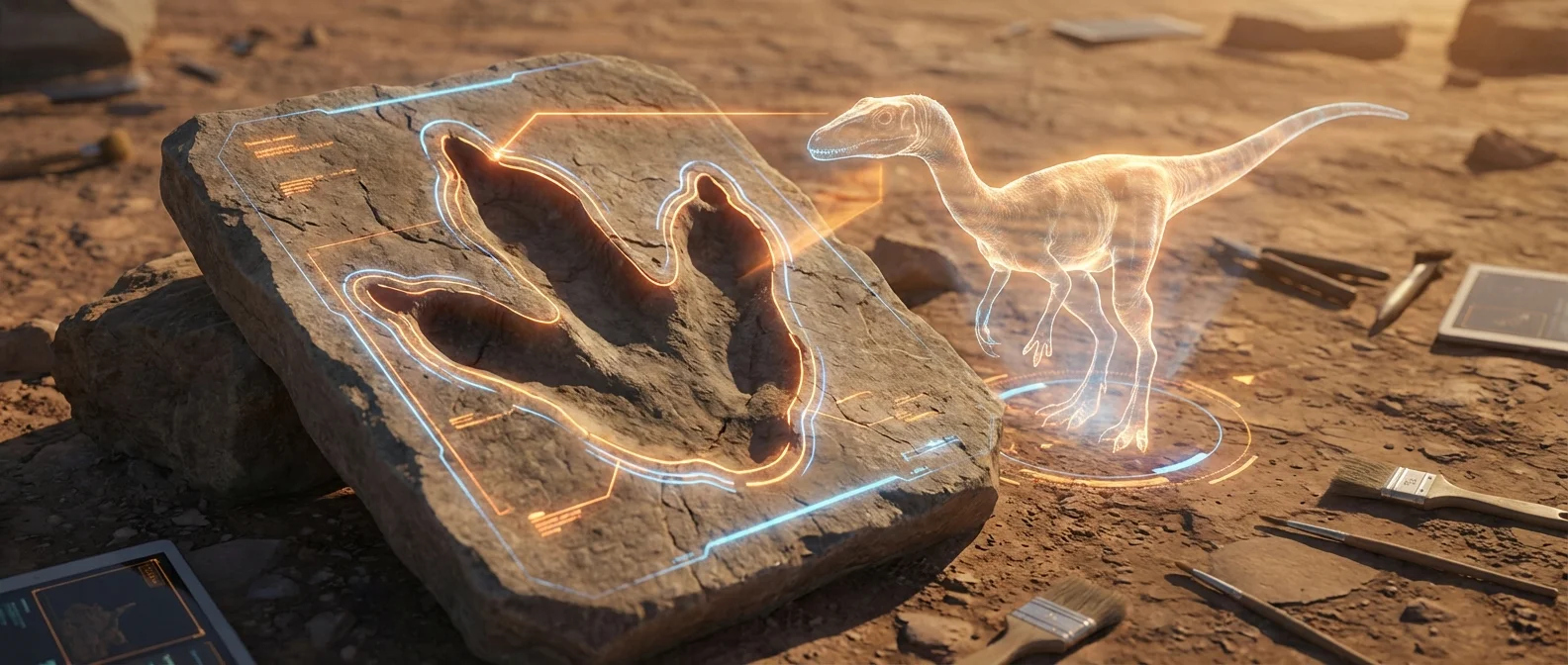
When paleontologists find a fossilized footprint, the first question is always the same: which dinosaur left it? The answer is far more difficult than one might imagine. Trace fossils — the fossilized tracks left behind by animals on muddy ground millions of years ago — deteriorate significantly over time. Compression, erosion, displacement of the edges — all of these alter the shape of the footprint and make identification extremely challenging.
Until recently, scientists relied on handmade databases that linked specific shapes to known species. This method had a major drawback: it introduced human bias. When an expert already believed a footprint belonged to a particular species, the classification became a self-fulfilling prophecy. For other tracks, experts disagreed fiercely among themselves for decades.
📖 Read more: One Gene Switches Caring Fathers Into Aggressors
🧠 How DinoTracker Works
To solve this problem, a team led by Dr. Gregor Hartmann of the Helmholtz-Zentrum in Berlin, in collaboration with the University of Edinburgh, developed DinoTracker. The application allows anyone — researcher or amateur — to upload a photo or drawing of a footprint from their phone and receive instant analysis.
The system was trained on nearly 2,000 real fossilized footprints, supplemented by millions of simulated examples. These simulations reproduced realistic distortions: compression from the weight of sediment layers, displacement of edges, erosion — all the changes that occur as a footprint is preserved over millions of years.
The algorithm learned to recognize eight critical features that distinguish one footprint from another: how wide the toes spread, where the heel is located, how much surface area touches the ground, how weight is distributed across different parts of the foot. Many of these are invisible to the human eye — but not to the neural network.
"Our method provides an unbiased way to recognize variation in footprints and test hypotheses about their makers. It is an excellent tool for research, education, and fieldwork."
— Dr. Gregor Hartmann, Helmholtz-Zentrum Berlin
🐦 The Big Surprise: The Oldest Birds in the World?
The most unexpected finding wasn't about dinosaurs — it was about birds. The AI detected striking similarities between certain footprints over 200 million years old and the feet of modern and extinct birds. If this is correct, birds appeared tens of millions of years earlier than scientists currently believe.
An alternative explanation, of course, is that some early dinosaurs had bird-like feet without being evolutionarily related — a phenomenon known as convergent evolution. Either way, the finding opens a fascinating chapter in evolutionary biology.
🧩 DinoTracker in Numbers
- ~2,000 real fossilized footprints in the training set
- Millions of simulated variations with realistic distortions
- 8 critical geometric identification features
- 90% accuracy — on par with human experts
- 200+ million years old — the oldest potential bird-like tracks
📖 Read more: Lipids Activate STING: New Cancer Defense Mechanism
📖 Read more: Living Blood Vessels on a Chip Mimic Real Ones
🏴 The Mystery of the Isle of Skye
DinoTracker also provided new answers for mysterious tracks on the Isle of Skye in Scotland — footprints formed at the edge of a lagoon 170 million years ago that had puzzled experts for decades. The analysis suggests they belong to some of the oldest known relatives of duck-billed dinosaurs, making them among the earliest examples of this group worldwide.
🚀 Paleontology for Everyone
One of the most interesting aspects of DinoTracker is that it is open to the public. Anyone can photograph a track on a beach or a rock and get instant analysis from their phone. This is radically different from traditional paleontology, which required specialized equipment and years of experience.
Professor Steve Brusatte from the University of Edinburgh — one of the most renowned paleontologists in the world — described the study as a “fascinating contribution.” "It opens exciting new possibilities for understanding how these incredible animals lived and moved, and when major groups like birds first appeared. This neural network may have identified the oldest birds in the world," he stated.
The study was published in Proceedings of the National Academy of Sciences (PNAS) in February 2026 and was funded by the Helmholtz project, the National Geographic Society, and the Leverhulme Trust. It serves as an example of how artificial intelligence doesn't replace scientists, but gives them the ability to see things that were always there but couldn't be seen.