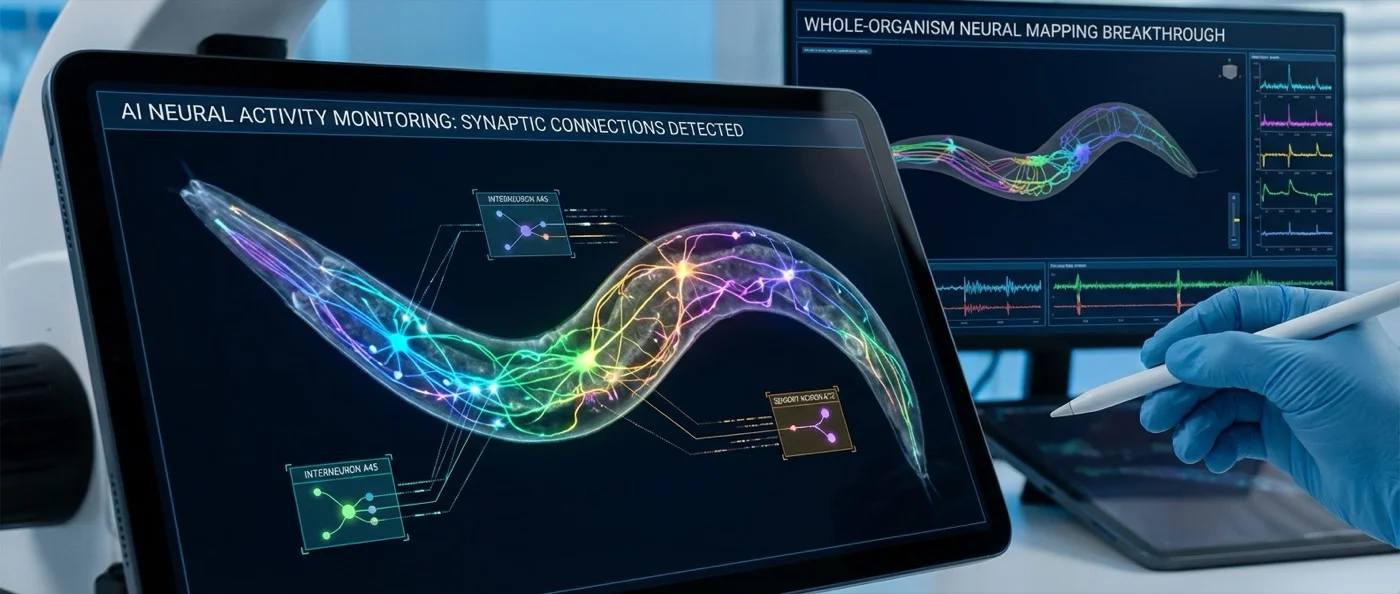
How does a worm think? How does a Hydra move? What happens inside the nervous system of a living organism the moment it makes a decision — a step, a turn, a fear response? These questions have driven neuroscientists for decades. Now, a team from the Princeton Neuroscience Institute has developed an AI system that — for the first time — can follow every neuron in two different living, behaving animals simultaneously.
The study, published in Nature Methods on February 25, 2026, is a milestone for neuroscience. For the first time, the complete brain of two organisms — the nematode worm Caenorhabditis elegans (302 neurons) and the freshwater polyp Hydra vulgaris (~1,050 neurons) — is mapped in real time during natural behavior.
📖 Read more: Jellyfish Sleep Like Us and Even Take Siestas
The Problem That Seemed Unsolvable
The idea of “whole-brain” neural recording is not new. Scientists have used GCaMP fluorescent indicator proteins since the early 2000s — proteins that glow whenever a neuron fires. Light-sheet microscopy can image many neurons at once.
But there was a central obstacle: movement. C. elegans performs continuous wave-like motions — it crawls, reverses, coils. Neurons move with the body. Earlier tracking systems failed to account for this physical displacement, conflating body motion with changes in neural identity — a critical error that led to misidentified neurons.
“If an animal turns and a neuron moves in space, how do you know you’re following the same neuron or its neighbor?” explains Dr. Viviana Greco, lead researcher on the study. “That was the foundational obstacle we solved.”
📖 Read more: Nasal Spray Stops Every Flu Strain
NeuroTrack: The Brain’s Language in Code
The system the team developed is called NeuroTrack. It combines three technologies:
1. High-speed 3D light-sheet microscopy that captures full volumetric images every 30 milliseconds — freezing each neuron before it moves significantly.
2. A new deep-learning model, trained on thousands of annotated registration images, that assigns the position of each neuron throughout movement — even when neurons are micrometers apart from each other.
3. A “neuron identity” system that maintains persistent labels for every cell across a full recording session — even if it briefly leaves the optical field.
The result: for C. elegans, the full neural network of 302 cells is tracked continuously for 10+ minutes. For Hydra, 1,050 neurons — scattered across a nearly transparent body that stretches and contracts — are measured simultaneously.
What the Neurons Reveal When the Worm Runs
The early results reveal patterns of neural behavior that were impossible to detect before. In C. elegans, the team found that directional changes (forward → reverse) are not triggered by a single “command” neuron but emerge from collective state transitions in a cluster of 12–15 cells that fire in rolling sequence — like a command wave traveling from brain to body.
In Hydra, the picture changed fundamentally. This organism was thought to be “primitive.” The new data reveals it has a distributed decision-making system — no central brain, but “will” expressed through simultaneous activation of networks in different body regions.
“It’s like a committee vote for every movement,” says Dr. Andrew Leifer, co-author and head of the Princeton Leifer Lab. “No central authority — just distributed consensus.”
📖 Read more: Scientists Finally Created Silicon Aromatic Ring After 50 Years
Why Worms and Hydra?
The choice of organisms is deliberate. C. elegans is the only multicellular organism on Earth with a fully mapped connectome — the complete wiring diagram of its neurons. Every synapse is known. This means researchers can now compare structure (which neuron connects to which) with function (which neuron fires when).
Hydra is equally valuable: it has no head, no tail, no left-right symmetry — only radial symmetry, like a wheel. This makes it an ideal model for studying how a nervous system can function without a brain hierarchy.
Together, the two organisms offer a “crystal-clear window” into the foundational principles of neural circuit operation — principles that, across hundreds of millions of years of evolution, were preserved in the human brain.
📖 Read more: AI Identifies Which Dinosaur Left a Footprint
The Road Toward the Human Brain
The human brain has 86 billion neurons. NeuroTrack will never track them directly. But that is not the limitation — it is the strategy. Rather than getting lost in the complexity of the human brain, the team decodes the fundamental principles of neural decision-making in simpler systems.
“Every principle we uncover in C. elegans — how neural ensembles form, how circuit states shift — will likely be conserved in mammals,” says Dr. Greco. “Because evolution is conservative. The basic building blocks of the brain were not reinvented every time.”
Already, researchers at MIT and University College London have requested access to NeuroTrack’s code to apply it to Drosophila fruit flies (100,000 neurons) and zebrafish (10 million neurons) — the next rungs of the ladder of complexity.
The research was funded by the Simons Collaboration on the Global Brain (SCGB), the NIH BRAIN Initiative (R01 NS113119), and the Princeton Neuroscience Institute. The team open-sourced the full NeuroTrack pipeline on GitHub.