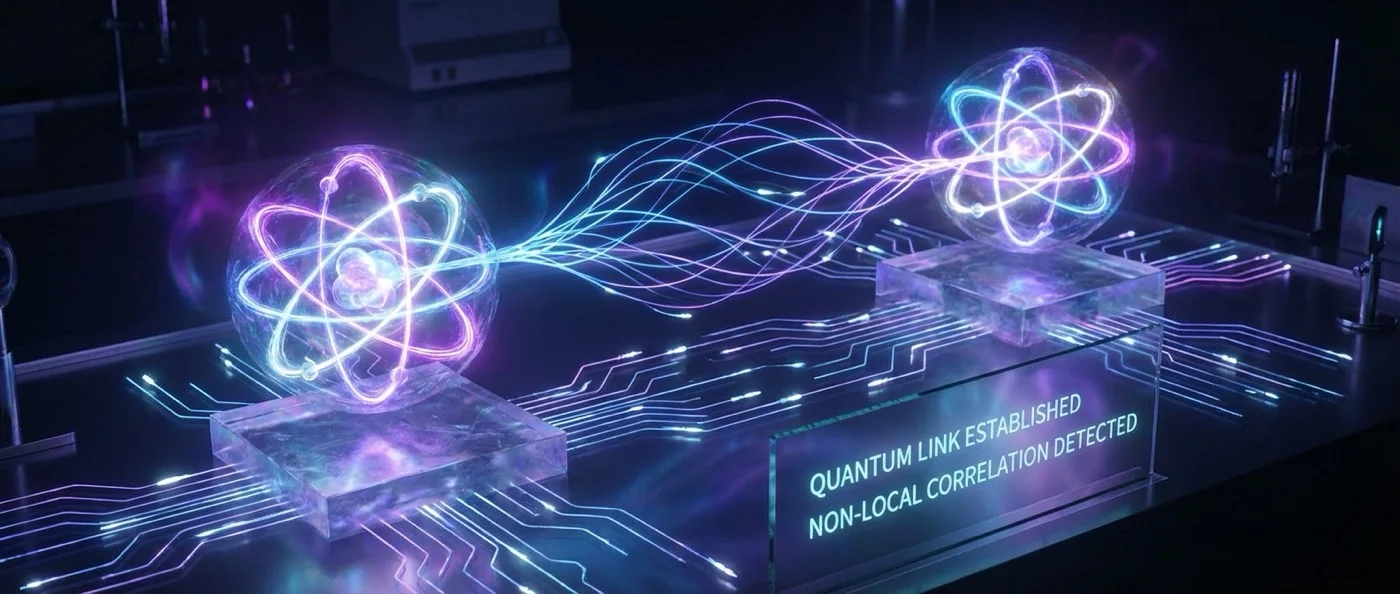
A quantum computer is only as powerful as the connections between its qubits and photons. A new study from the Max Planck Institute of Quantum Optics (in collaboration with Harvard Quantum Initiative) has achieved a record entanglement fidelity between an atom and a photon: 99.9% — at least 1.5 percentage points above the previous record (98.4%).
The study was published in Nature on February 25, 2026, led by Dr. Severin Daiss and senior co-author Prof. Ignacio Cirac, one of the founders of quantum information science.
📖 Read more: Photons Mimic Brain Function: Quantum Neuromorphic Memory
What Is Atom-Photon Entanglement?
In quantum networks, qubits communicate via photons. Ideal quantum network nodes operate as follows:
1. An atom emits a photon
2. The atomic qubit and photonic qubit become entangled
3. The photon travels via optical fiber to a distant location
4. A Bell state measurement (BSM) connects qubit A (local) with qubit B (remote)
Every step introduces errors. Total fidelity is the product of all error probabilities. 99.9% means only 1 error in 1,000 operations.
📖 Read more: Quantum Computer Corrects Qubit Errors in Real Time
The Ytterbium Ion as Perfect Architecture
The team used trapped ytterbium ions (Yb+) in a linear Paul trap. Yb+ ions combine two ideal properties: extraordinarily long memory coherence time (hyperfine structure) and optical photon emission at 435 nm (visible crystal blue).
Key innovations of the study:
— Use of an optical Purcell cavity for 1,000× enhancement of spontaneous emission
— Fiber photonic interface for coupling to telecom fibers via down-conversion
— Faster than the random retry rate: 85 entanglement attempts per millisecond (up from 12 in 2022)
📖 Read more: AI Monitors Every Neuron in Worms and Jellyfish Live
Why 99.9% Changes Everything
The problem with lower fidelity is error accumulation. At 98.4% (2024), in 1,000 entanglement operations, 16 qubits would error. At 99.9%, only 1. This seems numerically small — but in practice it’s the difference between massive and impossible communication.
“To operate a quantum key distribution cryptography network over 100 km, you need at least 10 reliable intermediate quantum repeater nodes,” says Daiss. “With 99.9% fidelity, we have entered that space.”
Applications: From Quantum Networks to European Backbone
The immediate application is quantum repeaters — nodes that extend entanglement between remote qubits without direct quantum state transmission. The high retry rate (85 per millisecond) and high fidelity make them ideal for this role.
The European Commission is funding an analogous program — EuroQCI (European Quantum Communication Infrastructure) — aimed at connecting government services across Europe with quantum-secured, unbreakable cryptography. The MPQ study provides the technology needed to make this reality.
Research was funded by the Max Planck Society, the European ERC Advanced Grant QNet (GA 101055902), and the Harvard Quantum Initiative. Full code and raw data are open-access via Zenodo.