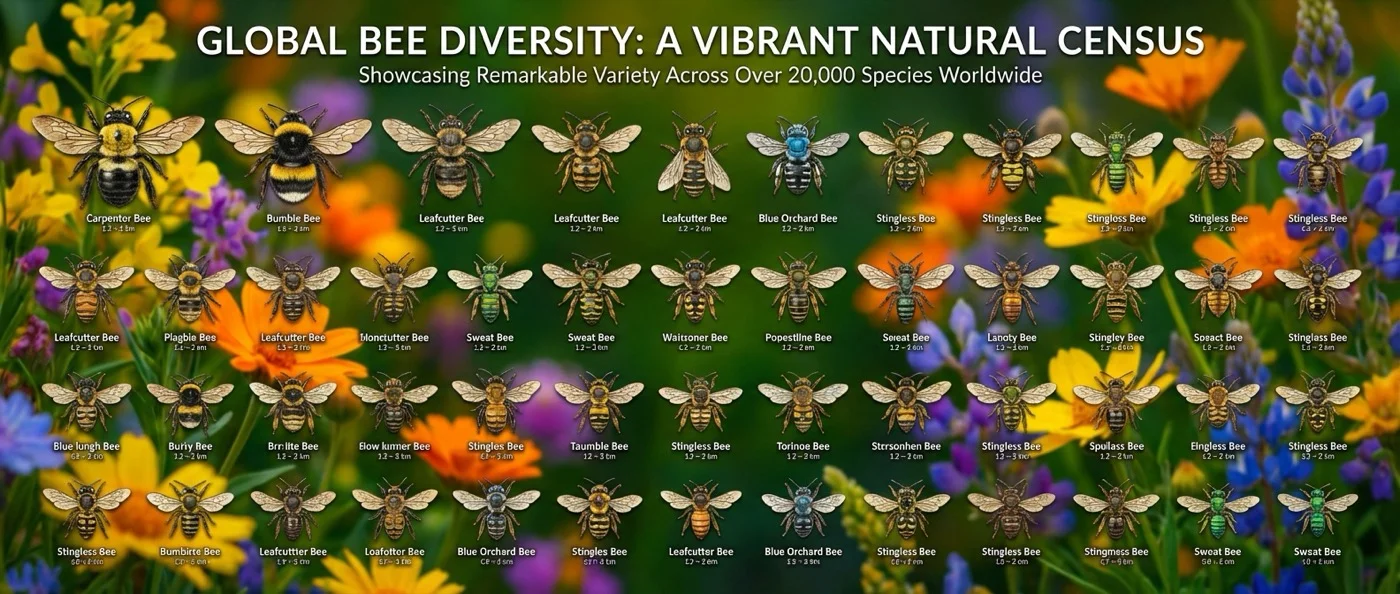
When we think of bees, honeybees and bumblebees come to mind. But the reality is far more impressive: there are more bee species on Earth than mammals and birds combined. A series of groundbreaking studies has mapped this vast biodiversity for the first time — revealing surprises that upend much of what we thought we knew.
📖 Read more: H5N1 Struck Antarctic Wildlife for the First Time
\ud83d\uddfa\ufe0f The First Global Map of Bees
A team led by Dr. Michael Orr from the Institute of Zoology at the Chinese Academy of Sciences, together with John Ascher of the National University of Singapore and Alice Hughes, published in Current Biology the first comprehensive global map of bee biodiversity. By combining the most complete checklist of known species — over 20,000 in the DiscoverLife.org database — with nearly 6 million public occurrence records, they created an unprecedented picture.
Ascher's checklist, continuously updated with new taxonomic revisions and field discoveries, now recognizes over 26,000 species worldwide — a number that grows each year, especially from regions in Africa and the Middle East where unexplored diversity remains enormous.
📖 Read more: Hundreds of New Species on the Pacific Ocean Floor
\ud83c\udfdc\ufe0f Deserts as Biodiversity Hotspots
One of the most striking findings is that bees defy the rule that applies to most animals. While the majority of species on the planet concentrate near the equator (latitudinal gradient), bees follow a reverse pattern: more species are found in arid, temperate regions than in tropical forests.
The explanation is unexpectedly simple: forests and jungles provide fewer food sources for bees compared to low-lying vegetation and flowers. Trees dominate the space, leaving minimal flower diversity near the ground. In contrast, the United States boasts the greatest bee diversity worldwide, and Utah alone harbors 1,167 documented species according to a recent study (Diversity, March 2025).
\ud83d\udd0d Why Do Bees Prefer Deserts?
- Greater variety of low-lying flowering plants in open landscapes
- Seasonal mass blooming events create “waves of food”
- Tropical forests favor birds and butterflies, not bees
- Unstable resource distribution drives increased speciation
- Northern Hemisphere: far higher diversity than the Southern
📖 Read more: Superfluid to Supersolid: First-Ever Transition
\u26a0\ufe0f 12 New Threats to Bees
Even as mapping improves, threats are multiplying. The Bee:wild report — an international campaign led by the University of Reading — identified the top 12 emerging threats facing bees and other pollinators over the next 5-15 years. Among them:
Microplastics: Testing of 315 honeybee colonies across Europe detected synthetic materials (PET plastic) in nearly every hive. Light pollution: Artificial light at night reduces nocturnal pollinator visits by 62%, undermining the critical role of moths and night-active insects. Armed conflict: The war in Ukraine forced many countries to reduce crop diversity, leaving bees without varied food sources. Additionally, increasing wildfires, pesticide cocktails, antibiotic contamination, and air pollution create a multi-layered crisis.
📖 Read more: The World's First Triple Superconductor Discovered
\ud83e\uddea Pesticides: The Silent Enemy
A separate study in the journal Science (November 2024) by Dr. Sabrina Rondeau of the University of Ottawa revealed that over 70% of wild bee species face significant risks from pesticide residues in soil — a threat that current regulations overlook entirely.
The problem: current risk assessments use the honeybee (Apis mellifera) as their model, which fails to represent the thousands of species that nest in the ground. The study found that larger-bodied bumblebee queens — those with the highest survival odds — were paradoxically more vulnerable to pesticides, creating cascading effects across entire populations.
\ud83c\udf31 Solutions and the Future
The Bee:wild report proposes specific steps, ranked by novelty and impact: stricter legislation on antibiotic pollution, transitioning to electric vehicles to reduce air pollution, breeding crops with enhanced pollen and nectar, creating flower-rich habitats within solar parks, and developing RNAi-based treatments that target pests without harming beneficial insects.
Mapping 26,000 species is not merely a taxonomic exercise — it is the first step toward their conservation. As John Ascher notes: "We really can't interpret abundance until we understand species richness and geographic patterns." Every bee, from the tiny solitary sand bee to Indonesia's giant Wallace's bee, is a link in an ecological network upon which our very food security depends.
\ud83d\udcda Sources
1. ScienceDaily — “First map of bee species around the globe” (November 19, 2020)
https://www.sciencedaily.com/releases/2020/11/201119141736.htm
Orr et al., Current Biology — Cell Press
2. ScienceDaily — “Bees facing new threats, putting our survival and theirs at risk” (May 20, 2025)
https://www.sciencedaily.com/releases/2025/05/250519204644.htm
Bee:wild / University of Reading
3. ScienceDaily — “Bee alert: Pesticides pose a real threat to over 70% of wild bees” (November 18, 2024)
https://www.sciencedaily.com/releases/2024/11/241118125223.htm
Sabrina Rondeau, Science — University of Ottawa