📖 Read more: Robots Share Resources Like an Insect Colony
🪰 The Inspiration from Insect Compound Eyes
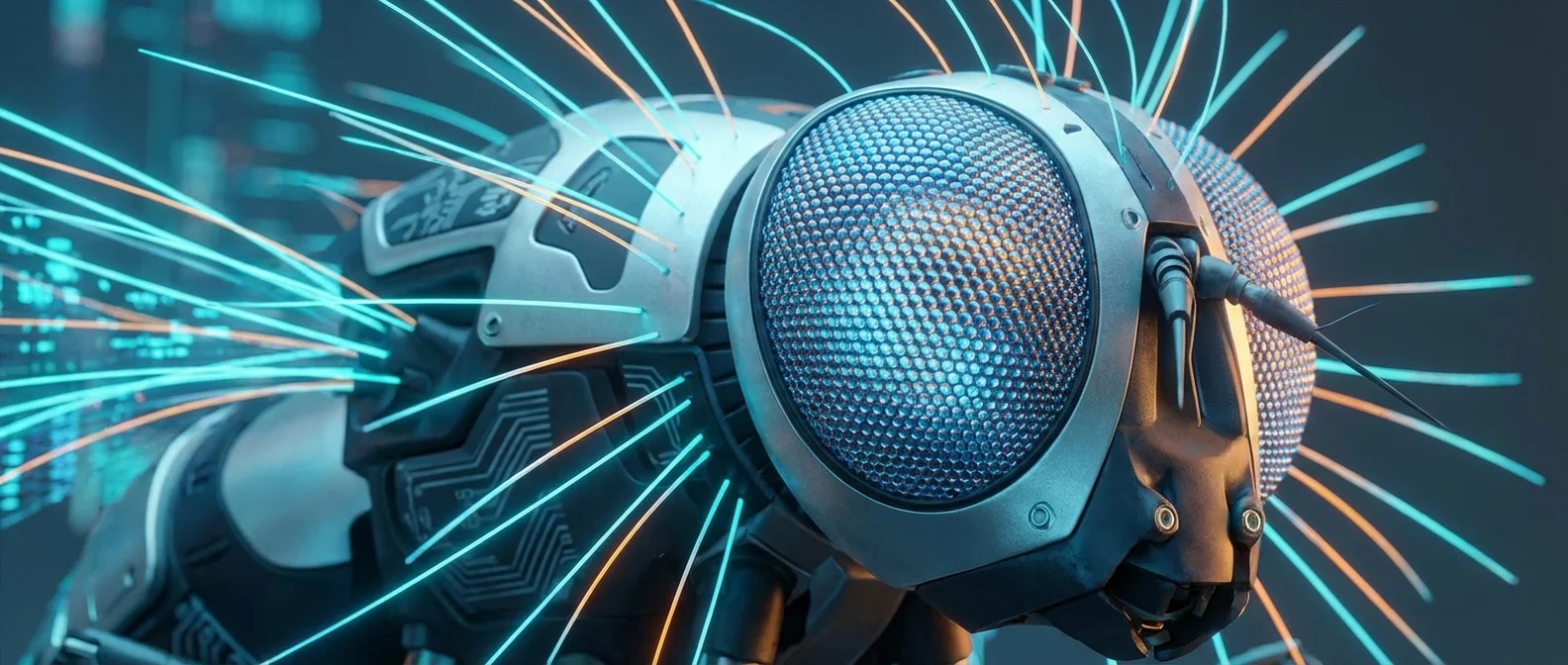
Insect compound eyes are among the most impressive creations of evolutionary biology. Unlike mammalian eyes, which have a single lens, compound eyes consist of hundreds or thousands of tiny optical units — the ommatidia. Each ommatidium functions as an independent sensor, focusing on a small region of the visual field.
The fruit fly (Drosophila) is particularly noteworthy: its eyes can process visual information several times faster than the human eye, while offering a nearly panoramic field of view. These properties — wide visual field, rapid motion detection, and microscopic size — make them ideal characteristics for robotic sensors.
Conventional cameras used in robots and drones, while excellent at capturing high-resolution images, fall short in critical areas: they are bulky, power-hungry, and limited to a narrow field of view. Robots only “see” what is directly in front of them, missing information from the sides. The biomimetic approach promises to fundamentally change this.
📖 Read more: Microplastics Found in Antarctica's Only Native Insect
🔬 How the Bionic Eye Was Built
The research team, led by Jiachuang Wang, used an extremely precise fabrication technique known as femtosecond laser two-photon polymerization (FL-TPP). Using this method, they printed microscopic lenses onto flexible sensors, creating a structure that faithfully replicates the architecture of the compound eye.
The result is impressive: 1,027 microscopic optical units packed into a surface of just 1.5 × 1.5 millimeters. Between the lenses, the researchers printed microscopic hairs (setae), just like in real fly eyes. These are not merely decorative — they function as an anti-fogging system, keeping the lenses clear in humid conditions.
The most innovative element, however, came next. Using inkjet printing, the team added a series of color-changing chemicals — essentially a “bionic nose.” This array reacts to the presence of hazardous gases in the air, mimicking the way insects use multiple senses simultaneously. Although the fly doesn't literally have a nose on its eye, the researchers integrated chemical detection into the same system, creating a pioneering multisensory sensor.
👁️ Two Senses in One Device
The system, named bio-CE (bionic compound eye), represents a fundamental shift in how robotic sensors are designed. Instead of separate camera and chemical detector, it combines both functions in a single microscopic unit.
The optical function provides wide-angle 180-degree coverage, enabling simultaneous motion detection from multiple directions. The chemical function detects hazardous gases through color changes in the chemical array, providing information that a camera alone could never collect.
🔑 Why It Matters
Integrating vision and chemical detection into a single 1.5-millimeter device means that even very small robots and drones can now “sense” their environment in multiple ways — without additional weight or energy consumption. This is a critical step toward truly autonomous robotic systems.
📖 Read more: Synthetic Skin Changes Shape and Hides Images
🤖 Robot Testing: Impressive Results
To demonstrate the system's functionality, the researchers mounted the bio-CE on a tiny four-wheeled robot. The results exceeded all expectations.
The robot successfully detected moving objects and reacted to nearby obstacles in real time. Unlike conventional robots that only “see” straight ahead, this one could simultaneously perceive obstacles to the left and right without rotating, thanks to the 180-degree panoramic field of view. At the same time, it detected hazardous gases in the environment, proving the sensor's dual functionality under real-world conditions.
Multisensory perception is critical in scenarios such as navigating damaged buildings after an earthquake, where a robot must simultaneously avoid debris and detect gas leaks or toxic substances.
“The bio-CE system achieves exceptionally high sensitivity in wide-angle detection of moving targets and obstacle avoidance, showing great potential for unmanned platform navigation and bionic robotic intelligence.”
📖 Read more: 99.9% Quantum Entanglement Record Between Atoms and Photons
⚡ Challenges and Future Applications
Despite the impressive results, the bionic eye still faces certain challenges. Image resolution has not yet reached high-definition levels — the microscopic scale of the system means that detail is sacrificed for breadth of coverage. Additionally, the curvature of the lenses can cause slight image distortion, while the color-change reaction of the chemical sensors is slightly slower than the system's optical component.
However, once these issues are addressed, the potential applications are enormous. Small drones equipped with such sensors could enter damaged buildings after natural disasters, searching for survivors while simultaneously detecting chemical leaks. In agriculture, similar sensors could identify plant diseases or fruit ripeness through volatile organic compounds. In environmental monitoring, microscopic robots could inspect industrial facilities for toxic emissions.
The technology could also find applications in security and surveillance, with autonomous drones capable of sensing both human movement and chemical traces — capabilities that current cameras cannot offer.
📌 The Significance of the Discovery
The publication in Nature Communications marks an important step in biomimetic engineering. For the first time, researchers managed to integrate two fundamentally different senses — vision and smell — into a single microscopic device, drawing direct inspiration from nature.
What is impressive is not only the technical achievement, but also the philosophy behind it: instead of developing separate sensors for each function, we can mimic the way nature combines multiple senses into compact, energy-efficient systems. Insect compound eyes, which have been evolving for hundreds of millions of years, once again prove to be an invaluable source of engineering inspiration.
As robotics moves toward increasingly smaller and more autonomous systems, the need for multisensory, lightweight, and efficient sensors becomes imperative. The bionic insect eye shows that the answer may lie where we least expect it — in the eyes of a fly.
Sources:
- Wang, J. et al. «An insect-scale artificial visual-olfactory bionic compound eye.» Nature Communications (2026). DOI: 10.1038/s41467-026-68940-0
- Tech Xplore — «The insect-inspired bionic eye that sees, smells and guides robots»