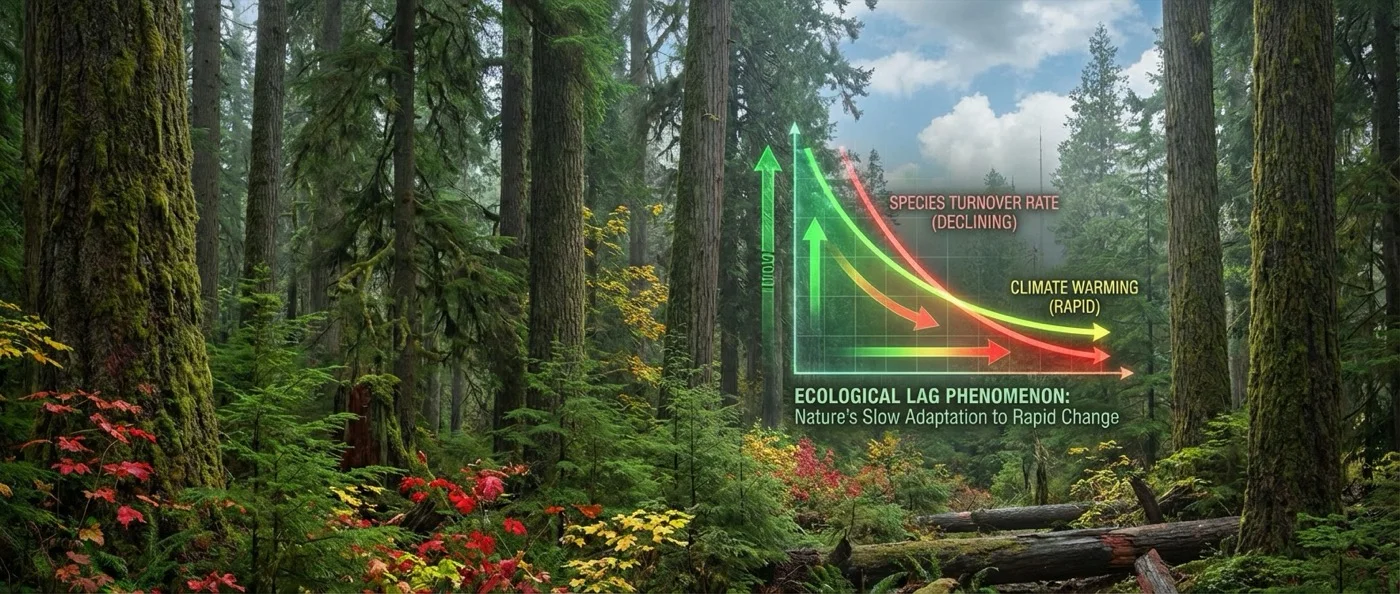
Everything about climate change logic suggests that ecosystems should be speeding up. As temperatures rise, climate zones shift poleward and upward. Species living below the new thermal ceiling of an area should vanish; species from warmer zones should move in. The constant reshuffling of communities — known as species turnover — should be accelerating in lock-step with the warming climate.
It isn't. A sweeping new study from Queen Mary University of London (QMUL), published in Nature Communications (DOI: 10.1038/s41467-025-68187-1), finds the opposite. After analyzing what the researchers describe as a massive global biodiversity database covering marine, freshwater, and terrestrial ecosystems over more than a century, the team found that species turnover has not increased since accelerated warming began in the 1970s. It has slowed — by roughly one third.
📖 Read more: Methane Surged After 2020: The Cause Is Surprising
A Self-Repairing Engine Grinding to a Halt
"Nature functions like a self-repairing engine, constantly swapping out old parts for new ones," says lead author Dr. Emmanuel Nwankwo. “But we found this engine is now grinding to a halt.”
Co-author Professor Axel Rossberg, also at QMUL, was struck by the magnitude of the finding: "We were surprised how strong the effect is. Turnover rates typically declined by one third."
The researchers focused on changes since the 1970s — when global surface temperatures began rising more rapidly and environmental stress on ecosystems became more pronounced. They measured species turnover rates over short periods of 1-5 years, comparing how quickly one species replaced another before and after this inflection point.
If climate change were the main driver of community dynamics, turnover should have gone up. Instead, it went down, consistently, across bird communities on land, benthic life on the ocean floor, freshwater communities, and other ecosystem types. The pattern appeared globally, not just in one region or one taxonomic group.
The Multiple Attractors Phase
To explain this unexpected result, the team turned not to external climate forcing but to the internal organizational dynamics of ecosystems themselves. Their findings point to a theoretical framework called the “Multiple Attractors” phase, first predicted in 2017 by theoretical physicist Guy Bunin.
In this phase, species continually replace one another because of internal biological interactions — competition, predation, mutualism, parasitism — even when external conditions remain constant. The process can unfold like a vast ecological game of rock-paper-scissors, where no single species dominates for long because every dominant species has natural competitors or predators that limit its expansion.
The new research provides strong real-world evidence that this multiple attractors phase is not just theoretical — it actually governs ecosystem dynamics across biomes. And critically, it appears to be the primary driver of turnover, more important than direct climate forcing in many systems.
Why Is It Slowing Down?
If healthy ecosystems naturally sustain turnover through internal dynamics, what is stopping those dynamics now?
The researchers argue that environmental degradation and shrinking regional species pools are the culprit. In a functioning multiple-attractors ecosystem, a broad regional pool of species continuously supplies potential colonizers — migrants from neighboring habitats ready to fill openings as resident species locally decline. This keeps the cycle running.
But as human activities destroy habitats, drain wetlands, fragment forests, and reduce biodiversity at regional scales, the pool of available colonizers shrinks. Fewer species can migrate in to fill gaps. The replacement cycle slows. What looks like stability — an unchanged community — is actually ecological stagnation: a community that can no longer renew itself.
"In other research we are seeing clear indications that human impacts cause the slowing of turnover. It is worrying," said Nwankwo.
Stable-Looking Ecosystems May Be Quietly Dying
This is one of the study's most unsettling implications: a slow-changing ecosystem is not necessarily a healthy one. The ecological literature has long used stability as a proxy for ecosystem health. But this research suggests that what looks stable at a local scale may actually reflect regional-scale biodiversity depletion — the pool of species available for local renewal is simply running dry.
Ecosystems that appear calm and unchanged from year to year may have quietly lost the capacity to self-renew. They may still produce ecosystem services for now — clean water, carbon storage, habitat — but in a more brittle way, with less redundancy and less capacity to recover from disturbance. The slowdown in turnover is an early warning signal that the machinery of life is losing resilience.
Scale and Scope of the Analysis
The strength of this study lies in its breadth. The database used covers hundreds of biodiversity surveys spanning more than a century, drawn from ecosystems across the globe and representing a wide range of organisms. The one-third slowdown in turnover rates is not a regional anomaly or a feature of a single group of organisms — it appears repeatedly as a global signal across fundamentally different ecosystem types.
This consistency makes the finding difficult to dismiss as a statistical artifact. Something real is happening to the rate at which life on Earth renews itself at local scales.
Implications for Conservation Policy
The findings carry direct policy implications. If the slowdown is driven by regional biodiversity loss and habitat degradation, then restoring regional species pools — through habitat protection, ecological corridors, rewilding programs, and active species restoration — is essential to maintaining the self-renewing capacity of ecosystems.
Focusing exclusively on reducing greenhouse gas emissions without simultaneously addressing habitat loss and biodiversity depletion risks creating a planet that stabilizes climatically while its ecosystems quietly hollow out. Climate change and the biodiversity crisis are not independent problems — they interact, and addressing one without the other can leave the underlying engine of ecosystem renewal running on empty.
The researchers at QMUL have contributed a disturbing new dimension to that picture: not chaos, not acceleration — but a deep, slow quieting of the living world's capacity to renew itself.