📖 Read more: Plants That Touch Each Other Are More Resilient to Stress
🐘 The Trunk: An Anatomical Marvel of Touch
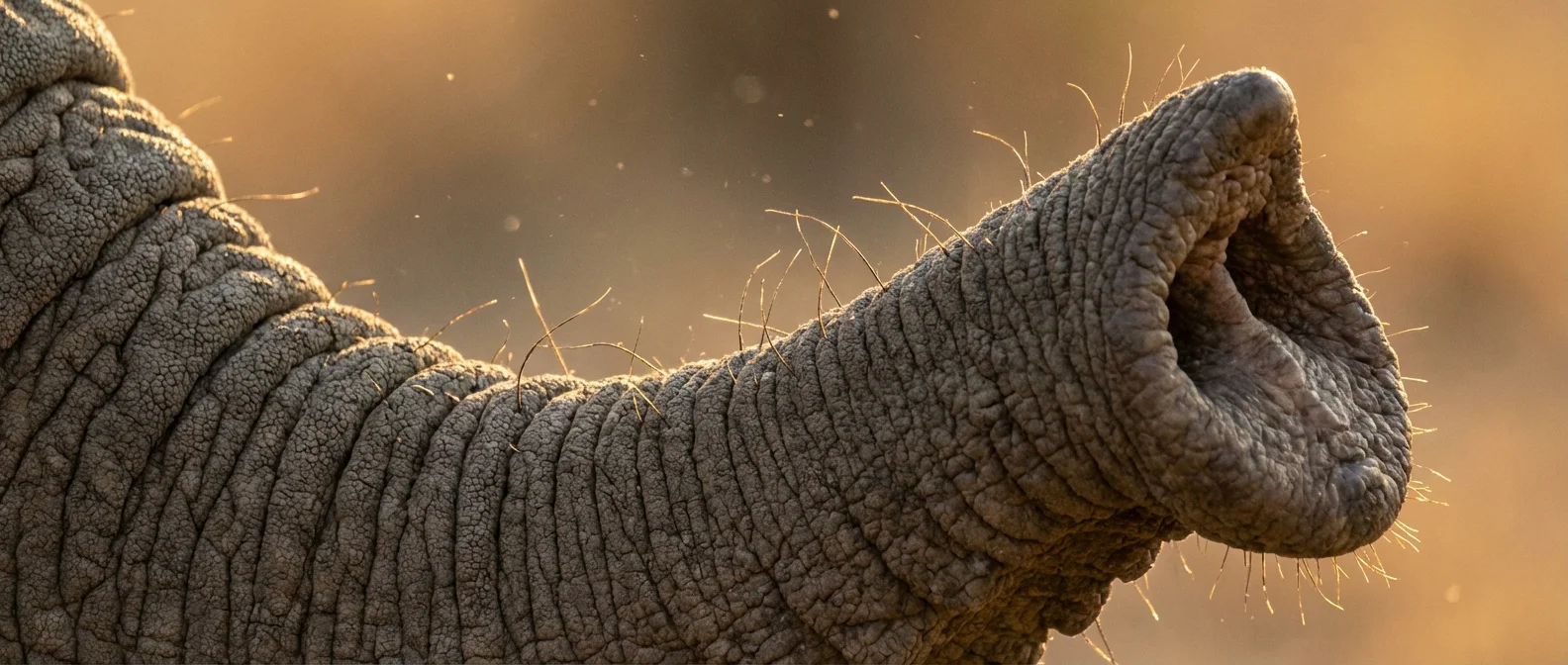
The elephant's trunk is a unique anatomical creation in the animal kingdom. It forms from the fusion of the nose and upper lip during embryonic development, creating a prehensile appendage with approximately 40,000 individual muscles — compared to the mere 600–700 muscles in the entire human body. It contains no bones or significant fat — only muscle tissue, nerves, and skin.
What makes the trunk truly remarkable is not just its strength — it can lift 350 kilograms — but its precision. An elephant can crack the shell of a peanut without crushing the seed. The tip functions similarly to human fingers, with African elephants having two finger-like projections at the top, while Asian elephants have only one.
The nerve that makes the trunk sensitive to touch — the infraorbital nerve — is thicker than both the optic and auditory nerves. Together with the trigeminal ganglia, it weighs about 1.5 kilograms in female elephants. This reveals a remarkable evolutionary priority: the elephant's brain devotes more neural resources to touch than to vision or hearing.
🔬 The Anatomy That Changes Everything
A groundbreaking study published in June 2023 in Communications Biology revealed for the first time the detailed functional anatomy of trunk whiskers. The team led by Nora Deiringer and Michael Brecht at Humboldt University of Berlin examined specimens from thirteen animals of three species: the African savanna elephant, the African forest elephant, and the Asian elephant.
The findings were remarkable. African elephants have an average of 621 whiskers on the trunk tip alone, compared to 367 in Asian elephants — a statistically significant difference. Across the entire trunk, a newborn African calf carries 1,220 whiskers, while an Asian one has 986.
The whiskers extend in two distinct rows along the ventral (lower) surface of the trunk. This placement is not random: it helps elephants balance objects on their trunk — an extremely common behavior when transporting food. On the dorsal (upper) surface, the whiskers are distributed more evenly. Near the tip, their density increases dramatically, explaining why the tip is so sensitive.
💡 Cylindrical and Durable
Unlike the thin, tapered whiskers of cats and rats, elephant whiskers are thick, cylindrical, and with almost no reduction in thickness from base to tip. This morphology makes them resistant to wear — an essential characteristic, as elephants apparently do not replace their whiskers through the “double-follicle” mechanism used by rodents. Each whisker follicle is innervated by an average of 87 axons, which enter through multiple nerve bundles.
📖 Read more: Jellyfish Sleep Like Us and Even Take Siestas
🧠 Embodied Intelligence: When Structure “Thinks”
The most notable discovery concerns what the researchers call “embodied intelligence.” Unlike the whiskers of many mammals — such as those of cats and rats that move independently (whisking) to scan their surroundings — elephant whiskers do not move independently at all. The trunk itself must move to bring the whiskers into contact with objects.
The research team confirmed this with high-speed video (100 frames/second), observing the female Asian elephant Anchali at the Berlin Zoo as she grasped fruit from a closed box without visual guidance. In no case was independent whisker movement observed — neither during grasping nor during food suction.
This means that tactile information does not come from active “scanning,” but from the mechanical interaction between the structure of each whisker and the object it touches. The physical structure encodes information right at the point of contact — before a signal even reaches the brain. This is similar to the difference between a “smart” sensor that preprocesses data and a simple one that sends raw signals.
The elephant's brain weighs 4.5–5.5 kilograms — the largest among land mammals — and its temporal lobes are proportionally larger even than those of humans. But part of this intelligence is not in the brain — it is literally in the whiskers.
"Elephant whiskers differ remarkably from the facial whiskers of other mammals. They are thick, immobile, lateralized, and arranged in specific high-density arrays — characteristics that evolved to support the extraordinary manipulation abilities of the trunk."
📖 Read more: Depression: An Early Sign of Parkinson's or Dementia?
🤝 Touch as a Social Language
The extraordinary sensory ability of the trunk does not serve only practical functions — it plays a central role in the social life of elephants. Individuals greet each other by touching mouths, temporal glands, and genitals, exchanging chemical cues through this regular contact.
Touch is particularly critical in mother-calf communication. Mothers touch their young with their trunk or feet when side by side, and with their tail when the calves follow behind. A newborn elephant calf relies primarily on touch, smell, and hearing, as its vision has not yet fully developed. It takes three months to gain enough control of its trunk to collect food, and nine months to achieve full coordination of mouth, trunk, and feet.
Even more remarkably, adult elephants show strong lateralization in trunk use — some are “right-handed” and some are “left-handed.” The study revealed that this lateralization is imprinted in the whiskers themselves: the side used more frequently has shorter whiskers due to wear, while newborns have perfectly symmetrical whiskers.
📖 Read more: Forests Glow in UV and Deer Can See It
🤖 From Nature to Robotics
The discovery of these unique characteristics has already inspired applications in robotics and biomimetics. Research teams are developing robotic grippers inspired by the flexible structure of the trunk — capable of grasping objects as delicate as an acupuncture needle, yet as large as a packaging box.
The principle of embodied intelligence is already being applied to artificial touch sensors. Instead of requiring complex circuits for signal processing, these sensors encode information through their very structure — dramatically reducing computational requirements. Nature needed millions of years of evolution, while engineers are trying to copy its solutions in months.
🔭 A New Perspective on Animal Intelligence
Research on elephant whiskers is changing how we understand animal intelligence. Traditionally, intelligence is measured by brain volume or behavioral complexity. Embodied intelligence demonstrates that “thinking” can happen outside the brain — in the sensory organs themselves.
Elephants recognize their reflection in mirrors, use tools, show interest in deceased members of their species, and maintain cognitive maps of extensive geographical areas. Their whiskers add yet another layer to this cognitive complexity — a layer that for decades remained hidden from our eyes, imprinted in the unseen hairs of a trunk.
📚 Sources
- Deiringer, N. et al. (2023). «The functional anatomy of elephant trunk whiskers». Communications Biology, 6(1), 591.
- Purkart, L. et al. (2022). «Trigeminal ganglion and sensory nerves suggest tactile specialization of elephants». Current Biology, 32, 904–910.
- Dagenais, P. et al. (2021). «Elephants evolved strategies reducing the biomechanical complexity of their trunk». Current Biology, 31(21), 4727–4737.
- Wikipedia — Elephant: Trunk anatomy and whiskers
- Schulz, A. K. et al. (2022). «Skin wrinkles and folds enable asymmetric stretch in the elephant trunk». PNAS, 119(31).