📖 Read more: Gut Bacteria 'Sense' Their Environment
🌲 A Forest That Glows in the Invisible
For decades, the scientific community believed that ultraviolet (UV) vision was the exclusive privilege of insects and birds. Mammals, according to conventional wisdom, could not see beyond the visible spectrum. This assumption turned out to be entirely wrong. Today we know that dozens of mammalian species — from deer and reindeer to cats, dogs, and hedgehogs — possess eye lenses transparent to ultraviolet radiation, revealing a world that remains completely invisible to us.
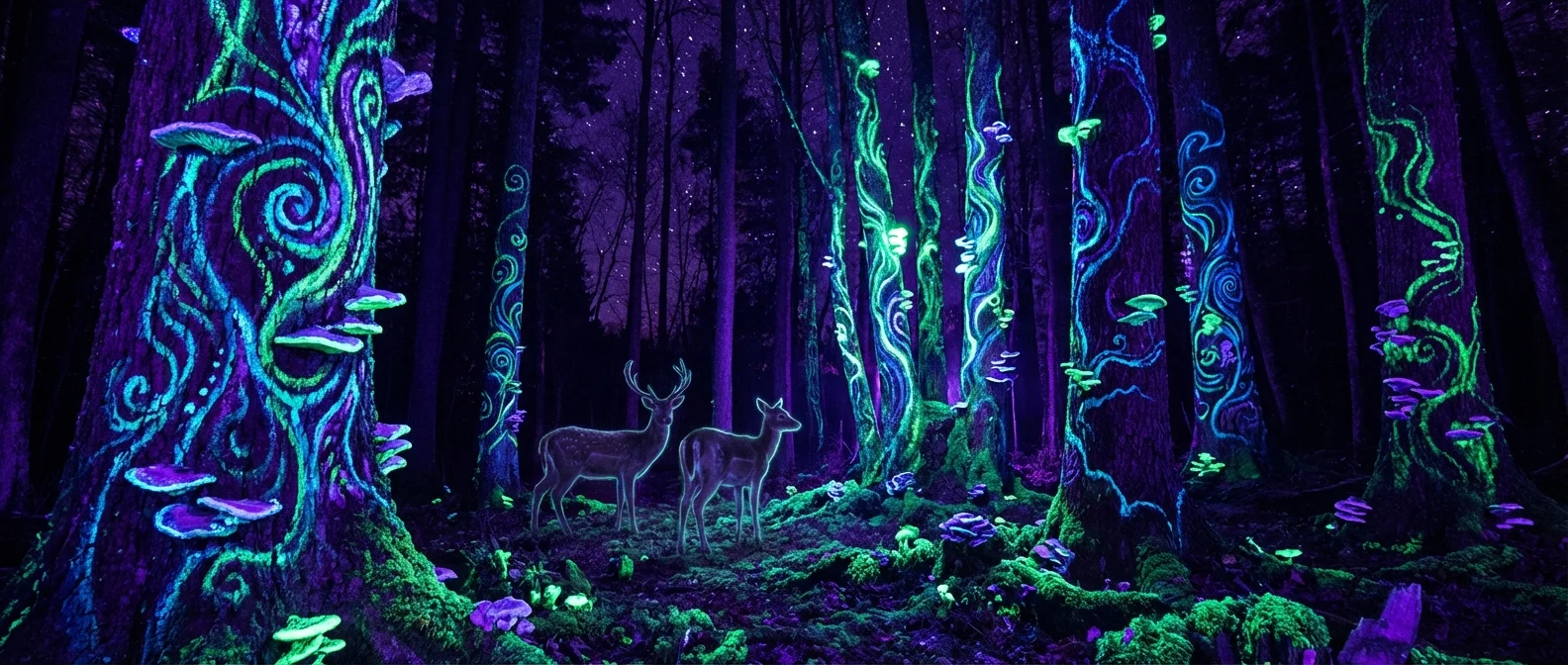
Under UV light, forests resemble an entirely different landscape. Tree bark, lichens, fungi, and animal urine emit fluorescence — a natural process in which organic materials absorb short-wavelength light and re-emit it at longer wavelengths. The result is a luminous mosaic of signals that functions for deer like an invisible navigation map through the dense forest.
📖 Read more: Hidden Geometry Bends Electrons Like Gravity
🦌 Deer See What We Cannot
A groundbreaking study published in the journal Ecology and Evolution in February 2026 provides the first undeniable evidence that deer use fluorescent markers on trees as a communication system. Researcher Daniel DeRose-Broeckert and his team studied an 800-acre area in Whitehall Forest, identifying active signpost sites of white-tailed deer (Odocoileus virginianus).
The team analyzed 109 antler rubs on trees, 37 ground scrapes, and 20 urination sites. The results were astonishing: these markers emit light at wavelengths of 450-460 nm and 537 nm — precisely within the spectrum to which deer eyes are most sensitive. In other words, deer have “beacons” throughout the forest, invisible to humans but plainly visible to their own eyes.
Deer rub their antlers and forehead glands against tree bark, stripping away the outer layer and exposing the inner wood. These exposed patches glow under UV light. At the same time, deer scrape the ground beneath low branches with their hooves, depositing substances from their interdigital glands — substances with well-known fluorescent properties. Urination at the same sites adds porphyrins and amino acids, which also glow intensely in the UV spectrum.
"Signpost sites are kind of like a community bulletin board. Deer go and smell and check who's in the area, as well as the reproductive status of others."
📖 Read more: Life Started as Sticky Slime Before Cells Existed
🔬 Glen Jeffery's Revolution in UV Vision
The foundation for this discovery was laid a decade earlier. In 2014, Professor Glen Jeffery of University College London (UCL) published a landmark study in Proceedings of the Royal Society B that overturned decades of assumptions. His team examined the eye lenses of dozens of mammalian species and discovered something stunning: many of them have lenses transparent to ultraviolet light, in stark contrast to human lenses that filter out nearly all UV radiation.
Reindeer proved particularly adept at UV vision — something entirely logical for animals living in Arctic regions where snow reflects significant amounts of ultraviolet radiation. Cats, dogs, hedgehogs, ferrets, and even some bats were found to possess similar capabilities. The study concluded that UV vision in mammals is the rule rather than the exception — an ability inherited from the common ancestor of vertebrates, according to an earlier 2003 study published in PNAS.
💡 Why Can't Humans See UV?
The human eye lens filters out UV light to protect the retina from damage. Our blue cone photoreceptors can theoretically detect UV, but the lens blocks it. Interestingly, after surgical lens removal due to cataracts, patients report seeing UV wavelengths as a pale blue-purple color. Impressionist painter Claude Monet, after cataract surgery in 1923, painted his water lilies with more intense blue and purple hues — reflecting his new UV vision.
📖 Read more: Πώς το Πλάσμα Μικροκυμάτων Επαναφέρει τον Γραφίτη σε Εύχρηστη Κατάσταση
☀️ How UV Light Penetrates Forests
Ultraviolet radiation does not penetrate forest ecosystems uniformly. The tree canopy filters a significant portion of UV, creating a pattern of bright patches — known as sunflecks — that shift continuously throughout the day. Deer, which are primarily active at dawn and dusk, take advantage of precisely these hours. At those times, visible light is weak but UV wavelengths remain prominent in the atmosphere, making fluorescent markers even more discernible in the twilight.
DeRose-Broeckert's research team also observed that signpost sites glow more intensely during the breeding season. Scientists hypothesize that more vigorous antler rubbing creates this brighter glow, amplifying the “signaling” of reproductive readiness throughout the forest area.
👁️ Ecological Implications and New Questions
The implications of these discoveries extend far beyond deer. UV vision fundamentally alters predator-prey dynamics. The urine of predators — wolves, bears, coyotes — glows under UV light due to porphyrins. For a deer with UV vision, a predator's tracks are not just scents but glowing danger signals. This explains why deer systematically avoid areas with predator markings — they literally see danger “glowing” on the ground.
Camouflage also takes on a new dimension. Hunters' clothing that appears perfectly camouflaged in visible light may glow like neon under UV — a phenomenon that explains why some hunters fail despite flawless visual concealment. Modern optical brighteners in laundry detergents emit UV fluorescence, making the wearer visible to every deer in the surrounding area.
However, Jonathan Goldenberg, an ecologist at the University of Oslo who was not involved in the study, cautions that "any interpretation of communication must be approached with the moderate understanding that fluorescence may be widespread without being functional." In other words, the fact that something glows does not automatically mean it glows for a biological purpose.
The study also raises critical questions about light pollution. Artificial lighting in urban and suburban areas often contains UV components that can disorient animals, disrupting migratory patterns, foraging, and reproductive behavior. Understanding the UV world of mammals is becoming increasingly critical in an era of growing urbanization.
The science of UV vision in mammals is still in its early stages. As new technologies — such as UV cameras and experimental ultraviolet spectrum displays — allow researchers to “see” through the eyes of other species, even more secrets are expected to be revealed about a world that was always around us — we simply couldn't see it.