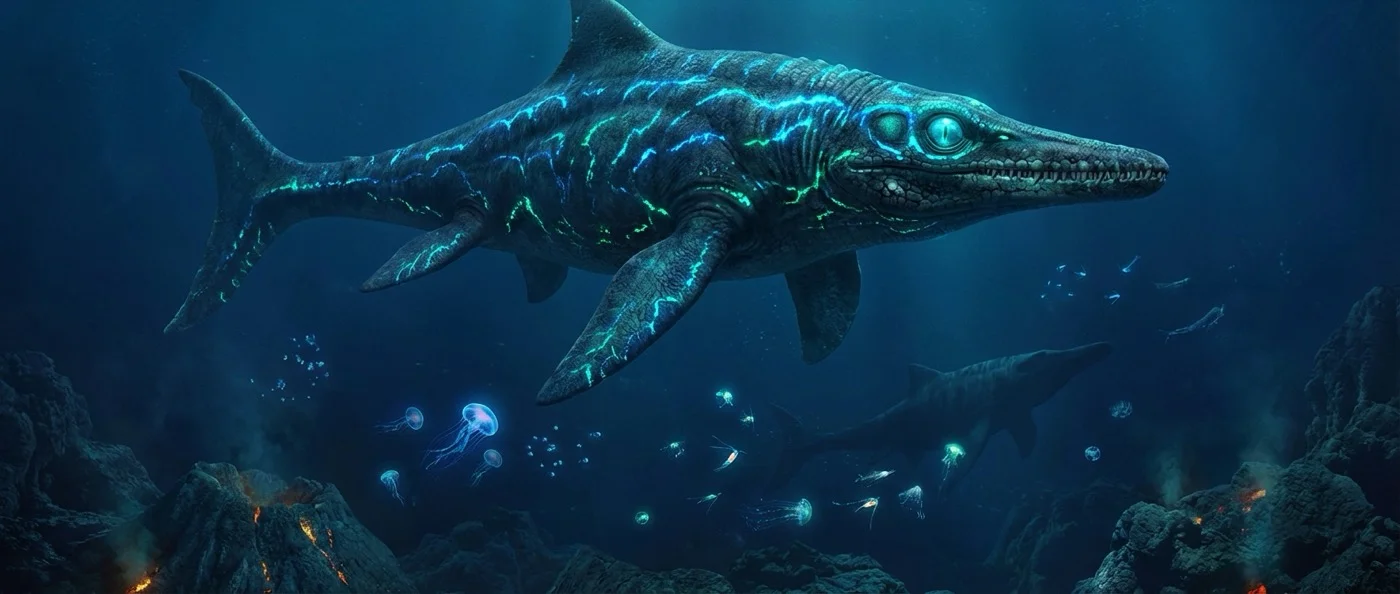
The End-Permian mass extinction 252 million years ago wiped out 96% of all marine species — making it the most catastrophic event in the history of life on Earth. Scientists have long debated how quickly the oceans could have recovered. Now, a remarkable set of fossils long lost in museum storage gives a clear answer: marine predators were back within just 1 million years, spectacularly diverse and globally distributed.
📖 Read more: 95-Million-Year-Old Spinosaurus: New Sahara Desert Discovery
🇦🇺 Lost Fossils Found Again: Australia's Hidden Sea Monsters
The story begins in the remote Kimberley region of northwestern Australia, where paleontologists collected fossils in the 1960s and 1970s. Stored in museum collections, these specimens were forgotten for decades — until 2024, when researchers from the Swedish Museum of Natural History rediscovered and systematically analyzed them for the first time.
The results, published in the Journal of Vertebrate Paleontology in February 2026, reveal two species of prehistoric marine tetrapods dating to approximately 250 million years ago — among the oldest known Mesozoic sea-dwelling vertebrates:
- Erythrobatrachus noonkanbahensis — a large-skulled apex predator known only from Australia, with a broad ~40 cm skull and powerful jaws designed to take large prey
- Aphaneramma — a long, narrow-snouted fish-hunter also found in Svalbard, the Russian Far East, Pakistan, and Madagascar
🦴 Two Hunters: An Apex Predator and a Fish Stalker
Erythrobatrachus noonkanbahensis is known exclusively from Australia. Its impressively broad skull, now 3D-scanned for detailed study, housed large teeth built for gripping large prey in shallow seas. It belongs to the trematosaurid temnospondyls — a group of large, crocodile-shaped amphibian relatives that were among the first tetrapods to fully re-enter the oceans after the extinction event.
Aphaneramma, by contrast, was built for speed and precision. Its elongated, narrow snout was perfectly adapted for snatching fast-moving fish — the same body plan independently evolved by gharials, dolphins, and ichthyosaurs. Finding this same genus across five continents shows just how rapidly early Triassic seas were colonized.
🔑 Key Discovery
These are the oldest securely identified Mesozoic marine tetrapods — present just 1 million years after the worst mass extinction in Earth's history. Their global distribution (Australia, Svalbard, Russia, Pakistan, Madagascar) proves that ocean ecosystems recovered far faster and more completely than most models predicted.
📖 Read more: Nasal Vaccine Targets COVID, Flu, and Pneumonia at Once
🌏 Surviving the End of the World: The Permian Extinction
The End-Permian extinction was triggered by massive volcanism from the Siberian Traps, releasing enough CO₂ to cause runaway warming, ocean acidification, and widespread anoxia. The seas became hot, acidic, and almost entirely devoid of oxygen in many regions. Only the most resilient organisms survived.
What happened next was long considered a mystery. Conventional wisdom held that recovery took tens of millions of years. But an accumulating body of evidence — including this study and a spectacular 2025 fossil discovery on Spitsbergen — shows the oceans bounced back with remarkable speed. Life, it turns out, is extraordinary resilient even after near-total annihilation.
🔍 The Tight Connection Between Extinction and Recovery
The rapid worldwide spread of these animals relates to the geography of the time. Two hundred and fifty million years ago, the continents were still assembled into the supercontinent Pangaea, with connected shallow seas ringing the landmasses on all sides. Once sea predators re-established themselves, they could spread quickly through these interconnected waterways.
The global distribution of Aphaneramma — from Norway to Madagascar — is particularly striking because it shows these animals weren't just surviving in an isolated refuge. They were thriving, spreading, and diversifying across the world's oceans within geological eye-blink of the catastrophe that had almost destroyed marine life entirely.
"These are the oldest clearly recognizable Mesozoic marine tetrapods. Their presence just 1 million years after the greatest extinction event demonstrates the remarkable resilience of life."
— Swedish Museum of Natural History, Journal of Vertebrate Paleontology 2026🦴 What These Fossils Mean for Our Understanding of Mass Extinctions
Beyond their age, these fossils reshape our understanding of how ecosystems recover. The speed and geographic scope of marine recovery after the Permian extinction rivals what we see after smaller, more recent extinction events. This has direct implications for our understanding of biodiversity loss today — though it also carries the sobering caveat that “fast” on geological timescales still means hundreds of thousands to millions of years.
The fact that these critical specimens spent decades unstudied in museum drawers also highlights the importance of revisiting historical collections. Major discoveries await not just in the field, but on museum shelves around the world.