📖 Read more: Life Started as Sticky Slime Before Cells Existed
🧬 LUCA: The Last Universal Common Ancestor of All Life
Every living organism on the planet — from microscopic bacteria in the depths of the oceans to giant sequoias and us humans — descends from a single ancestor. Scientists call it LUCA, an acronym for Last Universal Common Ancestor. LUCA represents the root of the tree of life, before it branched into the three major domains we know today: Bacteria, Archaea, and Eukaryotes.
The existence of this common ancestor is supported by genetic evidence. All organisms use the same amino acids to build proteins, share the same energy “currency” (ATP), have ribosomes, and use DNA as their information storage medium. These universal similarities can only be explained by common descent.
📅 4.2 Billion Years Ago: The Age of LUCA
In July 2024, an international team of researchers led by the University of Bristol published a groundbreaking study in Nature Ecology & Evolution. The team, under the guidance of Dr. Edmund Moody, compared genes across thousands of genomes of modern species, counting the mutations that have accumulated in their sequences since they shared a common ancestor.
Using a genetic equivalent of the well-known velocity equation in physics — and calibrating the clock with known species divergence ages from the fossil record — they reached a remarkable conclusion: LUCA lived 4.2 billion years ago, just 400 million years after the formation of Earth and our solar system.
"We didn't expect LUCA to be so ancient, just a few hundred million years after the formation of Earth. However, our results align with modern views about the habitable conditions of early Earth."
— Dr. Sandra Álvarez-Carretero, University of Bristol📖 Read more: Mathematics Existed Before Writing 8,000 Years Ago
🔬 A Complex Organism, Not a Simple Cell
The most astonishing finding was not the age, but the complexity of LUCA. The research team modeled the physiological characteristics of modern species back through time, tracing their genealogical steps to LUCA.
The results were striking: LUCA was not a primitive, simplistic cell. It was a complex organism, “not very different from modern prokaryotes,” as Professor Davide Pisani stated. It had complete DNA transcription mechanisms, an energy production system, and — perhaps most astonishing of all — an early immune system.
🛡️ Early Immune System
LUCA had already developed defense mechanisms against viruses 4.2 billion years ago. This means that even in the earliest stages of life, organisms were already in an “arms race” with viruses — a battle that continues to this day.
LUCA did not live alone. Its waste served as food for other microbes, such as methanogens, creating a recycling ecology. Professor Tim Lenton from the University of Exeter noted that "LUCA exploited and transformed its environment, but did not live alone. Its waste products would have been food for other microbes, such as methanogens, which would have helped create a recycling ecosystem."
🧪 Genes Older Than LUCA Itself
While the Bristol study revealed what LUCA was, a more recent study went even deeper into the past. In February 2026, scientists from Oberlin College, MIT, and the University of Wisconsin-Madison published a study in Cell Genomics describing a special type of genes: “universal paralogs.”
Paralogous genes are gene families that have multiple copies in the same genome. For example, the human genome contains eight versions of hemoglobin genes — proteins that bind oxygen and transport it in the blood. All these paralogous genes descend from an ancient globin gene that existed as a single copy 800 million years ago.
"Universal paralogs" are a rare, distinct category. They are genes that have at least two copies in the genomes of nearly all organisms that exist today. This widespread presence across all life means only one thing: the duplication of the original gene must have occurred before LUCA, and the multiple copies were inherited by its descendants up to the present day.
"While the last common ancestor is the oldest organism we can study with evolutionary methods, some genes in its genome were much older."
— Dr. Aaron Goldman, Oberlin College📖 Read more: Insulin Without Needles: The Gel That Changes Everything
🔍 What the Ancient Genes Reveal
The team examined all known universal paralogs and discovered that they are primarily associated with two fundamental functions: protein production and the transport of molecules across cell membranes. These two features were therefore among the first to evolve in primordial cells.
In Goldman's lab at Oberlin, the researchers reconstructed an ancient protein — the one responsible for embedding enzymes in cell membranes. Using techniques from evolutionary and computational biology, they resynthesized the ancestor of this protein and found that the simpler, ancient version could still perform basic functions: binding to the membrane and interacting with ribosomes.
🌍 Why It Matters
These findings overturn earlier assumptions that early life was extremely simple. Molecular complexity appeared astonishingly early in the history of our planet. Within just a few hundred million years after the formation of Earth, life hadn't merely appeared — it was already thriving in a complex ecosystem.
🧬 Complex DNA
LUCA had complete mechanisms for transcription and translation of genetic information
⚡ Energy Metabolism
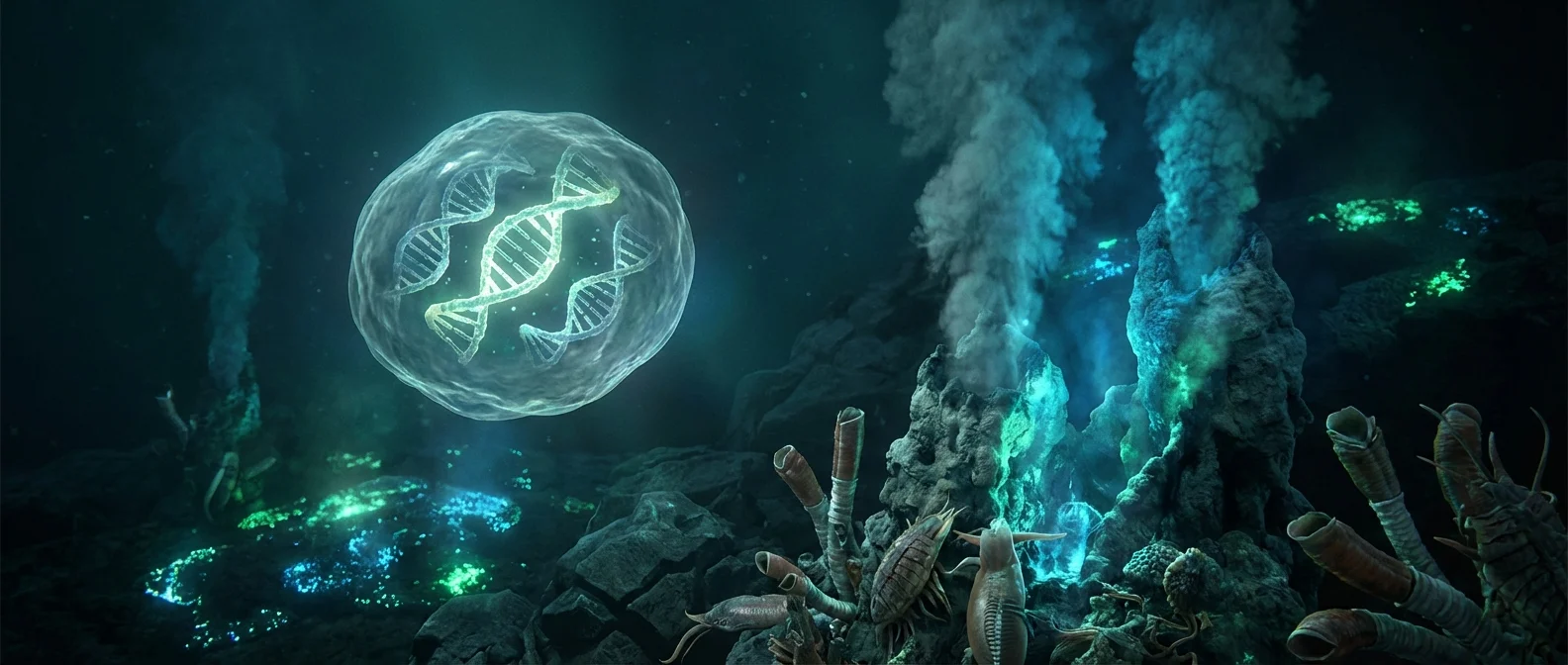
It used hydrogen as an energy source, likely at hydrothermal vents
🛡️ Immune System
It defended against viruses 4.2 billion years ago
🔄 Ecosystem
It did not live alone — its waste fed methanogenic microbes
Professor Philip Donoghue highlighted the broader significance: "Our work combines data and methods from multiple disciplines. It shows how quickly an ecosystem became established on early Earth — something that suggests life could flourish in Earth-like biospheres elsewhere in the universe."
Professor Betül Kaçar, one of the authors of the universal paralogs study, added: "By following universal paralogs, we can connect the first steps of life on Earth with the tools of modern science. They give us an opportunity to turn the deepest unknowns of evolution into discoveries we can actually test."
📚 The Future of Research
The researchers hope that new artificial intelligence tools will allow them to discover more families of universal paralog genes and describe their ancient ancestors in greater detail. Their goal is to paint a more complete picture of evolution before LUCA — an era during which life, as we know it, was just beginning to take shape.
This era, the “pre-LUCA” evolution, remains one of the most mysterious chapters in the history of our planet. However, thanks to these rare genes that have been preserved over billions of years, scientists are gaining for the first time a window into that distant past.
Sources: