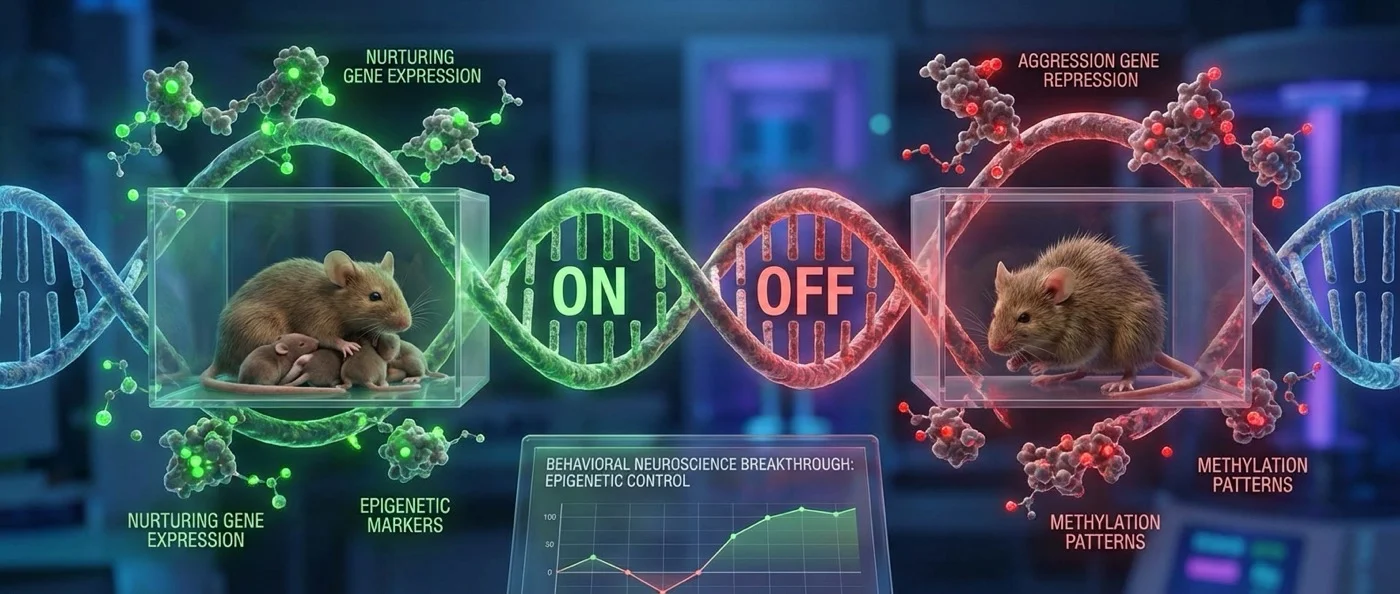
In fewer than 5% of mammals, fathers take an active role in raising their young. What determines whether a father will be nurturing or aggressive? A new study from Princeton reveals that a single gene — Agouti — acts as a molecular “switch” in the brains of male mice, dramatically altering their behavior toward pups.
📖 Read more: Manganese Catalyst Converts CO2 Into Clean Fuel at Record
🐭 African Striped Mice: A Unique Model
African striped mice (Rhabdomys pumilio) make an excellent model for studying paternal care because males display a remarkably wide range of behaviors: from devoted fathers who lick, groom, and warm pups beneath their bellies, to males that ignore or even attack newborns.
This spectrum of behaviors appears both in the wild and in the lab, making the species ideal for addressing a fundamental question: why are some males nurturing while others are neglectful?
🧬 The “Hidden” Role of the Agouti Gene
The research team, led by postdoctoral researcher Dr. Forrest Rogers at the Princeton Neuroscience Institute, exposed male mice to pups and mapped their neural activity. They discovered that a specific brain region — the medial preoptic area (MPOA) — was significantly activated in caring males.
Decades of research had shown that the MPOA functions as a “maternal care hub” in rodents. The new study demonstrates that the same region also works as a paternal care center.
💡 The Discovery
By analyzing gene activity in MPOA cells, the researchers found that the Agouti gene — known until now for its role in skin pigmentation and metabolism — was far more active in males that attacked pups compared to those that cared for them.
"Agouti is better known for its roles in skin pigmentation and metabolism, so discovering this previously unknown role in the brain for parenting behavior was exciting."
— Dr. Forrest Rogers, Princeton Neuroscience Institute🔬 Gene Therapy Revealed the “Switch”
To confirm that the Agouti gene was truly responsible for the behavioral shift, the researchers used gene therapy: they injected a virus that artificially boosted Agouti expression in the MPOA, mimicking the natural biology of a neglectful father.
The results were striking: males that had previously been nurturing showed less interest in pups after treatment — and some became aggressive. Agouti functioned as a molecular “off switch” for caregiving, turning attentive males into neglectful or even abusive fathers.
🏠 Social Environment: The Key Factor
The team discovered that the gene doesn't act alone — it is regulated by social conditions. Males that lived alone had low Agouti levels and were more likely to become caring caretakers. In contrast, males in group housing naturally had higher Agouti levels and spent half as much time on pup care.
Even more striking: when males were moved from group to solitary housing, Agouti levels dropped and caregiving increased. This means the “switch” is not permanent — it reverses depending on conditions.
"Our findings point to Agouti as a potential evolutionary mechanism that allows animals to integrate environmental information, such as social competition or population density, and adjust the balance between self-preservation and investment in offspring."
— Ricardo Mallarino, Assoc. Professor of Molecular Biology, Princeton🧠 Connection to Humans?
Both the MPOA and the Agouti gene exist in humans as well. However, the researchers caution that it remains unknown whether the same mechanisms regulate paternal behavior in our species.
"Parenting is a complex trait. We're not suggesting that you can take a pill to become a better parent, or that struggles with parenting reflect some molecular deficiency," emphasizes Catherine Peña, assistant professor of neuroscience at Princeton.
Nevertheless, by studying the biological changes that support fathering in naturally paternal species, the researchers hope their findings shed light on factors that place some fathers at greater risk for child abuse and neglect — opening new pathways for prevention.
The study was published on February 18, 2026 in the journal Nature, with funding from Princeton University, the New York Stem Cell Foundation, the Vallee Foundation, and the National Institutes of Health.