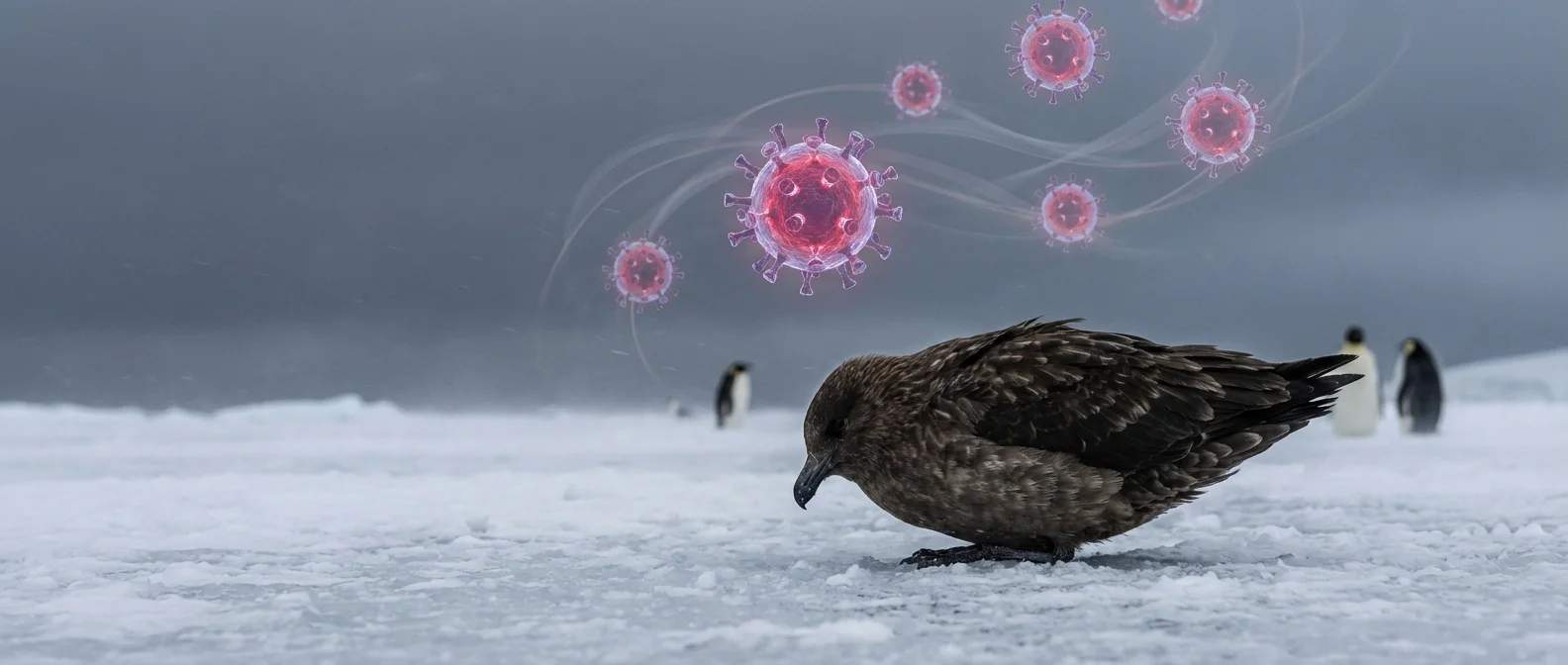
Antarctica was the last continent to remain unaffected by bird flu. Now, a study in Scientific Reports confirms the worst: the H5N1 virus not only reached Antarctica — it killed wild animals for the first time in history. The last line of defense has fallen.
📖 Read more: Bees: 26,000 Species — First Complete Global Census
🗺️ The Path of the Virus
H5N1 was first discovered in 1996 at a goose farm in Southeast China. From 2020, the 2.3.4.4b clade began an unprecedented global spread through migratory birds. By late 2022, it had reached South America, where it caused devastation: over 100,000 wild birds in Peru, 17,000 elephant seals in Argentina with 97% mortality among newborns, and 4,000 sea lions in Chile.
In early 2024, the virus crossed the last border: through skuas and migratory birds traveling between South America and Antarctica, it reached the Antarctic Peninsula.
First Deaths
The study by Iervolino, Kuiken, and Vanstreels confirmed that over 50 skuas died from H5N1 in Antarctica during the summers of 2023 and 2024. The symptoms were severe neurological ones: twisted necks, walking in circles, falling from the sky. This is the first confirmed mass die-off from bird flu in Antarctica.
📖 Read more: Quantum Computer Corrects Qubit Errors in Real Time
🐧 The Danger for Penguins
So far, H5N1 has not been confirmed as a cause of death in penguins. However, emperor penguins face enormous risk: they breed in dense colonies of thousands of individuals — ideal conditions for rapid spread. They share habitats with skuas, which are already confirmed carriers, and have limited genetic diversity that makes them vulnerable to disease.
In zoos, such as in Paris, penguins are already being vaccinated as a precaution — something that is impossible for the hundreds of thousands of penguins in the wild.
📖 Read more: Japanese Drug Mic-628 Cuts Jet Lag Recovery Time in Half
🌍 Biodiversity Crisis
"We let the virus slip through our fingers when it first appeared in the poultry industry. Once it entered wild bird populations, we lost the ability to control it. Now it is established on every continent except Oceania," says Professor Thijs Kuiken from Erasmus MC.
The problem is multi-layered. Antarctic wildlife simultaneously faces climate change, increasing tourism, and overfishing — H5N1 is being added to an already dangerous cocktail of threats. And most alarmingly: the last skua population survey in Antarctica was conducted in the 1980s. We don't even know how many we are losing.
"All signs point to this virus spreading further," warns Kuiken. “If no one is monitoring, we won't know what's happening.” Wildlife veterinarian Ralph Vanstreels from UC Davis described the situation as “a crisis of animal suffering.”