📖 Read more: Ocean Warming Could Slash Fish Biomass by 20% Before 2100
🪸 The Fourth Global Bleaching: Shocking Numbers
The U.S. National Oceanic and Atmospheric Administration (NOAA) declared the fourth global mass coral bleaching event in April 2024 — unprecedented in scale and intensity. Since January 2023, thermal stress in the oceans has reached historically unparalleled levels, affecting over 83 countries across every corner of the planet. This is a phenomenon unfolding in real time, with scientists watching in alarm as the greatest destruction of coral ecosystems ever recorded takes place.
According to the most recent data, nearly 84% of the world's coral area has been exposed to thermal stress intense enough to cause bleaching. This percentage far exceeds the previous record, set during the third global bleaching (2014-2017), when 68.2% of reefs were affected. The escalation is striking and alarming: in less than a decade, the extent of damage increased by nearly 16 percentage points.
🌡️ Why Corals Bleach
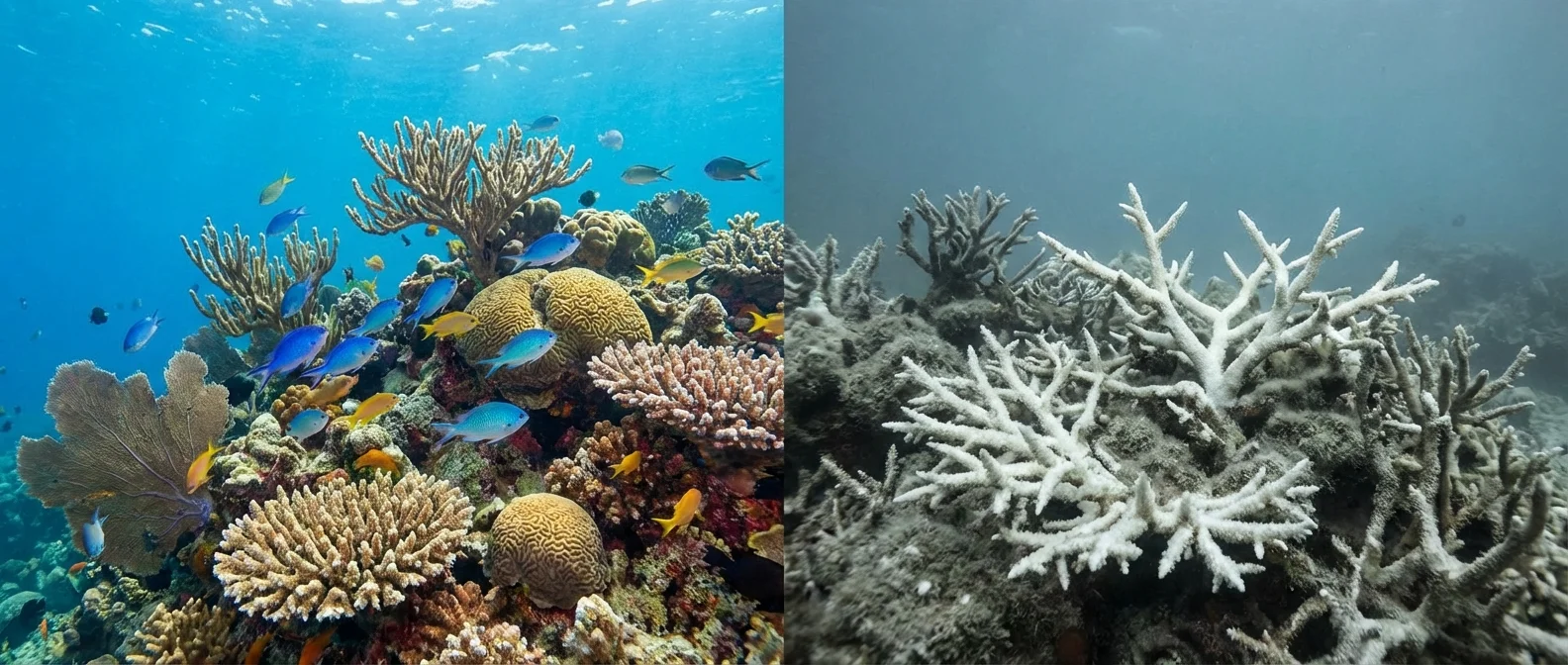
Coral bleaching is not merely an aesthetic phenomenon — it is a sign of a deadly crisis. Corals live in a mutually beneficial relationship with microscopic single-celled algae called zooxanthellae. These photosynthetic microorganisms reside within coral tissues, providing them with up to 90% of their energy through photosynthesis, as well as the characteristic vibrant colors that make coral reefs so spectacular.
When seawater temperature rises by even 1°C above normal for several weeks, corals undergo severe stress and expel their zooxanthellae. Without them, their limestone skeleton becomes visible — which is why they appear stark white. Bleached corals are not yet dead, but they are in an extremely vulnerable state, unable to feed adequately. If the overheating doesn't subside soon, the corals die within weeks.
💡 What Is Mass Coral Bleaching?
Mass bleaching is declared when extensive thermal stress is documented across coral reefs in multiple ocean basins simultaneously. In the history of systematic recording, only four such events have occurred: 1998, 2010, 2014-2017, and 2023-2024. The last is by far the worst, as elevated ocean temperatures shattered every historical record. In 2023, marine heat waves covered 96% of the planet's oceans.
📖 Read more: Sea Turtles Lay Fewer Eggs Due to Climate Change
🌊 The Great Barrier Reef in a State of Emergency
The Great Barrier Reef of Australia, the largest living organic structure on Earth, suffered the most severe annual coral loss in 39 years of systematic monitoring. This colossal reef stretches 2,300 kilometers along the Queensland coast and covers 344,000 square kilometers — so large it is visible even from space.
According to the Australian Institute of Marine Science (AIMS), live coral cover declined by nearly one-third in the southern section, by a quarter in the north, and by 14% in the central area — in just one year. Mike Emslie, head of the long-term monitoring program, stated that “these are significant impacts” and that "the increasing frequency of bleaching is really starting to have detrimental consequences on the Great Barrier Reef."
Particularly alarming were the findings from Lizard Island, in the northern part of the reef. There, researchers from Griffith University used high-resolution drones and recorded an overall coral mortality rate of 92% — one of the highest ever documented worldwide. Bleaching affected on average 96% of living corals in the surveyed areas, with some zones showing mortality above 99%. It is worth noting that the Great Barrier Reef has experienced bleaching in 2016, 2017, 2020, 2022, 2024, and 2025 — six times within a single decade.
"The world has spent most of the last two years at 1.5°C warming, and the marine heat waves that resulted have led to unprecedented bleaching of 80% of the world's reefs."
📖 Read more: Arctic Agriculture: Water Rise Apparently Stores CO2
🔬 The First Climate Tipping Point
The 2025 Global Tipping Points Report, involving 160 scientists from 23 countries, confirmed an ominous milestone: warm-water coral reef systems are now the first major Earth system to have breached its climate tipping point. Mass reef die-offs are estimated to begin at 1.2°C of warming above pre-industrial levels — a threshold the planet has already crossed, with average global warming having reached 1.3°C.
Repeated mass bleachings are now occurring so close together in time that corals cannot recover. A healthy reef's restoration cycle requires at least 10-15 years, but bleaching events now recur every 1-2 years. This leads to the mass and permanent mortality we are observing. Without drastic reduction of global temperatures, even the most ambitious coral restoration efforts are deemed insufficient.
⚠️ What This Means for the Planet and Humanity
Coral reefs, despite covering less than 1% of the ocean floor, harbor roughly 25% of all marine species. They are the “tropical rainforests” of the ocean — ecosystems of extraordinary biodiversity inhabited by thousands of species of fish, mollusks, crustaceans, and other marine organisms. Their disappearance would trigger chain reactions throughout the entire marine food web.
Beyond biodiversity, over 500 million people depend directly on coral reefs for their livelihoods — through fishing, tourism, and coastline protection from erosive waves and tropical storms. The ecosystem services provided by reefs are valued at over 2 trillion dollars annually. For many island communities in the Pacific, the Caribbean, and Southeast Asia, the loss of reefs is equivalent to losing their primary resource for survival.
Scientists warn that corals are simply the “canary in the coal mine.” With every fraction of a degree of additional warming, more vital Earth systems — from the glaciers of West Antarctica to the Amazon rainforest — will edge closer to their own collapse points. Under current policies, warming is expected to reach 2.5-3°C by the end of the century, putting multiple irreversible climate tipping points at risk.
However, the 2025 Tipping Points Report also highlights positive developments: renewable energy sources — wind, solar, and battery storage — are now fully competitive against fossil fuels. The energy transition can accelerate even further, and action against climate change can still save countless lives. As the researchers note, corals can recover — but only if we manage to bring temperatures back down. The time for decisive action is not tomorrow — it is now.
📚 Sources
- Phys.org — Great Barrier Reef records largest annual coral loss in 39 years
- Phys.org — Drones capture devastating coral loss as bleaching wipes out most reef life
- ScienceAlert — Mass Coral Die-Offs Confirm First Breach of a Major Climate Tipping Point
- ScienceAlert — Record-Breaking Coral Death in The Great Barrier Reef Alarms Scientists
- Phys.org — Winter's coming but the heat stays on for Australia's coral reefs