📖 Read more: Bees: 26,000 Species — First Complete Global Census
🌊 A Hidden World in the Clarion-Clipperton Zone
Between Mexico and Hawaii, in a vast area of the Pacific Ocean known as the Clarion-Clipperton Zone (CCZ), one of the greatest environmental dramas of our time is unfolding. The seabed of this zone is covered with millions of polymetallic nodules — dark, potato-shaped rocks rich in manganese, nickel, cobalt, and copper — metals critical for electric vehicle batteries, solar panels, and wind turbines.
For years, the industry treated this zone as a barren landscape with no particular biological value. The new research proves that was tragically wrong. Marine biologists from many countries joined forces in a five-year research effort, under the oversight of the International Seabed Authority (ISA), which regulates mining activity in international waters. The findings were published in the leading scientific journal Nature Ecology & Evolution.
📖 Read more: DNA On-Off Switch: A New Era of Nanotechnology
🔬 160 Days at Sea: The Largest Deep-Sea Census Ever
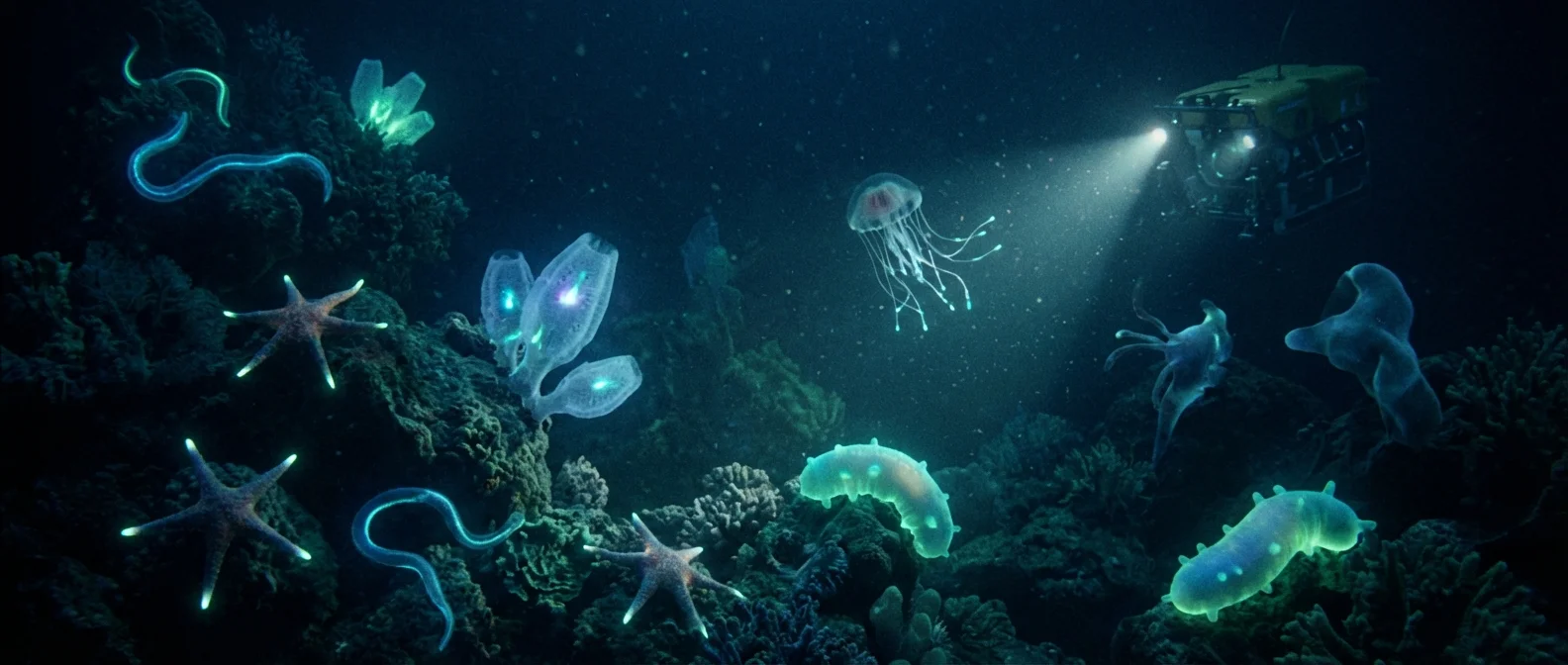
The study represents the largest systematic survey of life ever conducted on the deep floor of the Pacific. Over a span of five years and 160 days at sea, researchers collected 4,350 animals larger than 0.3 millimeters living in and on the seabed sediment. From these samples, 788 distinct species were identified.
The animals found belong primarily to three major groups: marine polychaete worms (bristle worms), crustaceans, and mollusks, including snails and mussels. The majority of species had never been described before — making molecular (DNA) data absolutely critical for their identification. Among the discoveries, a new species of solitary coral, Deltocyathus zoemetallicus, stands out, found attached to polymetallic nodules — that is, directly on what the industry wants to mine.
🏜️ Life at the Edge: An Environment of Extreme Rarity
To understand how extraordinary these discoveries are, we first need to grasp how inhospitable this environment is. At 4,000 meters depth, pressure is 400 times greater than at the surface. There is no sunlight, temperature hovers around 1–2°C, and food is extremely scarce — relying almost exclusively on “dead” organic particles that slowly sink from the upper layers.
The sediment layer on the seabed grows at a rate of just one thousandth of a millimeter per year. This means any disruption to this ecosystem could take millennia to recover. To illustrate how rare life is here: a seabed sample from the North Sea can contain up to 20,000 animals. An equivalent sample from the deep Pacific contains the same number of species, but only 200 individual organisms. Species diversity is enormous — but the population of each species is minimal.
🔍 Why the Clarion-Clipperton Zone Is Unique
The CCZ spans an area of roughly 6 million square kilometers — almost the size of all of Europe. Its seabed is covered with trillions of polymetallic nodules, spherical formations that take millions of years to form. These nodules aren't merely mineral resources — they function as micro-habitats for hundreds of species, from microscopic worms to corals that grow on them. Removing them doesn't simply mean mining metals — it means eliminating an entire functioning ecosystem.
📖 Read more: Genes That Existed Before Life Appeared on Earth
⛏️ The Shadow of Mining: What the Data Shows
The study didn't stop at cataloging. For the first time, researchers assessed the actual environmental impact of a trial seabed mining operation. A mining machine was dragged across the seabed, collecting nodules and leaving grooves in the sediment behind it. The results were mixed.
In the tracks where the machine passed, animal numbers dropped by 37% and species diversity fell by 32%. Although the overall impact was smaller than some scientists had feared, the local destruction was severe. Given that recovery of these environments is measured in decades or even centuries, even a “small” reduction in species could be irreversible on a human timescale.
Researchers also observed that seabed communities changed naturally over time, likely in response to fluctuations in the amount of food reaching the bottom. This means that every environmental assessment must account for natural variability — something that makes distinguishing between human-caused and natural change far more complex.
"I have been working in the Clarion-Clipperton Zone for over 13 years, and this is by far the largest study ever conducted. Given that most species have not been described previously, molecular DNA data were critical for studying biodiversity on the seabed."
📖 Read more: Nanopigment Sensor: Changes Color Based on pH in Seconds
🌍 Geopolitics and Ecology: A Dangerous Crossroads
Deep-sea mining is not a simple industrial issue — it is at the center of a global geopolitical competition. The metals found in the CCZ nodules are critical for the green transition: nickel and cobalt for batteries, manganese for steel, copper for electrical grids. China, Russia, and several European countries have already obtained exploration licenses for various sections of the zone.
At the same time, Pacific island nations such as Nauru and Tonga find themselves in a difficult position: mining could bring much-needed revenue, but destroying the marine ecosystem could undermine fishing and tourism — the two main pillars of their economies. The International Seabed Authority (ISA) is under pressure to approve the first commercial licenses, while many countries, scientists, and environmental organizations are calling for a moratorium.
🔮 What We Still Don't Know
Despite the study's scale, researchers emphasize that there are enormous gaps in our knowledge. We don't know how widely most of the 788 species are distributed. If some of them exist only in small areas of the CCZ, then mining could literally wipe them out before we even study them properly.
Only 30% of the Clarion-Clipperton Zone has been designated as an “Area of Particular Environmental Interest” (APEI) — meaning it is theoretically protected. But scientists admit that “we essentially have no idea what lives there.” The biodiversity of these protected areas remains almost entirely unexplored.
The discovery of these hundreds of new species is not just a scientific triumph — it is an urgent warning. Every nodule that is mined is a tiny habitat lost, along with the creatures that have lived on it for millions of years. The question is not whether we need the metals — but whether we can take them without destroying what we've only just begun to understand.
📚 Sources
- 🔗 ScienceDaily — Hundreds of new species found in a hidden world beneath the Pacific (Feb 2026)
- 🔗 Nature Ecology & Evolution — Impacts of an industrial deep-sea mining trial on macrofaunal biodiversity (Stewart et al., 2025)
- 🔗 Phys.org — New deep-sea species discovered during mining test (Dec 2025)
- 🔗 University of Gothenburg — New deep-sea species discovered during mining test