🔬 When the Enemy Wears the Ally's Uniform
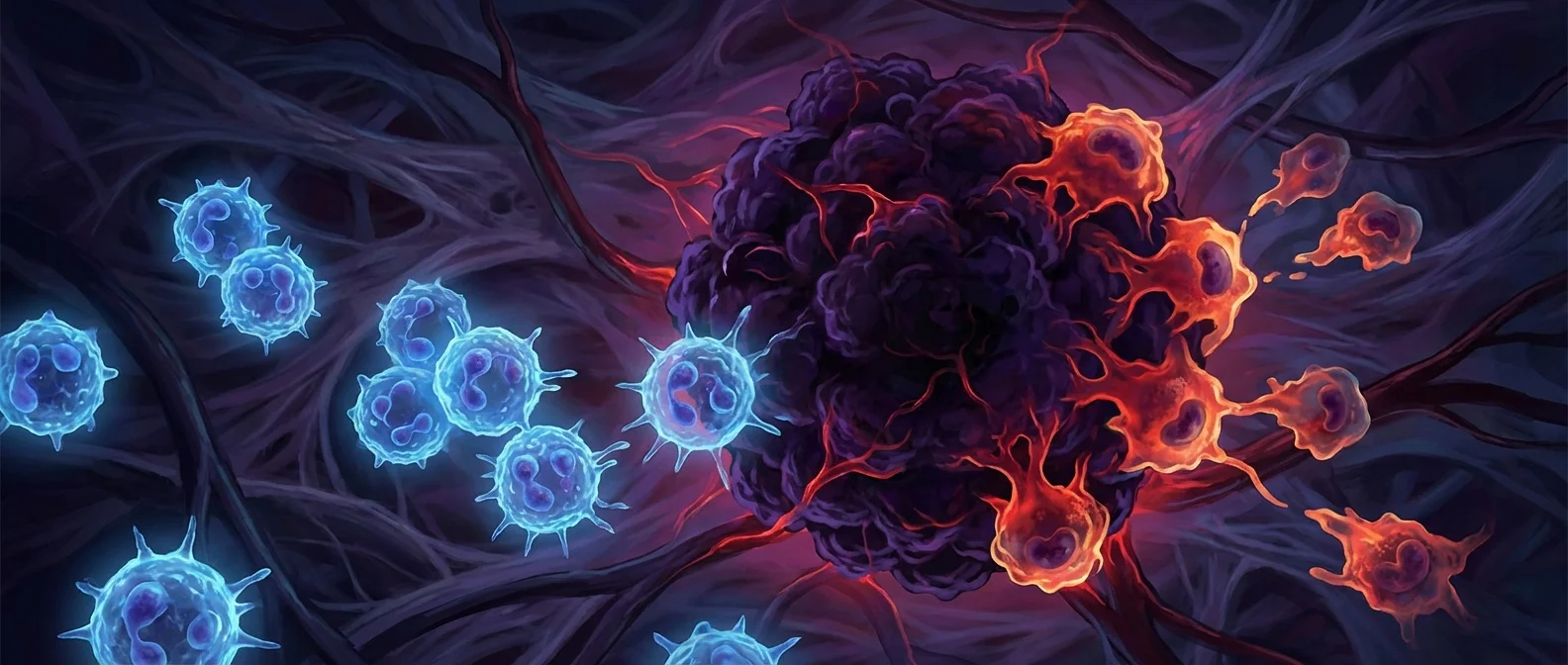
Imagine an army that invades enemy territory, but instead of fighting, gradually starts working for the opponent. That's exactly what happens inside cancerous tumors. Immune cells — the body's first line of defense — enter the tumor to destroy it, but the cancer's microenvironment “reprograms” them, turning them into growth tools for the tumor itself.
This process, known in the scientific community as immune exhaustion, is one of the primary reasons cancer resists treatment. And just in February 2026, researchers at the University of Geneva revealed a mechanism so insidious that it changes how we understand the relationship between cancer and immunity.
🧬 Neutrophils: From Guards to Traitors
The team of Professor Mikaël Pittet at the University of Geneva, in collaboration with the Ludwig Institute for Cancer Research, published their findings in the journal Cancer Cell. The research focuses on neutrophils — the most abundant immune cells in our blood, which typically serve as the first line of defense against infections and injuries.
What the researchers discovered was astonishing: tumors don't merely avoid neutrophils — they actively recruit them and change their behavior. Once neutrophils are exposed to the tumor's ecosystem, they begin producing a molecule known as chemokine CCL3. Instead of helping the body fight the disease, CCL3 encourages the tumor to grow.
⚠️ How Cancer “Hacks” Our Defenses
Neutrophils — which normally kill invaders — enter the tumor and switch sides. They begin secreting the molecule CCL3, which acts as fertilizer for the cancer. When researchers removed the CCL3 gene from neutrophils, the tumor stopped benefiting from them — without affecting their normal function in the blood.
"We are decoding the 'identity' of tumors, identifying one by one the key variables that determine disease progression. Our work shows that these variables are limited in number — and that opens the door to personalized therapy."
🛡️ T Cells in Exhaustion: The Second Mechanism
Alongside the “hijacking trick” against neutrophils, cancer also targets T cells — the immune system's most specialized “killers.” T cells enter the tumor to destroy it, but the constant battle within the toxic microenvironment wears them out. They gradually lose their ability to produce the proteins that activate the immune response and become increasingly less effective.
Researchers at Sanford Burnham Prebys in California discovered that a protein on the surface of T cells, PSGL-1, is key to this exhaustion process. In mouse experiments, an antibody that blocked PSGL-1 activity dramatically slowed exhaustion and allowed T cells to regain their function — even in melanoma resistant to immunotherapy.
⚔️ The Counterattack: “Armored” Immune Cells
While the discoveries about exhaustion mechanisms paint a grim picture, the scientific community is not sitting idle. One of the most promising approaches comes from EPFL (Swiss Federal Institute of Technology Lausanne) in Switzerland, where Professor Li Tang's team created "armored" CAR-T cells.
The idea is as elegant as it is effective: the modified immune cells were designed to secrete a molecule called interleukin-10 (IL-10), which allows them to continue multiplying and functioning near tumors. Essentially, the immune cells produce their own medicine to withstand the hostile environment that cancer creates around itself.
In mouse experiments, IL-10 CAR-T cells completely eliminated multiple cancer types — melanoma, colon, breast, and pancreatic cancer. Even more impressively: when cancer cells were reintroduced into the animals, the “armored” immune cells prevented them from forming new tumors. In an ongoing clinical trial, all 11 patients achieved complete remission.
💡 Why This Changes Everything
The significance of these discoveries goes beyond laboratory findings. Understanding that cancer doesn't merely evade the immune system but actively turns it to its advantage fundamentally changes the strategy for fighting it. CCL3 could serve as a biomarker for monitoring disease progression, while “armored” cells pave the way for immunotherapies that don't wear out over time.
There are practical advantages too. IL-10 CAR-T therapy requires just 5% of the usual dose of cells compared to traditional immunotherapies, drastically reducing both cost — which can reach hundreds of thousands of dollars — and preparation time, from weeks down to just a few days. A small blood sample is now enough to begin treatment.
The research community is simultaneously exploring multiple fronts: from using hydrogel that acts as a “rest stop” for T cells, to removing “sugar shields” from cancer cells that hide them from the immune system, and genetically modifying cells to make them resistant to exhaustion.
🔮 The Future of Immunotherapy
The fight against cancer is no longer just about chemotherapy or radiation. It's about understanding the language that our cells speak — and how the enemy manipulates it. Researchers are learning to “translate” the signals tumors send to the immune system and reverse them.
From neutrophils becoming “double agents” to T cells exhausted on the front lines, the emerging picture is clear: cancer is a strategist that wins by recruiting the enemy army. But science is learning to armor the soldiers before they enter battle — and that could change everything.
📚 Sources
- 🔗 ScienceDaily — When immune cells stop fighting cancer and start helping it (Feb 2026)
- 🔗 Cancer Cell — CCL3 is produced by aged neutrophils across cancers (Bolli et al., 2026)
- 🔗 Nature Biotechnology — Armored CAR-T cells with IL-10 (EPFL, 2024)
- 🔗 Cell Reports — Reviving exhausted T cells via PSGL-1 (Hope et al., 2023)
- 🔗 New Atlas — Armored immune cells make their own medicine (2024)
- 🔗 New Atlas — Giving exhausted T cells a second wind (2023)