📖 Read more: Snowball Earth: The Planet Never Froze Completely
☠️ What Are PFAS — The “Forever Chemicals”
PFAS (per- and polyfluoroalkyl substances) are a group of roughly 15,000 synthetic chemicals that have been in use since the 1940s. What makes them unique are the extremely resilient carbon-fluorine bonds they contain — bonds so strong that nature cannot break them. That's why they're called "forever chemicals": they never break down. Ever.
Industry loved them precisely for their durability. PFAS make pans non-stick (Teflon), jackets waterproof (Gore-Tex), food containers grease-proof, and firefighting foam effective. They're found in cosmetics, dental floss, bandages, and even ski wax. In short, they're everywhere around us — and now, everywhere inside us.
📖 Read more: AI Monitors Every Neuron in Worms and Jellyfish Live
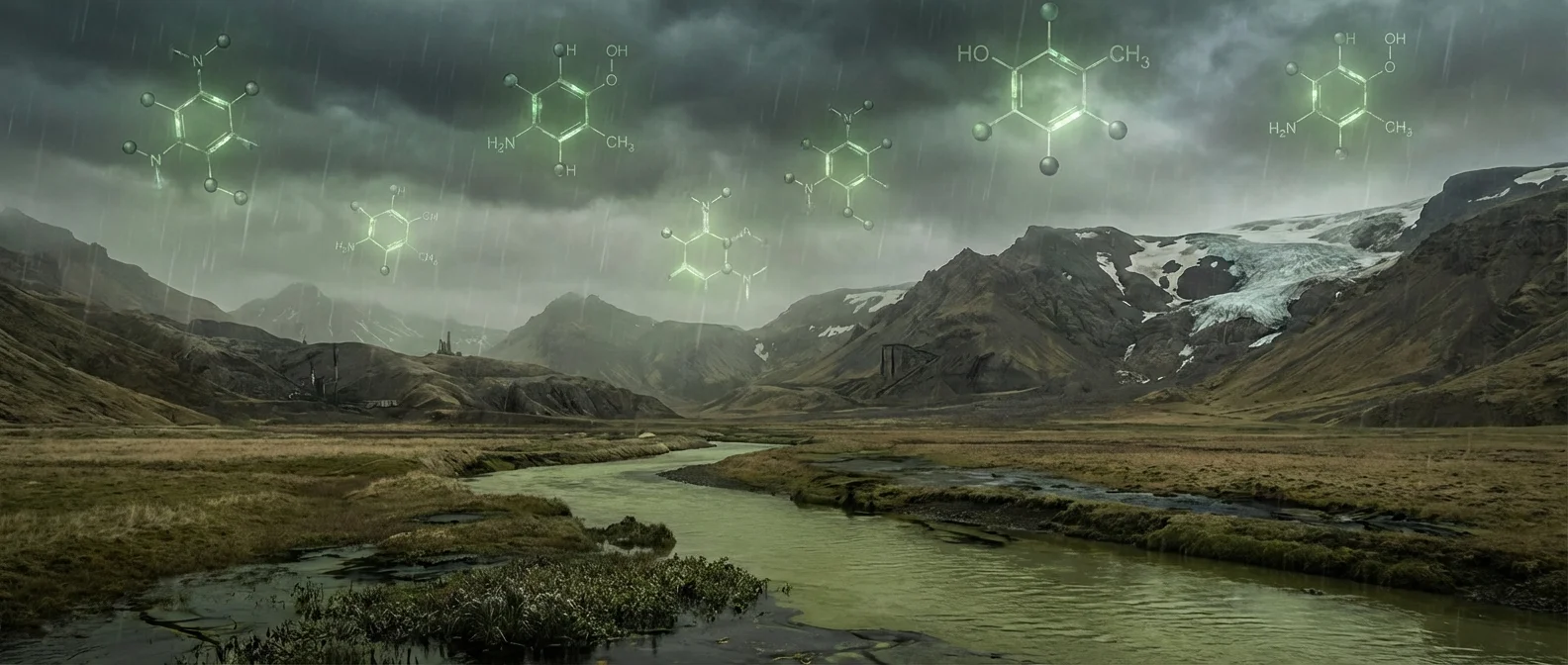
🌧️ It's Raining Poison — Literally
In 2022, a team of researchers from Stockholm University published a chilling study in Environmental Science & Technology. Analyzing a full decade's worth of data, they found that PFAS levels in rainwater “far exceed” the safety guidelines set by the U.S. Environmental Protection Agency (EPA).
And this isn't just about contaminated industrial zones. The pollution is uniform even in the most remote places on Earth. On the Tibetan Plateau, at elevations of thousands of meters, PFAS levels in rainwater exceeded EPA limits by a factor of 14.
"Based on the latest U.S. guidelines for PFOA in drinking water, rainwater everywhere in the world would be deemed unsafe for consumption. While in the industrialized world we rarely drink rainwater, many people globally depend on it."
— Ian Cousins, Professor of Environmental Chemistry, Stockholm UniversityIn Sweden, the national PFAS mapping revealed that nearly half of municipal drinking water networks exceeded safety limits. In the Netherlands, industry struggled so badly to comply with existing safety standards that the government ultimately relaxed them.
📉 Safety Limits in Freefall
One of the most alarming findings is the dramatic reduction in what are considered “safe” limits in recent years. In 2020, the EPA had set the safety threshold for PFOA and PFOS at 70 parts per trillion (ppt) in drinking water. Today, those limits have plummeted: 0.004 ppt for PFOA and 0.02 ppt for PFOS — barely detectable.
"There has been a remarkable decline in PFAS guideline values for drinking water over the past 20 years," Cousins noted. "The value for one well-known PFAS substance that is probably carcinogenic was lowered by 37.5 million times." This means, quite simply, that regulatory authorities dramatically underestimated the risk for decades.
📖 Read more: AI Reads Brain MRIs in Seconds
🔬 How Widespread Is the Contamination
A 2025 study from the PFAS Lab at Northeastern University, published in Environmental Science & Technology, revealed that the contamination is far worse than previously thought. While there are about 2,200 known contaminated sites in the U.S., researchers estimate there are another 80,000 potentially contaminated sites that simply haven't been tested yet.
94% of known contaminated sites had average PFAS concentrations in groundwater above acceptable regulatory limits. At none of these locations were the levels deemed safe. Three categories of sites stood out for the highest levels: airports, military installations, and municipal firefighting operations — all sharing one common factor: AFFF firefighting foam, the primary known source of PFAS.
A less expected finding was that the metals industry and electronics manufacturing are also significant sources of contamination — particularly concerning as many countries are investing heavily in semiconductor production.
📖 Read more: 99.9% Quantum Entanglement Record Between Atoms and Photons
🏥 What PFAS Do to the Human Body
PFAS enter the body through food, water, air, and — as 2024 research revealed — through the skin. Once they reach the bloodstream, they bind to proteins, pass into cells and organs, and remain there for years or even decades. They are detectable in the blood of the majority of the U.S. population.
The two most studied PFAS — PFOA and PFOS — have been linked to serious health effects. In 2023, the International Agency for Research on Cancer (IARC) of the WHO classified PFOA as “carcinogenic to humans” and PFOS as “possibly carcinogenic.” There is also strong evidence that PFAS interfere with antibody responses — in other words, they weaken our natural defenses.
PFAS have even been found in breast milk and umbilical cord blood. Dozens of studies show they easily cross the placenta, meaning many people are exposed to PFAS before they are even born. This early exposure has been linked to reduced immune response to childhood vaccines and changes in fat metabolism.
⚖️ Can We Turn Back?
PFOS and PFOA were gradually phased out of American production after the early 2000s, leading to a decline in their blood levels. However, these chemicals still persist in the environment and continue to be used in other countries. Furthermore, new, less-studied PFAS are being developed to replace the old ones.
The EPA has issued guidelines for consumers: install water filters, avoid eating fish from contaminated waterways, and avoid fabrics and household products treated with PFAS. Some U.S. states are enacting stricter regulations.
Why There Is No Easy Solution
Unlike many pollutants, PFAS don't disappear on their own. Researchers estimate that even if all PFAS production stopped tomorrow, it would take decades for levels in rainwater and groundwater to drop to undetectable levels. Removing them from the environment requires specialized and expensive cleanup technologies.
PFAS destruction technologies are under development — from electron beam accelerators to carbon filters — but none are yet sufficiently scalable. New research suggests that even gut bacteria may absorb PFAS, but these findings are still in early stages.
The reality is clear: the invisible chemical rain is already falling everywhere. Regulations must target the root of the problem — industrial emission sources. Until then, the legacy of “forever chemicals” will continue to contaminate every drop of water that falls from the sky.