📖 Read more: Elephant Whiskers: Embodied Intelligence of Touch
🌊 An Upside-Down Jellyfish — That Sleeps Normally
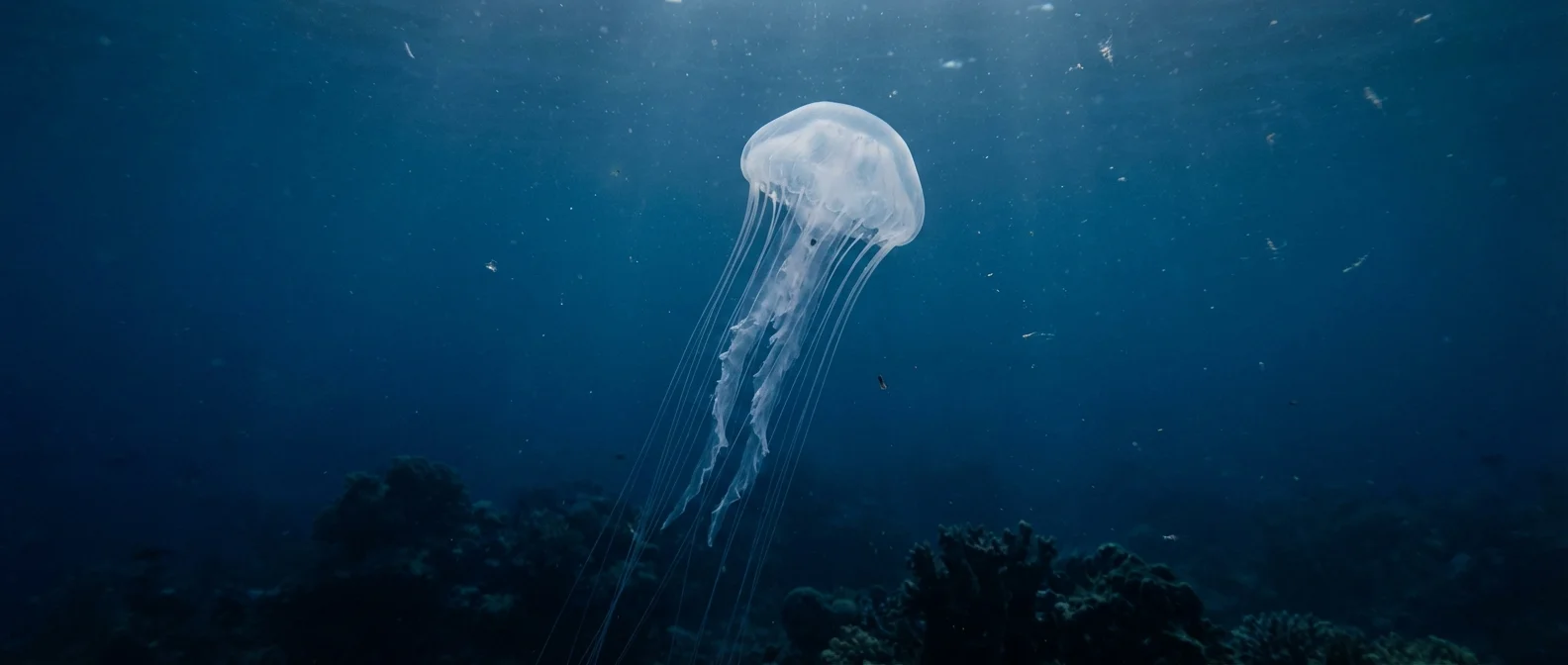
Cassiopea andromeda, also known as the “upside-down jellyfish,” spends its life lying on the bottom of shallow lagoons with its tentacles pointing upward. Instead of hunting for food, it hosts photosynthetic algae in its tissues, harnessing sunlight like a plant. It rhythmically contracts its “bell” — about 36 pulses per minute during the day.
At night, however, something remarkable happens. The rate drops to around 30 pulses per minute, its response to stimuli (light, food) becomes slower, and the jellyfish enters a state that, despite the complete absence of a brain, strikingly resembles sleep. Even more astonishing: around midday, Cassiopea takes a brief siesta — just like many of us after lunch.
🔬 The Three Criteria of Sleep — And the Jellyfish Meets Them All
How can we be sure that a jellyfish truly “sleeps” and is not merely inactive? In biology, sleep is defined by three basic criteria, and Cassiopea meets all of them:
First, reduced activity. At night, pulse frequency decreases significantly. The researchers considered the jellyfish to be in a sleep state when it pulsed fewer than 37 times per minute for at least three consecutive minutes.
Second, reduced responsiveness to stimuli. A research team at Caltech, led by Paul Sternberg, recorded that at night it takes three times as long for the jellyfish to begin pulsing after a disturbance, compared to daytime. "It's like the smell of coffee slowly penetrating your consciousness in the morning," Sternberg explained.
Third, homeostatic regulation (need for sleep recovery). When researchers deprived the jellyfish of sleep using water jets for 12 hours, the following day the animals exhibited noticeably reduced activity — a sign of “fatigue” that normalized after a good night's rest. This sleep rebound is exactly what we experience after an all-nighter.
🧬 Why They Sleep: DNA Repair as the Key
A more recent study, published in January 2025 in Nature Communications, took the subject a step further. Neurobiologist Lior Appelbaum and his team at Bar-Ilan University in Israel studied both the jellyfish Cassiopea and the sea anemone Nematostella vectensis, using infrared cameras and motion-tracking software in cycles of 12 hours of light and 12 hours of darkness.
The results were revealing: during wakefulness, damage to the DNA of nerve cells gradually increased. During sleep, this damage was repaired. And when the researchers exposed the animals to ultraviolet radiation (UV-B), which causes DNA damage, the damage nearly doubled within one hour — followed by increased sleep later that same day. After sleep, the damage returned to baseline levels.
💡 Why It Matters
If sleep evolved before the brain even appeared, then its fundamental function is not memory consolidation or brain rest — it is DNA repair in nerve cells. This explains why every living organism with a nervous system, from the jellyfish to humans, needs sleep. Chronic insomnia, even in such simple creatures, leads to an accumulation of damage that can prove fatal.
📖 Read more: Hidden Geometry Bends Electrons Like Gravity
🌙 Melatonin in Creatures Without a Brain
Another striking discovery was the role of melatonin. The researchers added melatonin to the tank water and observed that both the jellyfish and the anemones “fell asleep” during their most active period — daytime for the jellyfish, nighttime for the anemones. This was groundbreaking, because the sleep-inducing role of melatonin had until now been considered a trait that evolved alongside vertebrates and centralized brains.
The discovery that a brainless animal responds to melatonin suggests that this sleep-regulating mechanism is extremely ancient — likely having evolved 600–700 million years ago, before the cnidarian branch (jellyfish, corals, anemones) split from the lineage that led to worms, insects, and vertebrates.
⏰ The Upside-Down Jellyfish and the Anemone — Different Schedules, Same Need
An interesting finding was that the two cnidarian species follow opposite “schedules.” The jellyfish Cassiopea, which hosts photosynthetic algae, is active during the day, sleeps mainly at night, and takes a short afternoon nap. In contrast, the sea anemone Nematostella is more active at night and sleeps in the morning hours.
Despite their different schedules, both species sleep approximately 8 hours — that is, about one-third of their day. "What surprised us was that both animals sleep about 8 hours, which is interesting because we also sleep about one-third of our lives," said Appelbaum.
"Sleep evolved long before the brain — it is essential for cells, their maintenance, and neurons. Sleep helps even brainless animals recover from cellular stress."
📖 Read more: AI Monitors Every Neuron in Worms and Jellyfish Live
🧠 What It Means for Humans
The research on jellyfish is not just about marine biology — it sheds light on one of the greatest mysteries of human physiology. If sleep began as a DNA repair mechanism in simple neural networks, then chronic insomnia in humans may lead to an accumulation of DNA damage in our neurons — something already linked by research to neurodegenerative diseases.
Experiments on fruit flies and mice have shown that chronic sleep deprivation is linked to neuronal degeneration. Insomnia is also associated with elevated levels of reactive oxygen species — particularly potent metabolic byproducts that can destroy DNA, proteins, and cell membranes.
The emerging picture is clear: wakefulness gradually stresses the DNA in nerve cells, and sleep provides a window of “restorative silence” during which repair enzymes can “stitch” the damaged DNA strands without the noise of sensory input.
🔮 Open Questions
Of course, sleep likely serves multiple purposes. In more complex organisms, functions such as memory consolidation may have been “added” to an ancient program of cellular maintenance, as nervous systems became more complex. Nevertheless, the new research strengthens the view that DNA protection is the core function of sleep.
Future studies will need to examine whether the same DNA repair process occurs in cnidarians living in completely different conditions — cold, deep, or murky waters — in order to generalize the findings. And a bolder question, as researcher Ravi Nath wondered: “Do plants sleep?”
A napping jellyfish, on the bottom of a tropical lagoon, reminds us that sleep is not a luxury — it is perhaps life's most ancient “invention.”