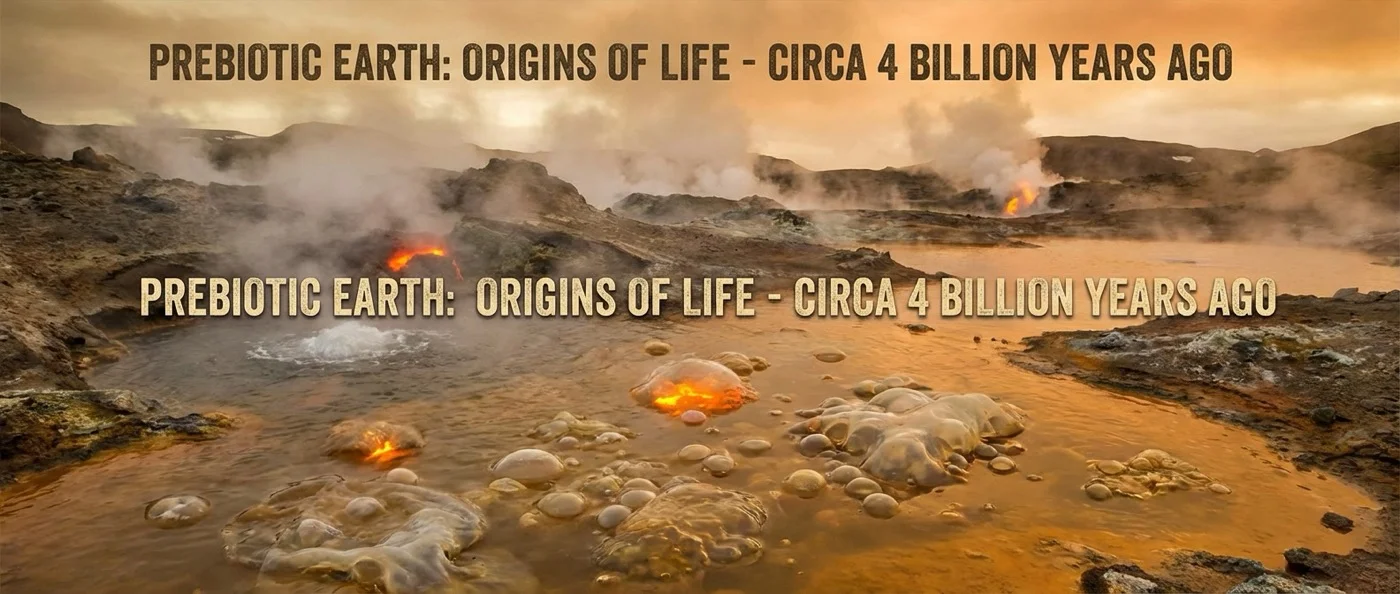
A new theory proposed by researchers at Hiroshima University suggests that life on Earth didn't actually begin inside a cell — it began as sticky, gel-like films clinging to ancient rocks in a prebiotic world, long before any membrane or cell existed.
📖 Read more: Mathematics Existed Before Writing 8,000 Years Ago
The Classic Debate: Where Did Life Begin?
The origin of life is one of science's deepest mysteries. We know that roughly 3.5 billion years ago, living cells appeared on Earth — but we don't know what came before them. Two competing ideas have dominated: the “RNA World” hypothesis (short RNA molecules self-replicated and eventually became enclosed in membranes) and the “Metabolism First” hypothesis (chemical reactions producing energy came first, and genetic molecules came later).
Both of these narratives assume that the relevant chemistry happened in solution — in the watery environment of early Earth's oceans or hydrothermal pools. But a new paper published in ChemSystemsChem (DOI: 10.1002/syst.202500038) challenges that assumption fundamentally.
The “Gel-First” Hypothesis
Lead researchers Dr. Tony Z. Jia (Hiroshima University) and Dr. Kuhan Chandru (Universiti Kebangsaan Malaysia Space Science Center) propose what they call the "gel-first" scenario: that before cells existed, prebiotic molecules first organized themselves into sticky, gel-like films attached to rock surfaces.
These surface-attached gels — which Jia and Chandru call "xeno-films" — would have acted like primitive biofilms, trapping and concentrating molecules that were otherwise too dilute in the ancient ocean to react meaningfully. The gel matrix would protect fragile molecular experiments from UV radiation and dilution, and enable molecules to stay in proximity long enough for chemistry to happen.
"Before there were cells, there may have been gels. These surface-attached systems could have trapped and concentrated prebiotic molecules, enabling the chemical reactions and proto-metabolic processes that eventually gave rise to life."
— Dr. Tony Z. Jia, Hiroshima University📖 Read more: Bacteria Invade Cancer Cells and Destroy Them from Within
Why Gels on Rock Surfaces?
The choice of rock surfaces is not arbitrary. In the prebiotic world, minerals were the most abundant solid surfaces available. Many minerals — particularly certain clays like montmorillonite — are known to catalyze organic chemistry. Researchers have previously shown that amino acids and nucleotides can polymerize on clay surfaces.
The new proposition goes further: that molecules didn't just react on mineral surfaces, but actively formed gel-phase materials — cohesive, viscous networks of organic molecules — that then served as the structural and chemical environment where proto-life chemistry could occur at scale.
These gels would differ from the “free-floating molecules in a pool” model in critical ways:
- Higher local concentrations: Molecules are trapped in a matrix instead of diffusing away
- Protection from UV radiation: The gel layer offers partial shielding
- Compartment-like behavior: Without a membrane, the gel provides spatial separation from the environment
- Enabling self-replication precursors: Close proximity means molecules “see” each other long enough to catalyze reactions
From Rock Gels to Cells — A Speculative Path
The researchers outline a speculative but plausible stepwise path from gels to cells:
- Prebiotic organic molecules (amino acids, sugars, nucleotide precursors) rain down from meteorites or form in hydrothermal systems
- These molecules adsorb onto mineral surfaces, especially wet-dry cycling environments (tidal pools, volcanic hot springs)
- Under repeated dehydration-rehydration cycles, molecules polymerize and form sticky gels
- Gels develop proto-metabolic chemistry — pathways that process energy-rich molecules
- Eventually, lipid-like molecules in the gel self-assemble into membranes — enclosing the gel contents and producing the first primitive cell
📖 Read more: Bourbon Waste Powers Next-Gen Supercapacitors with 25x Energy
"Xeno-Films": Looking Beyond Earth
One of the most intriguing aspects of this paper is its explicit connection to astrobiology. The “xeno-films” concept — gel phases attached to mineral surfaces — could be a universal feature of life's emergence wherever the right conditions exist.
On Mars, Europa, or Enceladus, where liquid water exists alongside mineral surfaces, such gels might form spontaneously. Jia and Chandru suggest that searching for gel-like organic surface deposits could be a new biosignature target for future space missions.
What's Next: Testing the Hypothesis
The paper is a theoretical framework — a proposal for how life's origins could fit into a “gel-first” model. The authors and their collaborators at the University of Leeds and German research institutions (supported by the Alexander von Humboldt Foundation and Japan Society for the Promotion of Science) plan to run laboratory experiments simulating early Earth conditions: forming gels from prebiotic molecules, testing whether those gels can concentrate reactive species, and probing what proto-metabolic chemistry they can sustain.
Summary
- New “gel-first” theory: life began as sticky prebiotic gels on rock surfaces, before cells or membranes
- Gels acted as primitive compartments — trapping molecules, enabling chemistry
- Concept: “xeno-films” — gel-phase organic deposits that could be universal life-start mechanism
- Published in ChemSystemsChem, Feb 11, 2026 (DOI: 10.1002/syst.202500038)
- Institutions: Hiroshima University + Universiti Kebangsaan Malaysia + University of Leeds + German partners
- Lead researchers: Tony Z. Jia (Hiroshima) + Kuhan Chandru (UKM); Ramona Khanum (co-first author)
- Astrobiology implications: searching for gel-like organic surface deposits on Mars, Europa, Enceladus