📖 Read more: Life Started as Sticky Slime Before Cells Existed
🏺 Pottery That Rewrites History
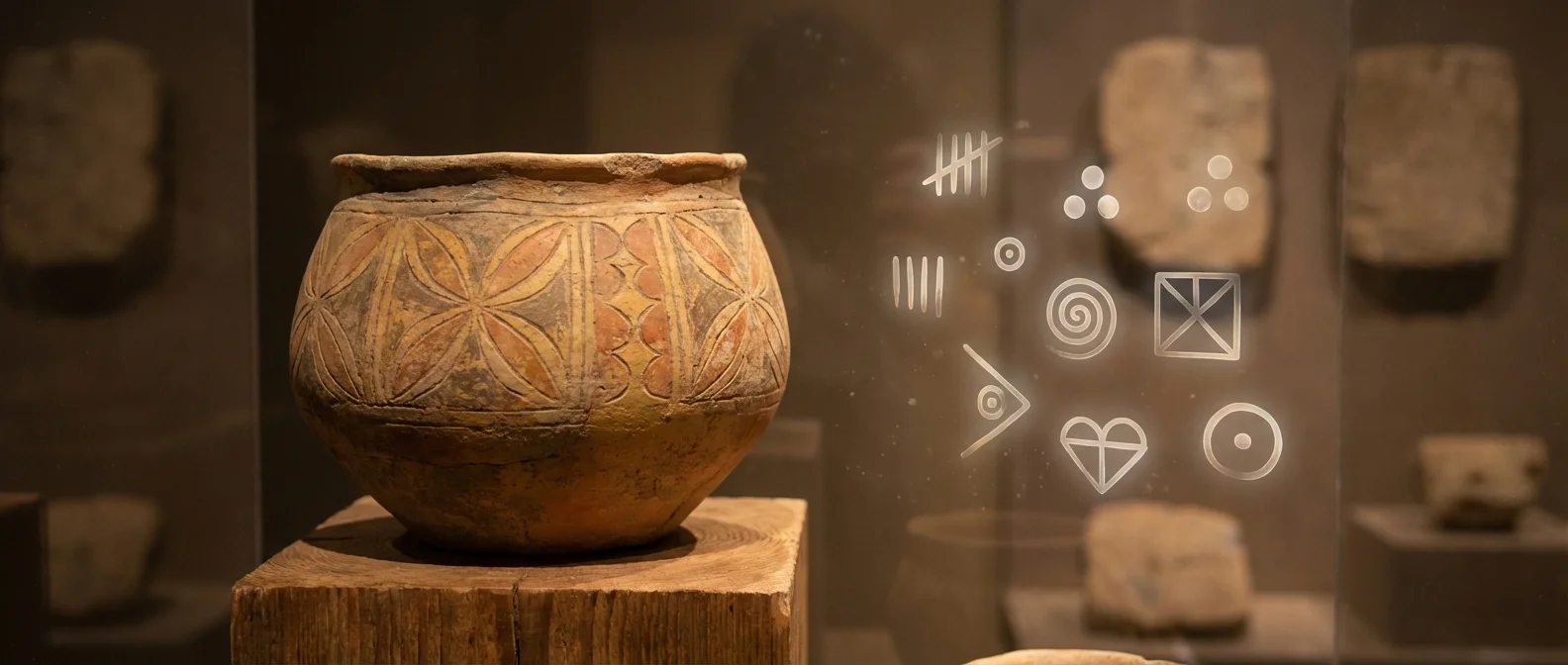
The conventional view holds that mathematics appeared alongside writing, roughly 5,000 to 6,000 years ago. However, a new study overturns this assumption. Professor Yosef Garfinkel and Sarah Krulwich from the Hebrew University of Jerusalem examined thousands of painted pottery fragments from the Halafian culture of northern Mesopotamia. The ceramics date to the period 6200–5500 BCE — that is, approximately 8,000 years ago.
The findings were striking: the plant motifs adorning the vessels — flowers, bushes, branches, and trees — were not random decorative designs. They were products of deliberate geometric organization, with numerical patterns that attest to advanced mathematical cognition. The study was published in the Journal of World Prehistory in December 2025 and constitutes the first systematic documentation of mathematical thinking in a pre-literate era.
📖 Read more: 40,000-Year-Old Signals: The Precursor to Writing Is Proven
🌸 The Petals That Count — A Hidden Geometric Sequence
The research team examined artifacts from 29 archaeological sites across northern Mesopotamia and cataloged hundreds of plant motifs. Flowers were by far the most common plant element, with 375 pottery fragments bearing floral designs painted with remarkable precision and symmetry.
The most noteworthy finding concerns the number of petals in the painted flowers. The petals consistently followed a specific geometric sequence: 4, 8, 16, 32, and 64 — that is, a mathematical geometric progression in multiples of two. This was no coincidence. It was a deliberate subdivision of space, requiring an understanding of geometric sequences, symmetry, and controlled spatial division.
Some flowers with 6, 7, or 13 petals were also observed, but the researchers believe these represent less skillful execution — “misfires,” in other words, that paradoxically reinforce the existence of a clear mathematical rule. The artisans knew the goal; they simply did not always achieve it.
💡 Why This Changes Everything
"The ability to uniformly divide space, reflected in these floral motifs, likely had practical roots in daily life — such as the equal distribution of harvests or the apportioning of communal fields," explains Garfinkel. Mathematics was not born in libraries — it was born in the fields and pottery workshops.
📖 Read more: Genes That Existed Before Life Appeared on Earth
📊 The Numbers Behind the Discovery
📖 Read more: Blood Test Detects Alzheimer's 4 Years Before Symptoms
🦴 Even Older Traces of Counting
The Garfinkel-Krulwich study is not the only indication that mathematical thinking preceded writing. Archaeological finds from Africa reveal roots of counting that extend tens of thousands of years into the past.
The Ishango bone, discovered in the 1950s in the Congo region of Africa, is a baboon bone 10 centimeters long, at least 20,000 years old. Its surface bears dozens of parallel notches — most likely a tally, that is, a counting record of some unknown object. In 1970, archaeologist Alexander Marshack argued that it was a six-month lunar calendar.
Even older is the Lebombo bone, discovered in southern Africa in the 1970s and dated to 43,000 years ago. It also bears notches — possibly a record of the 29 days in a lunar month or even tracking of the menstrual cycle. It is the oldest known mathematical artifact in the world.
According to Danish historian of mathematics Jens Høyrup, the earliest principles of counting may have been inspired by observing the night sky. "There was no artificial lighting then, only the fires inside caves. Without light pollution, the moon and stars were a wonder to behold," he told Live Science.
"These patterns show that mathematical thinking began long before writing. People visualized divisions, sequences, and balance through their art."
📖 Read more: Greenland Sharks: Living 500 Years Defying Aging
🔢 From Petals to Cuneiform
The transition from mathematical intuition to written mathematics came several millennia later, with the ancient Sumerians. Their civilization, which flourished in present-day southern Iraq from around 4500 BCE, is credited with both cuneiform — the oldest known writing system — and the sexagesimal base-60 numeral system, which we still use today in trigonometry, navigation, and measuring time in minutes and seconds.
The Sumerians developed multiplication and division tables, introduced algebraic thinking with symbols for unknown quantities, and created mathematical formulas for calculating the areas of triangles, rectangles, and irregular shapes. These developments were not theoretical — they served practical needs: land measurement, designing irrigation systems, and recording commercial transactions.
Mathematician Duncan Melville of St. Lawrence University explains how bureaucracy fueled mathematics: "The archivists needed to know not only what was coming in or going out of their storehouses, but how much or how many." The need to convert between different units of measurement led to the development of arithmetic and computational geometry.
🧩 A Cognitive Revolution Written in Clay
The study contributes to the growing field of ethnomathematics — the investigation of how mathematical ideas are expressed through cultural practices and artistic traditions. What emerges is that mathematical thinking was not a luxury of “advanced” civilizations. It was a fundamental survival tool, as old as human society itself.
Archaeologist Laurent Davin of the Hebrew University, who was not involved in the study, comments: "The research shows that mathematical cognition developed long before writing, embedded in techniques such as ceramic painting and seal carving. It proves that complex abstract thinking was already present in Neolithic communities."
Notably, none of the plant designs depicted edible plants. This absence suggests that the designs were not intended to document agricultural or ceremonial practices. Instead, the emphasis on flowers may be related to the positive emotional response they evoke — making them particularly attractive subjects for decoration.
"These vessels represent the first moment in history when humans chose to depict the botanical world as a subject worthy of artistic attention," note the authors. "It reflects a cognitive shift linked to village life and a growing awareness of symmetry and aesthetics." Mathematics, in the end, did not need numbers to be born — it only needed flowers.