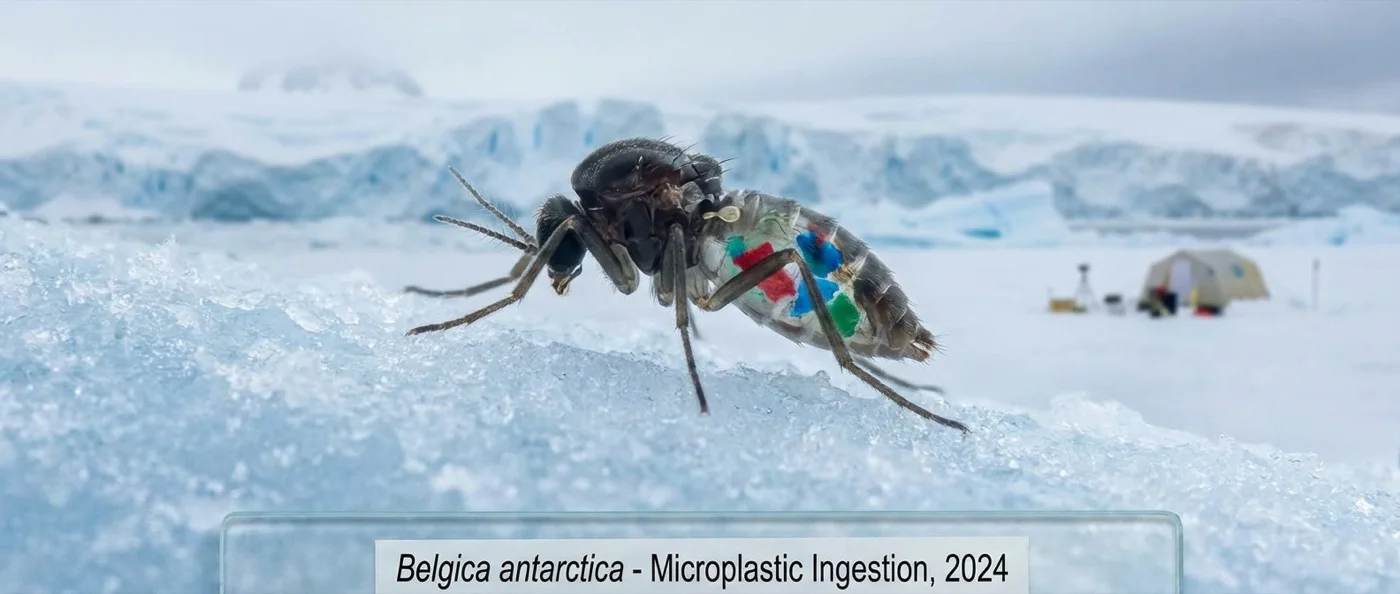
Antarctica is the most remote continent on Earth. Cut off by thousands of miles of open ocean, battered by wind and cold, it hosts almost no permanent land animals. The one exception: Belgica antarctica, a tiny nonbiting midge no larger than a grain of rice — and the only insect native to Antarctica.
Now, researchers from the University of Kentucky have found microplastic fragments inside its larvae. The study, published in Science of the Total Environment (DOI: 10.1016/j.scitotenv.2025.180800) and led by PhD student Jack Devlin, offers the first evidence of microplastic contamination in this iconic Antarctic species — and raises fresh concerns about pollution reaching even the most isolated corners of the planet.
The Insect That Survives Everything
Belgica antarctica is a remarkable creature. It thrives in extreme cold, extreme UV radiation, and extreme desiccation. At densities up to 40,000 individuals per square meter, it forms a critical part of the Antarctic food web — eaten by birds, seals, and other wildlife.
Devlin, who studies Antarctic biology and works as a marine ornithologist, collected 40 larvae from 20 sites across 13 Antarctic islands during a 2023 research cruise. Using infrared spectroscopy at Italy's Elettra Sincrotrone Trieste synchrotron facility — led by Giovanni Birarda — the team analyzed each larva for microplastic contamination.
What They Found in the Wild
Of the 40 larvae collected in the wild, only 2 contained microplastic fragments — a relatively low but scientifically significant rate. The fragments were identified as common synthetic polymers typically associated with packaging, textiles, and fishing gear.
"Finding microplastics in Antarctica's only native insect — even in small numbers — tells us the contamination is more pervasive than we thought," said microplastics specialist Elisa Bergami (University of Modena and Reggio Emilia), a co-author of the study.
Laboratory Results: Reduced Fat Reserves
The team also conducted laboratory exposure experiments, feeding Antarctic midge larvae varying concentrations of microplastics. The results showed that higher microplastic exposure led to reduced fat reserves in the larvae — a significant finding because fat is the primary energy source these insects rely on to survive the Antarctic winter.
Crucially, survival rates did not change — the larvae lived regardless of exposure level. But the energetic cost may compound over time and generations, potentially affecting population health and resilience.
How Microplastics Reach Antarctica
The Southern Ocean is not sealed off from global pollution. Ocean currents, atmospheric transport, and human activity — including tourism, research stations, and fishing — all contribute microplastic particles to Antarctic waters and shores.
Previous studies have found microplastics in Antarctic snow, seawater, sediments, and in the bodies of penguins and fish. This new study extends that picture to the insects that underpin the Antarctic terrestrial ecosystem.
Why Belgica Antarctica Matters
Because Belgica antarctica is so uniquely adapted to its environment and plays such a central ecological role, changes in its health or behavior could cascade through the Antarctic food web. Birds and seals that depend on it could face nutritional deficits if the insect population declines or weakens.
The study was funded by the Antarctic Science International Bursary, NSF Award 1850988, and NIFA/USDA. It represents an important step in understanding how microplastic pollution affects even the most remote and pristine ecosystems on Earth.